Tapping more fossil fuels, solar power among Singapore’s strategies to boost energy security
SINGAPORE – The Republic plans to diversify its sources of energy to tide it through global supply crunches and growing resource nationalism.
To ensure Singapore has adequate infrastructure to support this, a five-year plan detailing the expansion of the Republic’s power system from 2026 was rolled out on Oct 26, the first day of the Singapore International Energy Week conference.
The plan features five new power plants and an expansion of Singapore’s underground transmission cables, among other things.
ST looks at the sources of energy that the Republic is exploring.
Fossil fuels
Natural gas currently generates about 95% of Singapore’s electricity needs.
PHOTO: LIANHE ZAOBAO
-
Imported natural gas is currently used to generate about 95% of Singapore’s electricity needs.
-
These power plants have the capacity to generate 12 gigawatts (GW) of energy in all.
-
By 2031, Singapore will have five new natural gas power plants, adding to the more than 20 today. This will grow the country’s electricity generation capacity by 26 per cent.
-
Singapore’s power plants are also required to run on diesel, allowing them to tap the Republic’s reserves when there is a severe disruption to gas supplies.
-
Saudi Arabia and Singapore inked an agreement to enable the storage of Saudi crude oil in the Jurong Rock Caverns from the second half of 2027. Crude oil can be refined into diesel for power generation.
Solar energy and storage
Sembcorp piloted a vertical battery-stacking solution at its existing Jurong Island energy storage system.
PHOTO: SEMBCORP INDUSTRIES
-
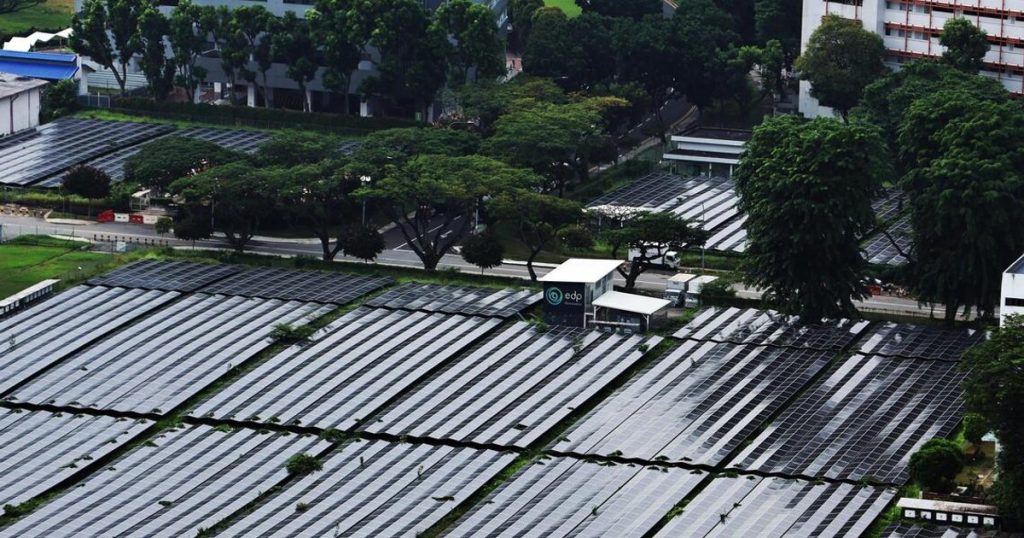
This is the most viable form of renewable energy now available to Singapore. But solar can meet no more than 10% of the country’s projected electricity demand in 2050.
-
The country now generates about 2.3 gigawatt-peak (GWp) of solar energy. In the first half of 2026, solar power made up 4.2% of Singapore’s energy mix.
-
By 2030, the plan is to increase this to 3 GWp – about 5% of projected energy demand that year.
-
This will be supported by the tripling of energy storage systems to just over 1 gigawatt-hour by 2030, up from 350 megawatt-hours today. Such systems are needed to store excess electricity generated during sunny periods, so it can be discharged at night or on cloudy days.
-
On Oct 26, Singapore announced a new target to harness 4 GWp of solar energy by 2035.
Electricity imports
-
Singapore has 14 electricity import projects in the works, with a combined capacity of more than 10GW.
-
The projects cover solar, wind and hydropower from Malaysia, Indonesia, Cambodia, Vietnam and Australia. Some of the imports could begin in 2028.
-
On Oct 26, Sembcorp Utilities was given a conditional nod to import up to 1.3GW of renewable electricity from and through Malaysia to Singapore.
-
Low-carbon electricity could come from Malaysian solar power and Vietnamese offshore wind.
Emerging energy sources
Nuclear energy
-
Advanced nuclear technologies such as small modular reactors are considered more suitable for densely populated places like Singapore.
-
In 2027, Singapore will undergo an assessment by the International Atomic Energy Agency to determine if the country is ready to make an informed decision on whether to deploy nuclear energy.
-
Initiatives are in the works to build a pipeline of nuclear energy manpower in Singapore, one of which is the country’s first master’s in nuclear engineering.
Geothermal energy
Sembawang Hot Spring Park in January.
ST PHOTO: LIM YAOHUI
-
An earlier national survey found that underground heat sources in Singapore had the potential to generate more than 60 times the nation’s current annual electricity consumption.
-
From end-2026, the country will assess the technical, environmental and commercial feasibility of deploying deep geothermal systems in Singapore.
Hydrogen
-
Hydrogen gas is considered a green fuel as burning it does not produce any planet-warming emissions.
-
In preparing for this future fuel, new gas-fired power plants have to be designed to run on a blend of natural gas and a portion of hydrogen.
-
A new $75 million initiative will fund research on areas such as developing technologies that efficiently extract hydrogen from ammonia and methanol.
-
Slower-than-expected global market development has kept costs high for hydrogen, which is not yet commercially viable.
Biomethane
-
Biomethane – which has similar compositions to natural gas – is a fuel produced from organic materials such as agricultural waste and manure.
-
Three power generation companies have been appointed to import and supply biomethane under a pilot, which could go live by 2028.
-
They will import enough biomethane to produce 300MW of electricity, enough to power around 600,000 HDB households.