Three Caminos by bike « Euro Weekly News
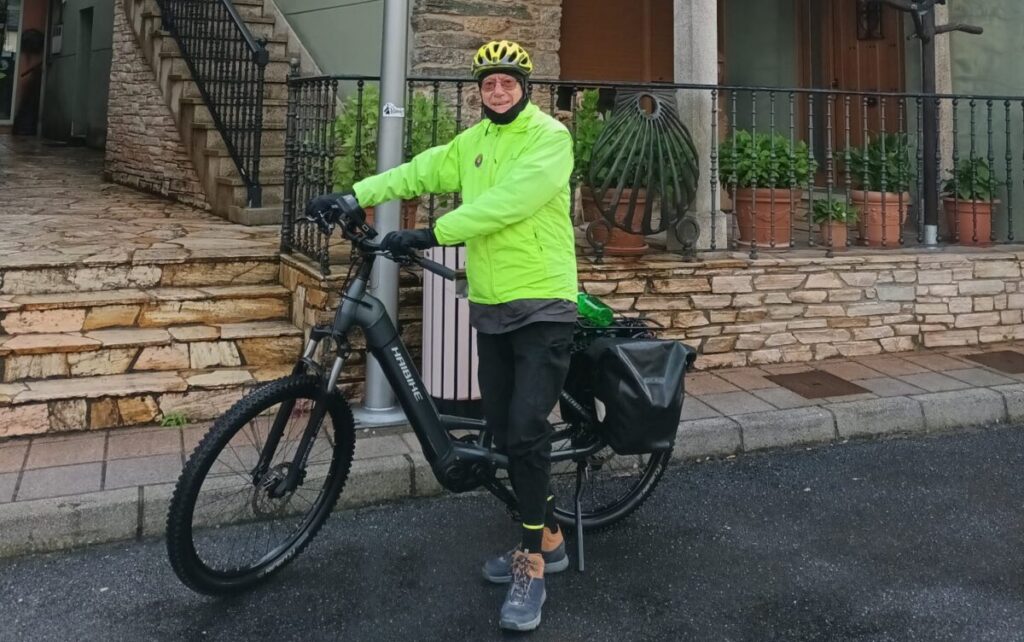
An 86-year-old British expat who suffered a heart attack and stroke after losing his wife has completed three cycling pilgrimages totalling 941 kilometres across Spain.
David, who lives in Orihuela, has cycled an astonishing 6,632 kilometres since beginning his preparations in November 2024. His journeys have taken him across challenging mountain trails, through driving rain and flooded tracks, and into encounters with strangers whose kindness has stayed with him.
But this is about much more than cycling. After losing his wife Angie following their 60th wedding anniversary, David struggled to find a reason to carry on. A heart attack and a stroke that left him unable to walk, speak or use his right hand brought further challenges.
Now, he says his pilgrimages have helped him come to terms with the past while giving him a reason to look ahead. In a personal account titled Reflections of an Old Codger, David explains what drove him to take on the challenges.
“I was devastated when Angie died in my arms having just celebrated our 60th Anniversary. I felt that there was no reason to continue.”
He decided to give himself a reason to get up each morning by cycling the Camino de Santiago, a pilgrimage to the tomb of Saint James in Galicia. “To give me a reason for getting up I would make a pilgrimage to Santiago de Compostella from Leon,” he writes.
A heart attack on the Camino de Santiago
David set off from Leon on a wet morning in May 2025, using a pedal-assisted bicycle to help him tackle the mountainous route. Despite the demanding climbs, he remembers the encouragement of fellow pilgrims and the peaceful sounds of the countryside.
“I always got a smile and a Buen Camino greeting. The mountains were quiet restful with just the sound of birds and waterfalls.”
But the journey took a frightening turn on the climb towards O Cebreiro, one of the most challenging sections of the Camino. “I suddenly had a heart attack that left me gasping for air.”
A group of Brazilian pilgrims came to his rescue, helping him and his bicycle reach the top. He was not well enough to continue the following morning and planned to return to finish the journey. Then, on September 1, 2025, David suffered another major setback.
“I had a stroke caused by blood on the brain that left me unable to walk, speak or use my right hand.”
By January, he had recovered sufficiently to consider returning to the pilgrimage. But he decided that his 86th year should be about more than completing the original journey.
“I decided that not only make my 86 year in memory of a special lady but using the medieval pilgrimage I would look at my life past, now and the future as well as testing myself.” He chose three Caminos that meant something special to him and Angie.
Mud, mountains and an unforgettable hug
David began with the Camino de Caravaca in March 2026, setting off from Orihuela Cathedral in freezing, wet and windy conditions.
The 160-kilometre journey took him along a towpath towards Murcia before climbing into rugged mountain country. He passed through abandoned, dark and flooded tunnels, with only a speck of light visible in the distance.
The conditions were so muddy that, after one day’s riding, he asked for a bucket of water to clean his bicycle. Yet David found that his age often brought unexpected kindness from other pilgrims.
“When they found out I was 86 I was treated like royalty,” he recalls.
In early May, he returned to Galicia to finish the Camino de Santiago. Thunderstorms, torrential rain and difficult mountain tracks made the final stretch a test of endurance. He lost the trail in poor visibility and, while passing a farm, encountered a rottweiler that grabbed his leg as he cycled past.
“I still can see its big teeth and now I get sick feeling when loose dogs come after me,” he writes.
But it was another encounter that left a more lasting impression. On a cold, wet morning, a man at a stone-built house offered him shelter, coffee and a hug.
“I was greeted by a lovely man who said, please come in you can have free coffee and a free hug. The free hug is what I remember.”
David says the kindness he encountered outweighed the difficulties.
“All through this bad weather all I remember is smiling faces and a willingness to help no matter what.” He also remembers crossing the huge lake at Portomarin and seeing the town whose buildings were moved when the Belesar reservoir was created. A pair of Chinese visitors asked him about the history of the church and town before insisting on taking a selfie with him.
The Camino de Santiago section totalled around 360 kilometres over seven days, according to David.
A gruelling 421-kilometre ride towards home
David’s third challenge was the Camino del Cid, a historic route associated with the medieval warrior Rodrigo Diaz de Vivar, travelling from Valencia towards Orihuela. He covered 421 kilometres in five days, tackling steep mountains, exposed roads and difficult trails.
At Canales, he suddenly found himself facing a mountain climb of around 3,000 feet, surrounded by motorways and with no gradual route upwards. He describes the views as “gut wrenching”, with drops of hundreds of feet beside the route. Other sections brought steep descents where he had to brake hard, while heavy rain created fresh obstacles on the trails.
At one point, he became surrounded by bushes around 12 feet high. Hearing a dog barking, he hoped there would be people nearby and a way out. A stream blocked his path, but someone had thrown down wooden pallets, allowing him to guide his bicycle across without getting wet.
The final day brought another soaking as the heavens opened near Cox. Despite the conditions, he continued through Callosa and Redovan before arriving back in Orihuela.
His return home brought a warm welcome. “Assia and Laila was there to give my big hugs,” he writes. Across the three pilgrimages, David’s total distance was 941 kilometres.
Recovery after a stroke gave him a new challenge
David says he did not fully appreciate how badly the stroke had affected him until he looked back at what had happened. He recalls struggling to walk, falling and needing nearly 20 stitches in his head. Yet cycling proved possible even when walking was difficult.
“Being paralysed last September did not put me off. I just treated as another challenge.”
The pilgrimages have not made grief disappear, and David is honest about the difficulties that still lie ahead. “The benefit from doing these Caminos is that I am in a better place accepting the past because it is not a rehearsal.”
He admits that living alone remains difficult. “Being alone is still a problem coping but I need to get out and talk to people. The future is still a black hole.”
Nevertheless, the people he met along the way have helped him find meaning again. “My experience is the benefit of doing the Caminos is that I was with so many good people that life had a meaning and the benefits has not finished.”
More cycling adventures are already planned
David has no intention of putting his bicycle away. He has already identified several possible future journeys around Spain. His plans include cycling from Ronda to Cadiz, Seville and Granada, as well as travelling from Seville to Cordoba. He is also considering exploring the hilltop villages around Ronda, making another trip to the Guns of Mazarron and visiting Xativa and Elda.
Since starting his preparations in November 2024, he has cycled 6,632 kilometres in total, with the three pilgrimages accounting for 941 kilometres of that distance.
For someone who once felt there was no reason to get up in the morning, the list of possible future adventures says a great deal.
David’s message to anyone struggling after losing someone special is simple. “Those who have lost a special person and feels that there is no hope don’t give up – A step at a time.”