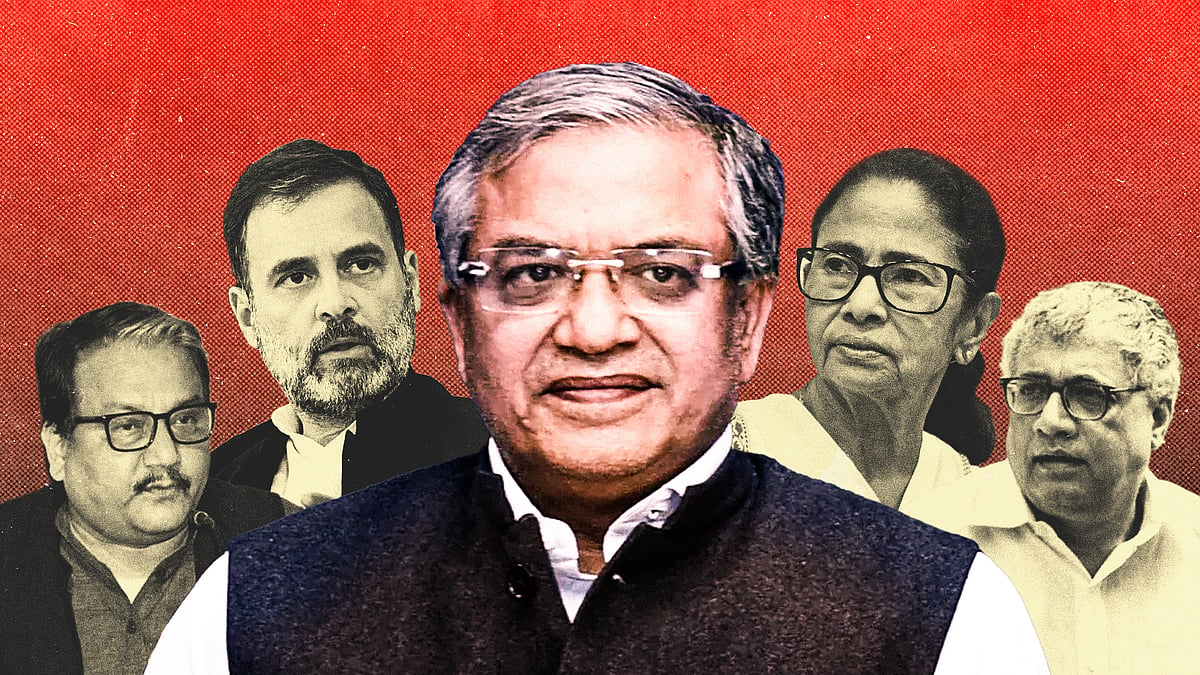
The Opposition’s battle to be heard by Gyanesh Kumar
On October 6, around 240 Opposition MPs marched towards the Election Commission of India’s office in New Delhi, demanding a meeting with Chief Election Commissioner Gyanesh Kumar and seeking his resignation. They were stopped a few hundred metres from the Commission’s office and eventually sat in protest.
The Election Commission, however, gave a different account.
In a press note issued that evening, it said it learnt through the media that MPs wanted to meet the Commission and that, until 4 pm, no political party representative had sought an appointment.
Later, Delhi Police informed the Commission that a delegation led by Leader of Opposition Rahul Gandhi wanted to submit a memorandum. The ECI said the delegation wanted to meet at Parliament House Annexe, whereas its protocol required such meetings to be held at the Commission’s premises. It offered to send a senior-most officer to receive the memorandum, but the MPs declined.
The explanation may address the question of procedure. But it does not answer a larger question that has been building around Gyanesh Kumar for more than a year — how does the Chief Election Commissioner deal with political parties that question him and how does he deal with the two Election Commissioners who sit alongside him?
The October 6 incident is only the latest in a series of episodes involving the CEC and Opposition parties. Once, Kumar publicly demanded that Rahul Gandhi either substantiate his allegations against the Election Commission through an affidavit or apologise to the nation. In yet another, a political delegation claimed that Kumar asked them to “get lost” within minutes of their meeting.
Taken individually, each incident can be explained away as a disagreement between the Commission and a political party. Taken together, they raise questions about the style in which the country’s top election official engages with political stakeholders.
‘Sir, please invite us?’
One of the more striking episodes came on June 9, when a Congress delegation went to the Election Commission over a matter concerning the party’s Rajya Sabha nomination in Madhya Pradesh.
Congress leaders were the Commission’s office and made to wait. Police cited prohibitory orders under Section 163 of the Bharatiya Nyaya Sanhita. The episode ended with Congress leaders staging a protest at the entrance, while some senior leaders were subsequently allowed inside.
For Congress MP and national spokesperson Pawan Khera, the episode was not simply about access to an office. It was about the manner in which the country’s principal Opposition party was being treated by an institution that is expected to engage with political parties.
“Sir, please invite us? Is that how it is supposed to happen?” Khera said, questioning the manner in which the delegation was handled.
On another occasion, when a Congress delegation from Uttarakhand requested a meeting with the Commission, Khera said they were made to wait a week with no response. A delegation, including Khera, then went to the Commission to raise issues regarding the SIR process and Form-7. They were refused entry. Instead, he said, “An upper divisional clerk was deputed to come out and take our representation.”
His point was that Opposition MPs are not ordinary petitioners approaching an office. They are elected representatives and political stakeholders in the electoral process.
The Bihar meeting
On July 2, 2025, Opposition parties met the Election Commission to discuss the Special Intensive Revision (SIR) of electoral rolls in Bihar. The later said that it had heard the concerns and queries of representatives of several political parties and explained the SIR process to them.
But the experience of the Opposition leaders who attended the meeting was markedly different.
Rashtriya Janata Dal (RJD) MP Manoj Jha remembers walking out of the meeting and saying openly: “I cannot call this meeting cordial.”
For Jha, the problem was not merely disagreement. It was what he saw as an absence of listening.
“An individual who is sitting in a constitutional post must have the habit and capacity to listen. The capacity to listen is completely missing in him,” Jha said.
He recalls telling Kumar after one meeting: “I teach at Delhi University … work on your listening skills. Cultivate the ability to listen.”
Jha said he initially believed Kumar had understood the point. But subsequent meetings, according to him, convinced him otherwise.
Interruptions are the order of the day in meetings with Kumar, Khera also said.
There was another change that Jha noticed. Even during his predecessor Rajiv Kumar’s tenure, he said he could send a simple email to the Election Commission and get an appointment, even though he had only been an MP since 2018. When Gyanesh took over, his request for a meeting was met with questions about whether he was authorised to seek one.
For Jha, this represented something larger than bureaucratic procedure, what he described as the creation of walls around an institution that should remain accessible to political stakeholders.
‘Get lost’
Then came April 8, 2026.
A four-member Trinamool Congress delegation – Derek O’Brien, Sagarika Ghose, Menaka Guruswamy, and Saket Gokhale – went to the Election Commission with concerns about officials involved in the West Bengal election process. The delegation also carried nine letters written by Mamata Banerjee to the Commission.
The meeting lasted just seven minutes.
According to, after the delegation raised its concerns, Kumar told them to “get lost”. O’Brien publicly challenged the Commission to release the recording or transcript of the meeting. The ECI, on the other hand, said O’Brien had shouted at the Commission and that Kumar had asked him to maintain decorum. The Commission also issued an unusually sharp public statement describing its response as “straight talk” to the TMC.
Saket Gokhale, who was in that room, remembers the encounter differently.
Gokhale said that in the eight or nine meetings with the Commission since Kumar became CEC, he had never seen the other two Election Commissioners being given an opportunity to speak.
On April 8, he said, the TMC delegation specifically asked to hear from the other two Commissioners. According to Gokhale, Kumar’s response was: “You get lost, I won’t let them speak.”
He described Kumar as “very arrogant” and said the delegation had put 16 questions before him but did not receive answers to them.
Recounting a meeting involving a larger opposition delegation, Saket said, “Gyanesh Kumar once raised a pointed finger while our leader Abhishek Banerjee was speaking. Abhishek shut him off saying, ‘Put your finger away. You’re a nominated person and all of us here are elected’.”
But Gokhale’s most serious allegation goes beyond these remarks.
According to him, during one of their meetings, Kumar told the TMC delegation: “Remember, I have the power to take away your symbol.”
That is Gokhale’s account of the conversation and should be viewed as such. But for him, the remark was part of a broader pattern.
Recorded disagreement, projected unanimity
It is not only political parties that have complained about Kumar’s style of functioning.
The Indian Express investigation published in September reported that Election Commissioners had placed objections on record at least 14 times over 10 months. Their objections concerned several aspects of the management of electoral rolls, including adding and deleting voters, the statutory Form 6, appeals concerning voters in West Bengal, and control of the electoral-roll database.
The two Commissioners, according to the investigation, recorded that certain decisions and orders were issued without their knowledge or approval. In some cases, they described the moves as “unauthorised” and “illegal”. They also raised concerns about the gradual centralisation of the electoral-roll database in Delhi and the ability of state-level officials to access the system.
One of the most consequential disputes concerned Form 6, the statutory form used for registering new voters.
Joshi recorded in May that the form could not be altered without amendments to the Registration of Electors Rules, 1960. Sandhu concurred. Yet the change was subsequently introduced. Sandhu later described it as “unauthorised and illegal” and called for its immediate removal.
The two Commissioners also separately approached the Cabinet Secretary over changes relating to the work allocation and IT infrastructure handling electoral rolls.
The significance of these objections is not simply that Commissioners disagreed. Disagreement is normal in any institution. The question is whether decisions of the Commission were being taken collectively, with the three members participating in them, as required by the legal framework governing the body.
The Commission itself, responding to the Indian Express investigation, said that differing views are a normal part of deliberation and maintained that decisions taken over the past year were unanimous. But its response did not dispute the existence, dates, or contents of the 14 notes highlighted by the newspaper. It also did not explain how the objections recorded by the two Commissioners fit into the claim that the decisions were unanimous.
That distinction matters.
Under Article 324, the Election Commission consists of the Chief Election Commissioner and other Election Commissioners. The 2023 law says the Commission’s business should, as far as possible, be transacted unanimously, with differences decided by majority. The CEC is the “first among equals”, not a superior Commissioner with a unilateral veto over the other two.
And this is where the political complaints about Kumar’s conduct begin to acquire an institutional dimension.
A ‘one-man’ Commission?
Gokhale described Kumar as running the Election Commission like a “one-man army”.
Jha, without using exactly the same formulation, described a person who does not listen and who, in his view, has built walls around a constitutional institution.
Their accounts are political assessments. They cannot by themselves establish how the Commission takes its decisions.
But the Indian Express documents provide a separate, institutional record: two of the three Election Commissioners repeatedly put their objections on file.
In one instance, the two Commissioners objected to changes affecting the voter database. In another, they objected to the alteration of Form 6. They raised questions over electoral-roll appeals in West Bengal. And in Goa, the Commission faced a software-related problem in which 97 voters found eligible by local election officials could not be restored to the final roll because the software lacked the required rollback facility.
The Goa episode is particularly revealing because it moves the debate away from personalities and into the mechanics of an election system. If a local electoral authority determines that a voter is eligible but the software does not allow that decision to be implemented, where does the statutory power actually lie — with the officer authorised by law or with the software controlled by the Commission’s IT machinery?
That is precisely why the objections of Sandhu and Joshi matter.
The two Commissioners were not outsiders criticising the ECI. They were two of its three members.
From political confrontation to institutional question
There is a pattern across these political episodes.
On August 17, 2025, during his first press conference after becoming CEC, Kumar Rahul Gandhi to either submit his allegations of “vote chori” in a sworn affidavit within seven days or apologise to the nation. It became one of the early examples cited by Opposition parties to argue that Kumar was responding to political criticism not merely institutionally, but combatively.
In July 2025, Opposition leaders came out of a Bihar SIR meeting saying they had not experienced the kind of consultation they expected from the Commission.
In April 2026, the TMC alleged that Kumar told its delegation to “get lost”.
In June 2026, Congress leaders protested outside the Commission after they were not immediately allowed to meet the poll panel.
And on October 6, 2026, around 240 Opposition MPs marched towards the ECI office seeking a meeting, only to be stopped outside, with the Commission and the MPs offering sharply different accounts of how the meeting request was handled.
None of these episodes, by themselves, prove that the CEC is acting outside the law. Nor do complaints from Opposition parties establish that the Commission’s decisions are politically motivated.
But taken together with the objections recorded by the two other Election Commissioners, they raise a question that goes beyond political etiquette.
Is the Election Commission functioning as a three-member constitutional institution, or has the office of the CEC become so dominant that the institution increasingly operates under one person?
That is ultimately a more serious question than whether Gyanesh Kumar was rude to a political delegation.
Newslaundry has emailed questions to CEC Gyanesh Kumar’s office, seeking his response to the allegations in this report. The story will be updated if we receive a reply.
A quarter-century of Modi governance calls for questions and a hamper. To mark the occasion, we have offers and .