
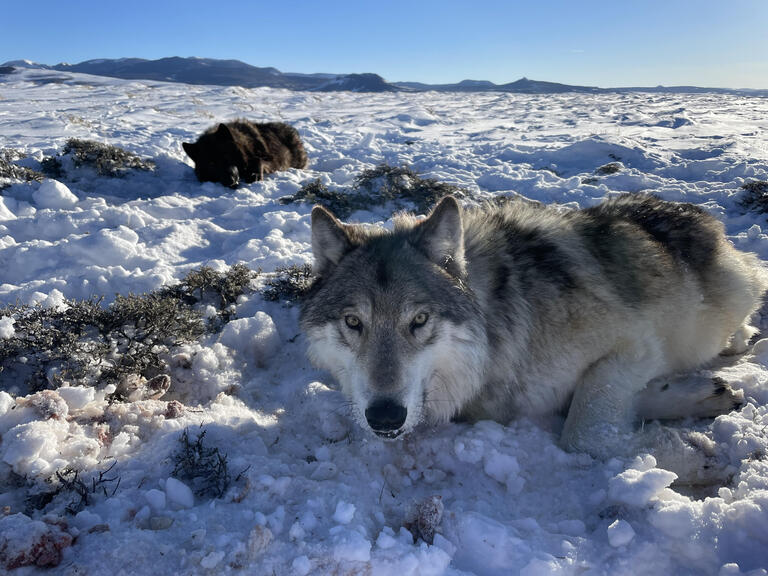
Colorado to stop killing wolves amid falling survival rate
Colorado Parks and Wildlife says it will temporarily suspend its directive that allows the killing of gray wolves that harass or kill livestock, over fears that population growth may not occur this biological year and possible evidence of an infectious parasite “that could impact wolf survival” in the future.
The agency Wednesday shared a midyear wolf population count following pressure from wolf advocacy groups and concern over the wolf reintroduction program’s future. The shift comes after the state shot and killed three wolves earlier this month.
A CPW news release says Colorado has four reproducing gray wolf packs, a fifth pack of four siblings that travel together and several wolves that do not live in packs that could potentially pair this winter.
Wildlife workers say the state’s population of gray wolves totals 45 including breeding adults, yearlings and 20 pups — a new state record, as of Sept. 24.
Pup survival in Colorado in 2025-2026 was high, with 82% of detected pups surviving their first year. But the agency says typical survival rates of pups range between 50% to 60% in Western wolf populations, “so this number will likely fall by the end of the biological year in March 2027.”
And adult survival during the last biological year (April 1, 2025-March 31) was 61%, which is below the 75% survival rate more typical of a population of wolves that aren’t allowed to be hunted.
CPW biologists and veterinarians are also investigating evidence of hair loss in multiple wolves in two packs in northwestern Colorado, which could be associated with an infectious skin parasite and, if so, could impact wolf survival, the agency says.
Human-caused mortalities and management actions
Four times in 2026, CPW killed wolves that were killing livestock, following the “three and 30 rule” in the state’s definition of chronic depredation.
Three and 30 refers to a single wolf killing or harassing livestock or working dogs three times in 30 days — the allowable amount before the agency can shoot a wolf under the rule that classifies reintroduced wolves in Colorado a “nonessential, experimental population.”
Three of those killings occurred in early September after confirmed livestock attacks by three wolves.
One occurred June 12, when CPW and USDA Wildlife Services killed an uncollared yearling left behind after CPW trapped five of six members of the Copper Creek pack in Grand County. The lone wolf was tied to at least 22 sheep deaths spanning 11 months in Routt County.
But due to the challenges with the current population, “and in alignment with the Colorado Wolf Restoration and Management Plan’s direction to use an adaptive approach to wolf management,” CPW says it “will evaluate additional requests for lethal removal on a more conservative basis.”
“The Wolf Plan states that when evaluating the use of lethal control on a context-specific basis, CPW must consider the trade-offs among many competing factors, including ‘wolf reproductive and recruitment success, wolf population size and listing status,’” the news release says.
“The Plan also recognizes that CPW will monitor, and if necessary, adjust the extent of lethal removals to meet conservation and management needs, noting that excessive levels of lethal removal can inhibit the recovery of wolf populations.”
Agency will work with all stakeholders to revisit “chronic depredation directive”
CPW says it will work with stakeholders to revisit its chronic depredation directive and the conditions under which the state can kill wolves may take place.
Those revisions will be in place by April 1, 2027, and the start of the new wolf biological year in coordination with the release of the Gray Wolf Annual Report. In the interim, CPW staff will continue to work with ranchers and farmers to deploy all reasonable nonlethal tools and methods.
Concurrent with the suspension of the current chronic depredation directive, CPW pledged to commit to the following actions:
- Continue to work with stakeholders on two petitions with the Colorado Parks and Wildlife Commission concerning wolf damage compensation and wolf harassment or attacks
- Extend the range riding season in select locations based on conflict and producer willingness. Range riders patrol areas where wolf activity is high to help protect livestock.
- Keep supporting livestock producers through nonlethal tools, technical assistance, site assessments and issuing nonlethal hazing permits
- Continue to review retroactive in-the-act permit applications, which allow ranchers to kill wolves if they catch them in the act of killing or attacking livestock
- Continue to apply the standards of the current compensation regulations and ensure compensation for losses to wolves as defined within those regulations in a timely manner
- Continue to explore options for further translocations of wolves
“We’re doing everything we can to meet our objective of a sustainable population while working with livestock producers and continuing to follow the adaptive guidance provided in the Wolf Restoration and Management Plan,” CPW Director Laura Clellan said in a statement. “Right now, we’re in a critical moment for wolf restoration in Colorado.”
A genetic analysis by CPW shows the wolf population has high diversity, indicating that inbreeding is not a hurdle to recovery, something Clellan emphasized at a CPW commission meeting Sept. 10.
But “while this is promising news for the program, achieving a successful reintroduction effort and a self-sustaining population of wolves will require doing everything we can to ensure the survival of existing wolves in the state,” she said in Wednesday’s statement.
The news release said CPW continues to explore options for future translocations with a goal of meeting the recommendations laid out in the Colorado Wolf Restoration and Management Plan (30 to 50 total translocated wolves over a three- to five-year period).
“This is the number experts agreed provided the best chance to establish a self-sustaining wolf population in Colorado, however, right now the agency must consider all options based on the current population,” Clellan said.
Multiple wolf advocacy groups applauded CPW’s decision on Wednesday.
“This is great news and I congratulate CPW’s decision,” said Marc Bekoff, carnivore expert and professor emeritus of ecology and evolutionary biology at University of Colorado Boulder. “Solid science has told us over and over again that CPW’s killing sprees violate what we have long known, namely, that killing wolves does not work to stop predation on farm animals. I can only hope that the chronic depredation directive will be permanently shelved.”