Weld County approves $1.7B green energy project across active ranchland
GREELEY — Weld County will get a $1.67 billion wind and solar energy facility in the region surrounding the Chalk Bluffs after county commissioners voted 3-2 to approve it following several hours of heated public comment Wednesday.
The project, expected to begin construction in 2027 and be completed by 2029, will employ 2,200 acres of solar panels and 79 wind turbines to generate 805 megawatts of energy, enough to power 600,000 homes. It will span 25,000 acres between U.S. Highway 85 and Colorado State Highway 390 and extend from Weld County into southern Laramie County in Wyoming.
Commissioners Kevin Ross, Lynette Peppler and Perry Buck voted for the facility and Scott James, chair of the commission, and Jason Maxey, chair pro-tem, voted against it.
Enyo Energy, the developer, presented its plan to commissioners Wednesday.
Enyo representatives have touted the project’s economic, infrastructural and regional advantages, including increased power generation and grid reliability. They’re taking an “all-of-the-above approach” to electricity generation, they said, and cited a $47 million property tax payout over the project’s 30-year timeline as well as a boost in construction jobs during the three years the facility is under construction.
Enyo Energy says 97% of the project area is secured through long-term private land leases with local landowners. The remaining 3% consists of publicly owned state, federal or municipal land or easements, Enyo states. The developer also states current ranching and agricultural land uses can largely continue around the planned infrastructure.
But the majority of people who gave public comments at the meeting were against the facility.
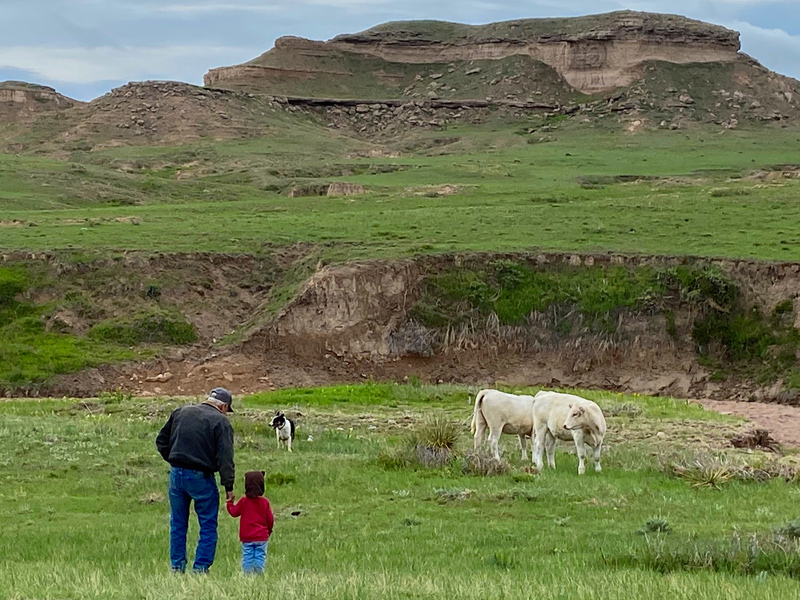
They included several multigenerational ranching families whose properties fall just outside the project boundary, like Robert Wagner, who owns and manages a 6,000-acre ranch with his wife that shares a border with it on three sides.
Enyo representatives told the commissioners they’d done extensive public outreach with residents who might be affected. But Wagner said “we’ve had virtually no contact from Chalk Bluffs Energy or anyone else, except early on in the process they wanted a lease across a corner.”
“I’m a scientist,” he added. “I have a Ph.D. in biochemistry and molecular biology. And I’m also a fan of wind and solar.”
But he asked commissioners not to approve the project because the turbines will block vistas around the Chalk Bluffs, a rare geological escarpment lined with ancient fossils, unique trees found in mountain environments and important bird habitat. Remnants of past energy projects had been abandoned on his property, he added.
The topsoil in the region, which will be impacted by heavy machinery, “doesn’t recover quickly,” he said. “Maybe not for decades.
“That’s a huge loss of grazing land, and I think that matters.”
The one ranch entirely contained within the project boundary had a different take.
The Salo family started ranching and farming in northern Weld County in 2014 after running a farm and feedlot in Wyoming for 15 years. According to Scott Salo they’d spent nearly a decade watching their neighbors collect oil checks from wells drilled from pads on his ranch.
Over the years, ranching has become harder and more unpredictable, with drought, low cattle supply and fluctuating markets shaped by political decisions, like what happened when President Donald Trump announced in August he was easing tariffs on imported beef, which ranchers say flooded the market.
One of the Salos’ daughters told commissioners Wednesday that she hopes to continue farming and ranching into adulthood. Rather than changing her family’s way of life, she said the project “represents an opportunity to strengthen the financial foundation of a ranch and create more certainty as we plan for the years ahead.
“For me personally, that means the possibility of coming home to live alongside my parents, learning from them while I still have the opportunity, and preparing one day to leave our ranch with the same dedication they have shown throughout their lives.”
James Trosper, an Eastern Shoshone tribe member and Eastern Shoshone Sun Dance chief, asked the commissioners to deny the permit on a cultural basis, saying an archeological study conducted by Colorado State University “confirms our oral history and evidence that this is a sacred place and an important place to our people.”
Commissioner Kevin Ross responded by asking how far from the project Trosper lived (a question he asked all speakers. Trosper said Fort Collins, around 50 miles away).
On Sept. 9, Weld County commissioners unanimously voted to approve a permit for Global AI to build what could become the largest data center operation in Colorado.
Republican state senator Byron Pelton, whose district includes Weld County, was neutral on the decision.
“Local governments have to walk a fine line between private property rights and what’s best for the county as a whole!” he wrote in a text to The Colorado Sun Friday. “Land use decisions should always stay with the local governments because it’s the government closest to the people.”
Wagner, the landowner adjacent to the project, said he believes “the die was cast before that meeting ever occurred.”