State lawmakers say GAJA will be a focus of next legislative session
Two state lawmakers speaking at an energy conference on Tuesday had nothing good to say about GAJA — the Generating Arkansas Jobs Act — calling it the “gotcha” law that needs to be changed.
GAJA was in the spotlight recently as Entergy was caught red-handed charging customers in full and upfront for a new solar facility to power a Google data center; the utility has pointed out it has the right to do so under the 2025 law, which attracted little attention until customer bills started climbing this summer.
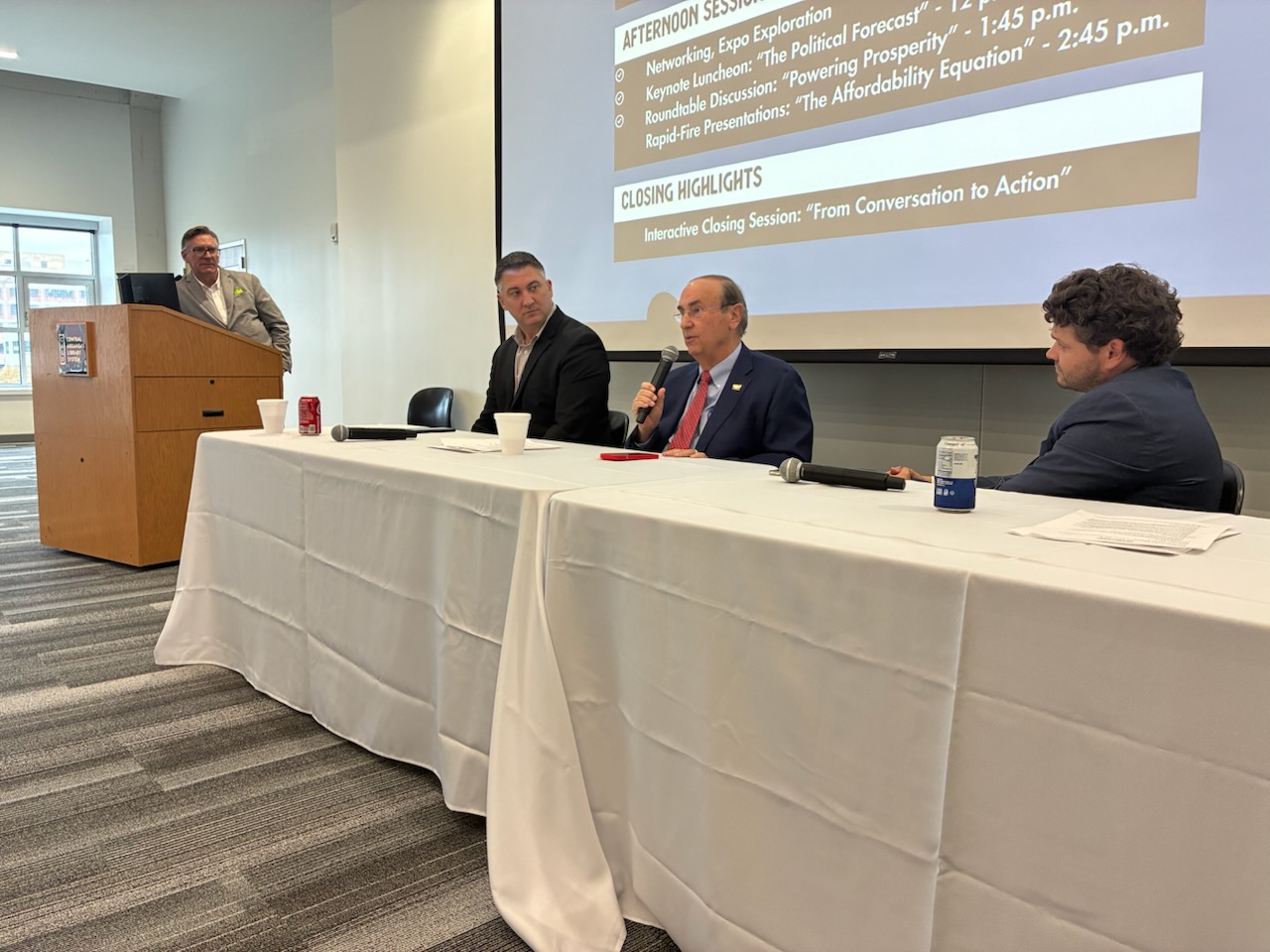
State Sen. Clint Penzo (R-Springdale), state Sen. Mark Johnson (R-Little Rock) and state Rep. Aaron Pilkington (R-Knoxville) were the keynote speakers during a luncheon session at the Arkansas Advanced Energy Association’s Empower Arkansas Conference and Expo.
The three quickly agreed that the state was not creating enough electricity, a hindrance set to hurt economic development.
“Energy equals jobs,” said Pilkington, answering a question from moderator Roby Brock, who owns the Northwest Arkansas Business Journal and several weekly newspapers. “Having more energy would attract economic development to the state. The only way to do that is to increase the power we produce, and right now we don’t have enough.”
The three also expressed support for nuclear power, saying new technology made nuclear power plants safer and, in many cases, they said, quicker and easier to build. A 500-page feasibility study conducted by EXCEL Services Corp. and delivered to state lawmakers in August echoed that sentiment, saying the state should consider expanding nuclear generation.
When asked what legislation would be prioritized during the regular legislative session that starts in January, all three said GAJA would be front and center.
Penzo and Johnson did not hold back, saying they did not vote for GAJA last year and still didn’t like it.
The law allows energy companies to charge ratepayers in advance for power creation. In the past, ratepayers were charged for the cost of new power after it was built. Through GAJA, however, ratepayers are on the hook when construction starts. Entergy, one of the main recipients of the utility bill add-on, has defended GAJA by saying it keeps customers from experiencing large spikes on their bills when new power generation comes online.
Penzo and Johnson, however, said the law went too far.
“The deal was, we give you a monopoly, and in exchange, you can have investors,” Johnson said. “But now, ratepayers are paying for capital expenditures, and that puts us going down a dangerous road. This is the wrong way to do this. That’s a cost shift that’s not appropriate.”
“It removes the risk from investors and moves it to ratepayers,” Penzo said.
Pilkington voted for GAJA, but even he said he thought there should be a cap on how much customers were charged through the measure.
Johnson said energy topics would be brought up in a legislative study session in the near future.
Johnson said that customers are now aware of the law and are raising questions about it to their representatives. “When we passed it, no one knew what was going on. They understand it now and they’re asking questions.”
One of the chief architects of GAJA was Sen. Jonathan Dismang (R-Beebe), who resigned abruptly last month to go to work for the Electric Cooperatives of Arkansas.
Johnson said he also thought the state would have to deal with Medicaid during the legislative session. Republicans passed, and President Trump signed, the One Big Beautiful Bill, which cut almost a trillion dollars out of Medicaid, cuts that have or will be felt across the state.“That’s the 500-pound gorilla in the room for 2027,” he said.
Source link