
Aspen Snowmass considers snow storage pilot a success
Can Colorado do more with less water?
Where Colorado will find the water it needs to thrive is a more urgent question than ever amid historic drought, undeniable climate change and unprecedented interstate conflicts over limited river supplies.
The Colorado Sun is embarking on a solutions journalism series asking who in the state is doing their share to save precious water. Our solutions-oriented reporting will assess whether specific water conservation projects can free up water at a large scale, or whether local conservation is always overwhelmed by uncontrollable natural conditions or immovable market realities.
The Colorado Sun series, “Can Colorado do more with less water?,” will create a body of work showcasing what may or may not be possible in creating water solutions across the state. From Akron to Aspen, we’re looking for signs of success or failure that will help lead us to water security.
SNOWMASS VILLAGE — Over the weekend, the lifts were spinning at Snowmass Bike Park for the last time this season, but it wasn’t just bikers getting air on the mountain.
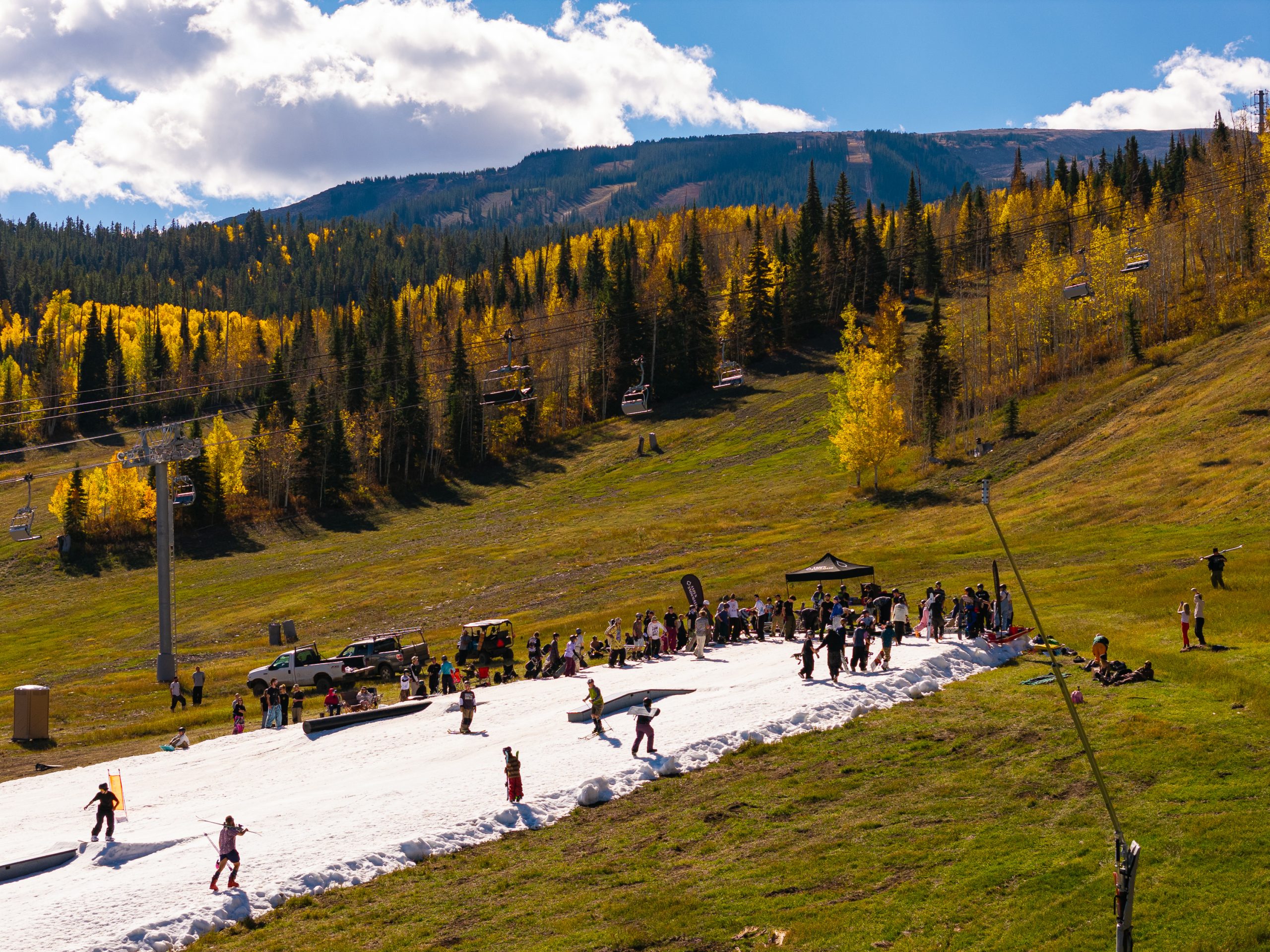
Skiers and snowboarders had a rare opportunity to get on snow in early October, courtesy of — well, last year’s snow.
Aspen Snowmass opened the Makaha Terrain Park for the weekend, giving skiers and riders a chance to ski and snowboard on about 300 feet of snow that had spent nearly five months beneath insulated blankets. Meanwhile, mountain bikers bombed down Snowmass’ trails through the golden-leafed canopy.
Despite a dry winter that forced Aspen Snowmass to close some terrain early and a summer that broke historic drought records, the snow survived. Roughly 85% of the snow volume stored at Snowmass remained when the blankets were removed late this summer. At Buttermilk, where another pile rested on the slope above the half pipe, about 84% remained, including both melt and the natural compression of the pile.
The results mark a successful first season for Aspen Snowmass’ pilot program using Snow Secure technology. The resort is the first in Colorado to test the Finnish company’s system, which debuted in the United States at Bogus Basin in Idaho after the 2024-25 ski season.
In fact, the experiment was such a success that Aspen is already buying more.
“The results speak for themselves,” said Chris Miller, senior vice president of sustainability, community and advocacy at Aspen One. “We’ve already purchased additional blankets for next year.”
The snow piles at Snowmass and Buttermilk were built in April, when crews used snowcats and other heavy equipment to push leftover winter snow into piles totaling roughly 10 acre-feet, or the equivalent of 3.5 million gallons of water. They then covered the piles with Snow Secure’s insulated blankets. As temperatures rose and snow melted from the surrounding slopes, what was underneath the blankets stayed remarkably cold.
At Buttermilk, sensors recorded an average temperature of 62.6 degrees on top of the blankets between April 19 and Aug. 31. Beneath the insulation, the average was 34.8 degrees. The outside temperature reached as high as 121 degrees in direct summer sun, while the snow underneath never rose above 44.9 degrees.
“The blankets did exactly what they’re designed to do,” Miller said.
For Antti Lauslahti, CEO of Snow Secure, the best proof came when the blankets came off and people could actually ski the snow.
“We can talk about percentages and temperature data all summer, but in the end the best demonstration is the snow itself,” Lauslahti said.
For Aspen Snowmass, the point of the pilot wasn’t to create a fun October ski day. The stored snow gives the resort a head start on building terrain park features and other early-season operations. That means fewer snowmaking hours, less water and less energy used to get those features ready, Miller said.
“At scale, this technology can support less early-season snowmaking which should mean less water consumption and energy use to get a jumpstart on the season, and that’s the real win here,” he added.
That matters in a place where the past two winters have been difficult for snowmaking and this summer brought record-setting drought conditions to the Roaring Fork Valley.
The pilot is part of a broader effort to prepare for increasingly unpredictable conditions rather than simply react to them, Miller said.
“Building systems that reduce our dependence on early-season snowmaking isn’t just good operations, it’s how we adapt to a shifting climate and protect the guest experience over the long term,” Miller said. “We’re not waiting for conditions to force our hand; we’re investing in solutions before we need them.”
Ski areas are increasingly looking for ways to manage the timing of snow, rather than its total amount. Snow storage is one way to put some of that winter snow in the bank for the following season.
“A ski resort cannot control whether October or November will be cold enough to make snow,” Lauslahti said. “But it can decide in February or March, when conditions are good, to preserve some of the snow it already has for the following season.”
Lauslahti said Snow Secure has seen increased interest from other North American resorts — including some in Colorado — since Aspen’s pilot. He declined to identify the resorts that are considering the technology.
He doesn’t see snow storage replacing snowmaking but rather “adding another tool to the snow-management toolbox.”
At Snowmass this weekend, the proof was in the skiing.