
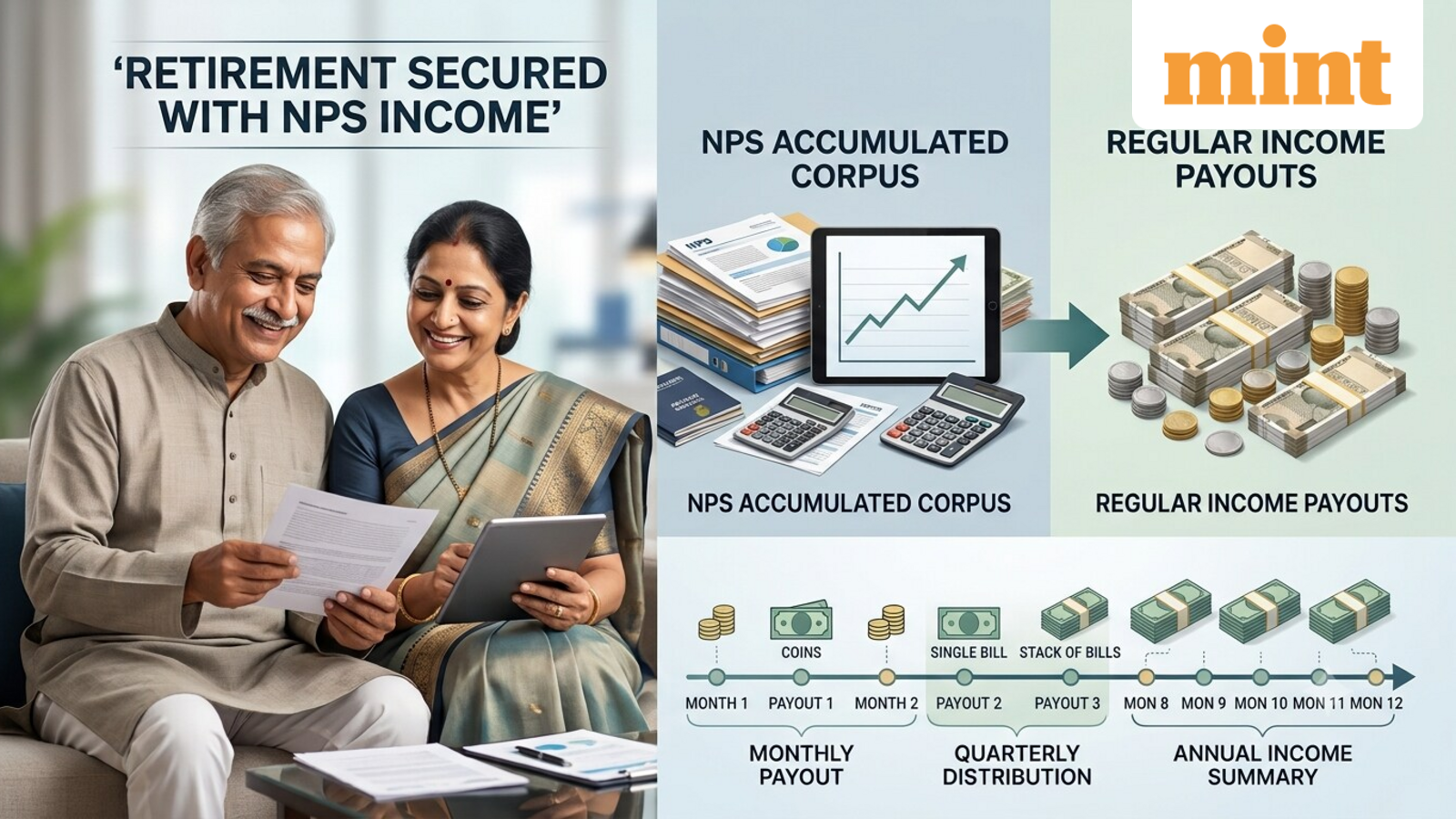
NPS Retirement Income Scheme: How payouts work, what happens to annuity and where corpus is invested
For someone saving through the National Pension System (NPS), retirement planning does not end with building a corpus. Once you retire, you also need a way to turn that accumulated money into a regular income.
On 15 May 2026, the Pension Fund Regulatory and Development Authority (PFRDA) introduced Retirement Income Schemes (RIS) for NPS subscribers. The scheme is designed to help retirees receive regular payouts from the portion of their NPS corpus that is available for phased withdrawals.
Why is this important for NPS subscribers?
Think of your NPS retirement corpus as the money you have built over your working years. At retirement, this money has to be split according to NPS exit rules.
A specified portion, 20% or 40%, depending on the applicable exit rules, has to be used to buy an annuity. An annuity is a product that gives you a regular income or pension after you invest this amount with an annuity provider.
The remaining portion can be used according to the applicable withdrawal rules. The RIS gives subscribers a way to take regular payouts from this portion, rather than treating it simply as a lump-sum withdrawal.
This means an NPS subscriber can have two sources of retirement income: the annuity (pension) income from the mandatory portion and regular RIS payouts from the designated remaining portion of the corpus.
What does the RIS actually offer?
Under RIS, you can choose to receive money from your designated NPS corpus every month, every quarter, or once a year. The payouts can continue until the age of 85 years, or for a shorter period chosen by you when you exit NPS.
The objective is to help retirees manage their post-retirement cash flow while keeping the remaining corpus invested during the payout period.
It is available to both government and non-government NPS subscribers who wish to receive regular payouts from their designated pension corpus, up to the age of 85 years.
Does RIS replace the annuity?
No.
The RIS does not remove the existing mandatory annuity requirement. The required 20% or 40% portion will still have to be used for annuity purchase, as applicable. RIS applies to the designated portion of the corpus available for phased payouts.
So, the annuity is one source of retirement income, while RIS provides a way to draw regular income from the other designated portion of your NPS corpus.
How much pension will you get under RIS?
There is no fixed pension amount under RIS. The amount you receive will depend on factors such as how much corpus is available for the RIS payout, the payout option, and the value of the corpus when the payouts are calculated.
So, RIS is not promising a fixed monthly pension. It is a way to draw regular income from your NPS corpus during retirement.
How will the RIS corpus be invested?
Under RIS, your designated NPS corpus continues to be invested while you receive periodic payouts from it. The scheme has a life-cycle investment approach, under which the asset allocation changes as you get older.
One variant available under RIS is RIS Steady, which follows an age-based investment approach. At age 60, 35% of the corpus is invested in equity, while 10% is in corporate debt and 55% in government securities.
The equity allocation then gradually falls with age. It comes down to 25% at 65, 15% at 70, and 10% from age 75 onwards. At the same time, a larger share is allocated to debt and government securities.
The idea is to gradually reduce equity exposure during the retirement years while keeping the corpus invested during the period when the subscriber is receiving payouts.
Disclaimer: This is purely for educational/informational purposes and should not be taken as any sort of investment advice. Always consult a SEBI-registered advisor before making any investment decisions.