Understanding French lycées protest signs
Protests and demos in France offer foreigners a crash course in vocabulary via banners and signs – from the profane to the politics, here’s a guide to the banners spotted at this week’s lycée protests.
This week, thousands of French high school students have been taking part in blockades at lycées, some of which have turned violent.
The protests began as a call for better funding for education, with the 15-18-year-old pupils complaining of a lack of teachers and resources and crumbling classrooms.
But as the protests have deepened, other issues have come to the fore, many of them explained on the banners waved by the protesting students.
Don’t miss our journalists’ daily news roundup from France
Protest banners are an art form all of their own – and from puns and in-jokes to cultural references and party slogans, they can be hard for foreigners to understand.
Here’s a selection of translations from this week’s protests, all images from AFP.
Let’s start with a simple one – More money for lycées [high school, which pupils attend for the final three years of their school career, mostly between the ages of 15 and 18], and not for the army.
The main focus of these protests is on resources for schools, so plenty of banners call for extra funding, more teachers, a proper maintenance budget for school buildings etc. Many of them also call on the government to prioritise education above other types of spending.
This one is another spending call. It would be easier to understand if the sign-writer had used both upper and lower case letters, although the gender of the nouns also gives a clue – Le Bac, pas la BAC.
Le Bac is the commonly used shorthand for the baccalaureate, the exam that all French pupils take at the end of their lycée career, usually at the age of 18, before either going on to university or entering the world of work.
In this context, B.A.C. stands for la brigade anti-criminalité, a well-known unit of the police. There have been several high-profile cases of BAC officers involved in corruption, violence or both, although in this case BAC is probably used mainly because of the pleasing echo of Bac. In short, the sign says ‘exams, not police’.
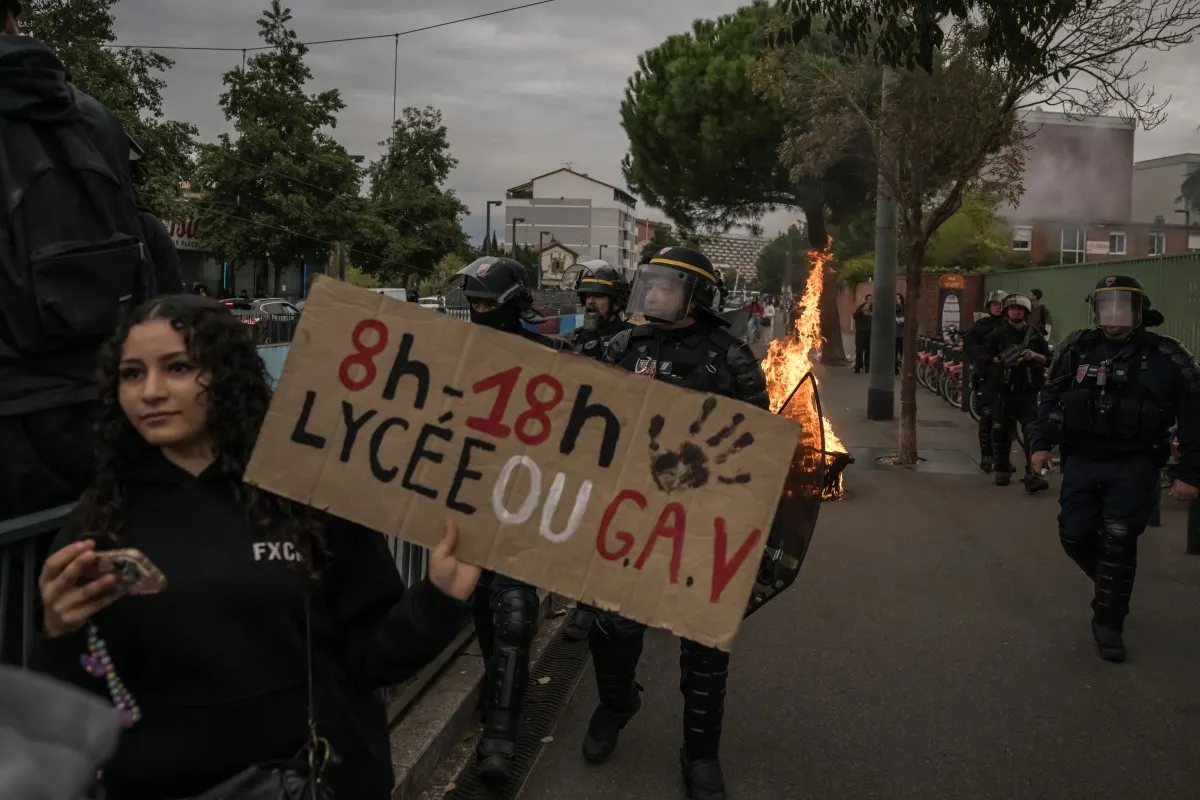
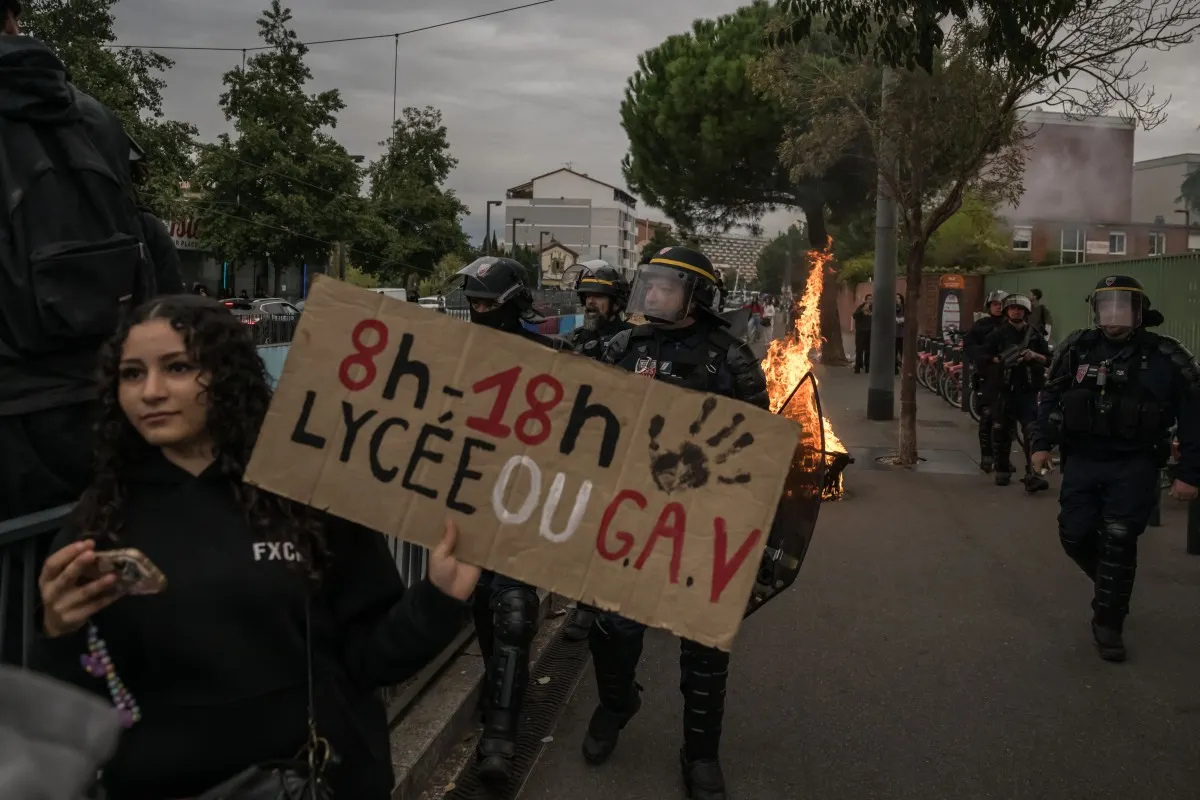
Sticking with the education themes, this one takes aim at the length of the school day – ‘8am to 6pm are we in school or custody?’ – G.A.V. stands for garde à vue, when one is arrested and held in custody but not yet charged.
(On a related note, I have very bad news for these kids about their future working days).
Puns and wordplay are an important part of political sign writing, and this one has gone for a nice semi-rhyme to make its point.
Less Elysée [the home of the French president, also used as shorthand for the French presidency], fewer elected officials [from the verb élire – to elect. Normally you would say élus, but then it wouldn’t rhyme] more lycée.
But apart from their school-related complaints, many of the students used the protests to make more general political points.
This one is a double-whammy of a pun and a political reference.
The phrase ‘R-haine’ is a common one for leftist street demos, signs and graffiti. It references the far-right political party Rassemblement National, which is commonly known by its initials RN. The French pronunciation of the initials RN and R-Haine sounds very similar. Haine means hatred, so the slogan is basically saying that RN is a party of hate.
In this sign, it’s combined with another common slogan referencing a song – La jeunesse emmerde le Front National, released in 1988 by the punk band Bérurier noir as a protest song against the Front National party, which has since renamed itself Rassemblement National. The song’s title is actually Porcherie, but it’s usually referred to by the chorus; you can find the full lyrics here.
Roughly translating as ‘the youth are pissing off/fighting back against the Front National’, the lyric has become iconic and versions of it are often seen on demos, adapted to the particular circumstances. So the above sign very broadly translates as ‘the youth tell the Rassemblement National to fuck off.”
Which brings us nicely to profanities.
Most demos have some level of crude language, so it’s unsurprising that the teenage protesters would embrace this – the English word ‘fuck’ seems to have become part of the universal language and it’s very common to see it used on banners at all types of political event. The below really needs no translation.
But sometimes protesters are a little more coy with their gros mots.
Here the initials BZ stand in for ‘baise‘ – the crude French term for having sex. Just like the English word ‘fuck’, baise can mean either to have sex with someone or to do them harm in some way, such as ‘screw them over’ or ‘fuck them up’.
This sign plays on the double meaning to say ‘Macron – fuck your teacher, not the others’. Versions of this are common on protest signs; it refers, of course, to Emmanuel Macron’s relationship with his former teacher – and now wife – Brigitte.
Have you seen any interesting banners at French protests? Share them in the comments section below