
How a California law could free English learners from test mess
In a major overhaul of a decades-old practice, nearly 1 million California students designated as English learners will no longer have to pass a battery of tests and benchmarks to move out of a program that advocates say has long been holding back their education, under a new law signed by Gov. Gavin Newsom on Sunday.
Assembly Bill 2555 dismantles and streamlines an aging system that some researchers said kept far too many students classified as English learners months or even years after mastering the language. Under the new law, students will have to pass only one state-approved English assessment to show they are proficient.
“It is a big win,” said Nancy Villarreal, executive director of Parent Organization Network, an advocacy group for families. “This bill will … remove all the extra hoops they have to jump through, but also make sure that the students will continue having some extra support.”
There are just under a million designated English learners in California schools — roughly 1 in 6 students in kindergarten through 12th grade. This formal classification means that students receive specialized English language instruction during the school day, largely funded by the state.
Engage with our community-funded journalism as we delve into child care, transitional kindergarten, health and other issues affecting children from birth through age 5.
The problem, supporters of the new law said, is that it has been far too difficult to pass out of the program — with different requirements in districts throughout the state — and has caused confusion for parents and families.
Between 2022 and 2024, an estimated 37,000 California students scored at the highest level on the standardized English Language Proficiency Assessments for California, known as the ELPAC, but remained classified as English learners the following school year, according to University of Oregon research.
On average, it took over 220 calendar days for students to be reclassified, according to the California Department of Education. One in 10 waited at least 532 days. A school year in California is 180 days. Some students earned the highest score multiple years before they were reclassified.
‘The most over-tested’
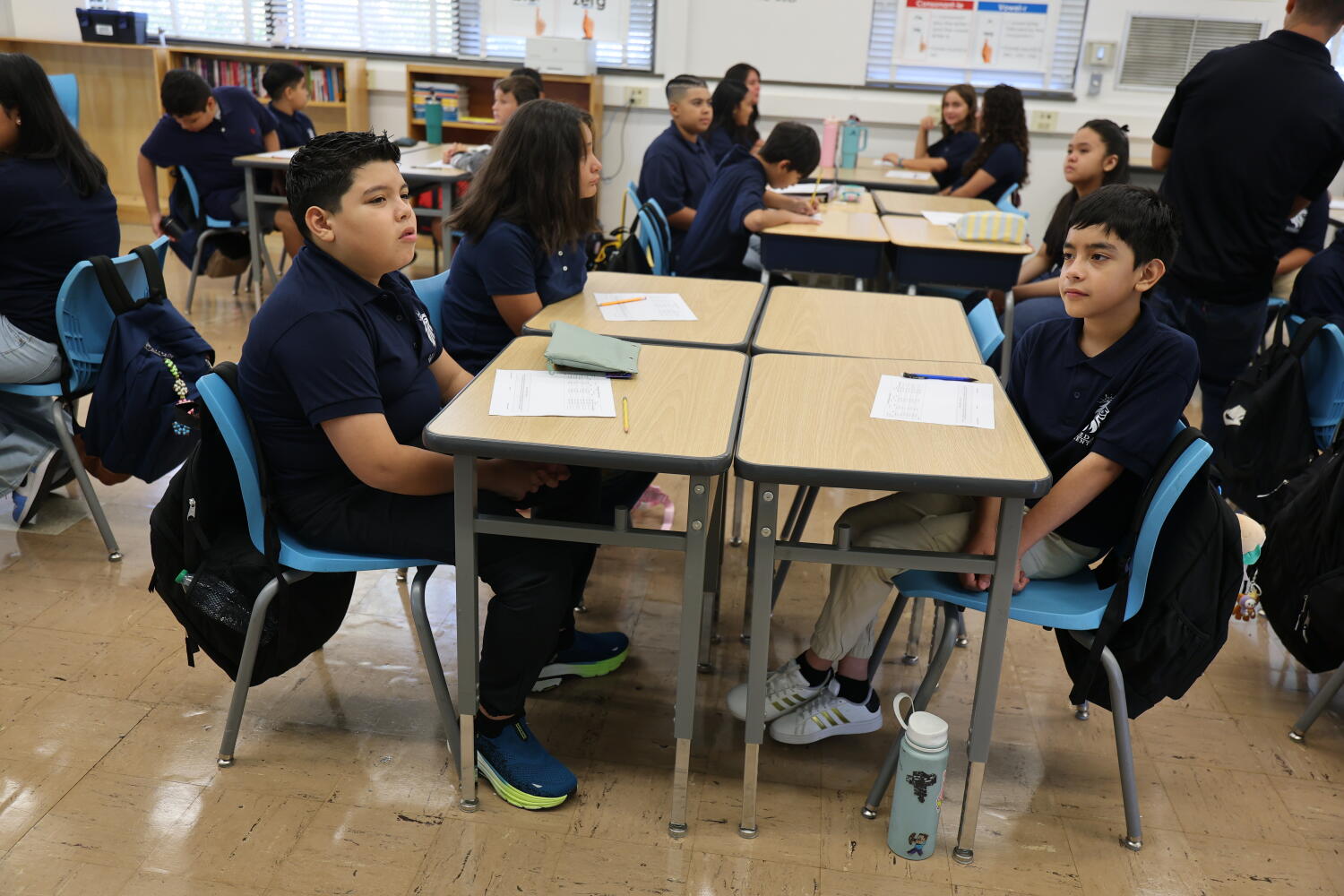
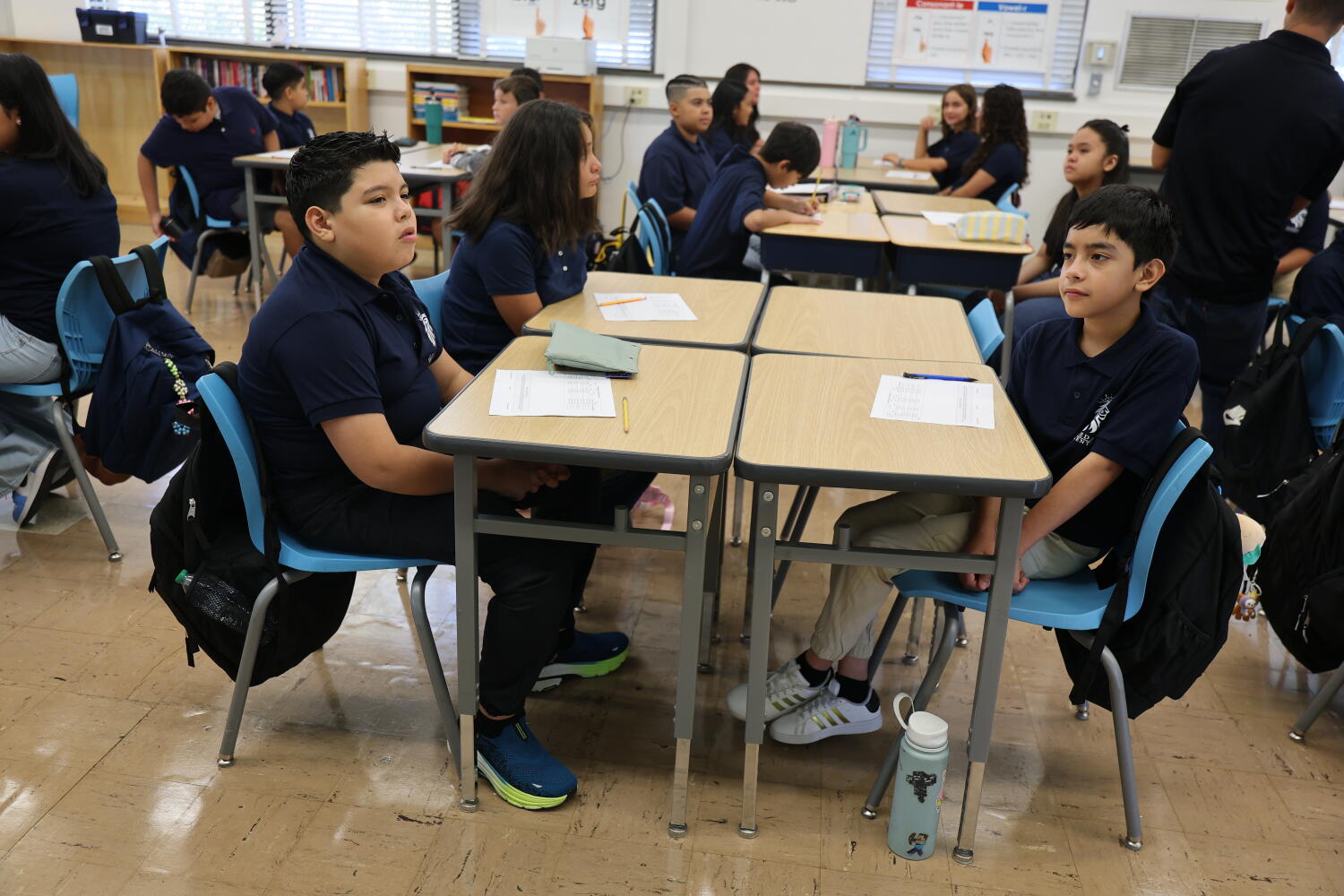
In David De La Cruz Rosales’ middle school classroom, some students have earned the highest test score. But they remain classified as English learners while they wait to clear other requirements. The assessments weigh on them.
David De La Cruz Rosales, an English language development teacher for 7th and 8th grades at Young Oak Kim Academy, a middle school in Koreatown, is photographed on Saturday.
(Christina House/Los Angeles Times)
“Our students are some of the most over-tested throughout the school year,” said De La Cruz Rosales, an English language development teacher at Young Oak Kim Academy in Los Angeles.
Many students have a lot on their minds, he said. They grapple with low morale awaiting reclassification — sometimes missing a passing score by a point or two. This past year, fear of immigration enforcement has kept some home and others worried about loved ones, De La Cruz Rosales said.
“There are so many things that a test date and a test schedule do not consider,” he said. “One bad test, one bad day … we have to consider that as well.”
Reclassification could take months or longer because a qualifying score was only the first step. California students had to pass three other requirements under state law: receive a positive teacher evaluation, have the school consult with a parent and demonstrate basic academic skills in an assessment chosen by each district.
Advocates had gone “back and forth” on attempts to overhaul the current system, said Araceli Simeón, executive director of the California Family Engagement Network, a supporter of the bill. The stakes are high: Pulling English support too early risks a student losing language support before they’re ready. But leaving them in the program too long can stall their learning and limit the other instruction or classes they can take.
Recent data showed students were languishing in the system. About 200,000 English learners remained classified for six years or more. Nearly half of long-term English learners had already demonstrated proficiency in English but had not been reclassified, according to research cited by the Assembly Education Committee.
The legislation followed more than a year of research and conversations with stakeholders.
“It painted a very clear picture that the current system is not working, and it puts up a lot of barriers for English learners to be reclassified,” said Simeón.
The evidence led to the development of the streamlined approach — which did not encounter opposition throughout the legislative process, according to Assemblymember Darshana R. Patel (D-San Diego), who presented the bill.
Pitfalls of the former system
When a child enrolls in a California public school, families are asked what language is spoken at home. As early as kindergarten, children who mainly speak a foreign language at home could be designated as an English learner and placed in language classes.
Maryana Khames testified before legislators about the pitfalls of the old system. She arrived to the U.S. from Iraq at age 12 as a United Nations refugee and did not speak any English. She was enrolled in an English learner program, but said she was not allowed to take math or science courses. As her language skills improved, she was kept in the English learner class.
She said her school never explained the reclassification process. Khames worried she was falling behind. She was reclassified only after requesting help during a school board meeting when she was in eighth grade — a change that immediately opened up more rigorous classes, including honors English.
“I went from being an English learner to an honors student over the summer,” Khames, now a law student at UC Davis, said during an April hearing in Sacramento.
The definition of basic skills varied widely between districts. A 2026 Public Policy Institute of California survey found that districts used 24 different assessments, along with other exams and report cards, to satisfy the basic-skills requirement among fifth-graders.
The teacher evaluation was also not standardized. For instance, half of districts included math performance, according to an Assembly Education Committee analysis. Attendance, homework and participation were factors in some districts.
“When I looked at reclassified students from one district to another, I couldn’t compare apples to apples,” said Manuel Buenrostro, policy director at Californians Together, an advocacy group that co-sponsored the bill. “If a student was in a different district, they might have otherwise been reclassified.”
Involving parents
The law changes how schools communicate with families.
Under the old system, parents were contacted when their child was about to be reclassified. Advocates said parents often did not know that their child was still classified as an English learner. Often a parent hears a child speaking English with friends or siblings and assumes the child is already proficient and has exited the program, Villarreal said.
Schools will now have to explain the entire designation process when students are first put in the English learner program.
Yosadara Carbajal Salmerón’s two children were classified as English learners in kindergarten. Years went by before her son was reclassified in seventh grade and her daughter as a freshman in high school.
Her children, who are now adults, would constantly be pulled out of class and weren’t able to take electives like their peers as they got older. A simpler and clearer system could have changed that, she said.
“I do believe that my children would have been able to reclassify much earlier if the law had changed earlier and if I, as a mother, would have educated myself earlier,” Carbajal Salmerón said.
What the new law requires
The new law keeps the ELPAC score of level 4 sufficient to exit the English learner path, but strips the other requirements, putting California in line with 44 states that have just one requirement.
Students who leave the program will be monitored for four years, a safety net meant to keep students who still need help with English skills.
The new rules will be applied retroactively, and students who passed the test in the spring of 2026 will be reclassified for the current school year, said Assemblymember Patel.
“They’ll get to explore their curiosities and interests sooner, just like their peers,” Patel said.
Financially, Patel said it should have little impact on schools. Although schools receive money for English learners, roughly 94% of those students are also low-income, another category that already qualified schools for more funding for those students.
Times audience engagement editor Kate Sequeira contributed to this report. This article is part of The Times’ early childhood education initiative, focusing on the learning and development of California children, from birth to age 5. For more information about the initiative and its philanthropic funders, go to latimes.com/earlyed.