PAP party leadership renewal rests on co-option next, with four spots to fill on top committee
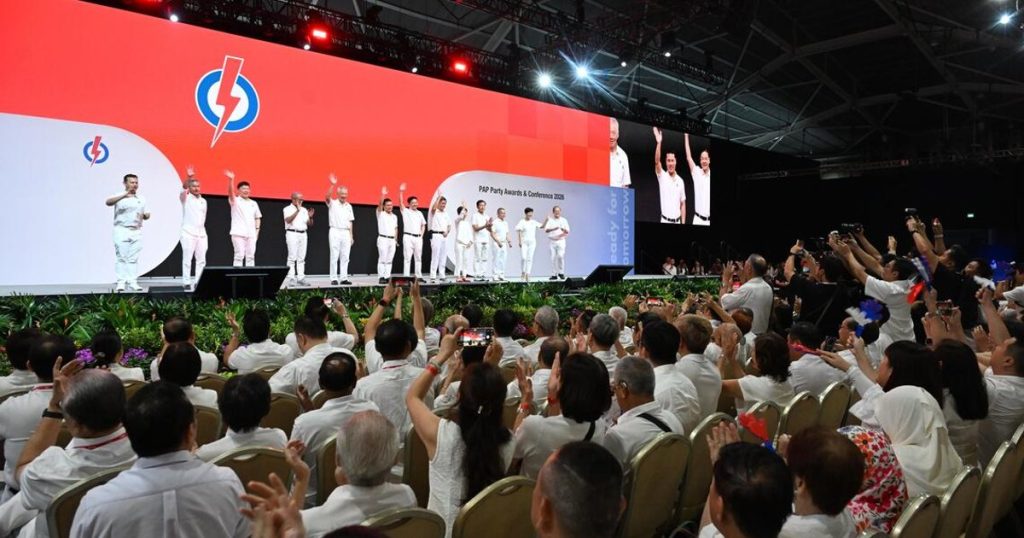
SINGAPORE – The PAP’s cadres on Oct 25 returned a largely unchanged line-up to the party’s top leadership body, leaving co-option as the next step to bring in fresh blood.
It is a route commonly used in the past to introduce new leaders who do not yet have enough sway within the party to secure a seat directly to the committee.
The front runners for inclusion this time are ministers Jeffrey Siow and Jasmin Lau, the only two first-term MPs included on a list of 19 candidates put up for cadres to consider.
Making room for them could mean re-allocating seats which the party has for its past few elections reserved for the labour movement, its candidates in opposition-held wards, and other senior party figures.
Cadres at Sunday’s biennial party conference re-elected 12 members to the ruling party’s central executive committee (CEC), which then co-opted the two next highest vote-getters for a total of 14.
This leaves four slots left for the committee to co-opt members to reach its maximum size of 18.
Precedent suggests that the CEC will now move to co-opt first-term ministers to facilitate renewal, which Prime Minister Lawrence Wong has flagged as a priority.
PM Wong, who is the party’s secretary-general, said a day before the election that he hoped to work with a team that has a mix of experienced and fresh perspectives on the CEC. At the party convention in 2025, he had said he hopes to see the next generation of PAP leaders emerge by the next general election, due by 2030.
If the CEC co-opts both Siow and Lau, as well as labour chief Ng Chee Meng and a candidate from an opposition-held ward, as it has typically done, all four seats would be filled.
This would mean no room for the heads of internal party bodies or other backbenchers.
While Siow and Lau were not voted in, it is not surprising that the two new ministers, who were recently promoted at a July Cabinet reshuffle, missed out on seats this way.
Both are former senior civil servants not yet well known to the wider party after having made their political debut in 2026.
Analysts said their inclusion on the list already marks them out as bright sparks and puts expectations on them to lead the party’s newer cohort of politicians.
The situation also has precedent. In the past, former public servants who later became prominent politicians also entered the party’s top leadership through co-option first rather than the vote.
Most recently, two from the 2015 batch of new MPs also entered the CEC in their first term: Ong Ye Kung and Ng.
Ong was co-opted after the party election in 2016, while Ng was elected at the next one in 2018.
Ng, as labour chief, was co-opted at party elections while he was out of Parliament between 2020 and 2025. Ong, meanwhile, has entered the CEC through the ballot at every party election since 2018. Both now sit in PM Wong’s Cabinet.
Over the past few elections, the CEC has used co-option to give at least one seat to leaders from the labour movement, and another to a candidate from the party’s teams in opposition-held wards.
It has also historically co-opted other senior party figures, including backbench MPs and the heads of its various internal bureaus or outreach wings.
The previous CEC co-opted two NTUC leaders: Ng, and Desmond Choo, who is the labour movement’s deputy secretary-general.
The CEC could cut this down to one slot to make room for renewal.
Ng is the most likely person to be co-opted. The NTUC secretary-general has traditionally had a seat on the PAP’s CEC, and Ng was reappointed as Minister in the Prime Minister’s Office after the July Cabinet reshuffle.
The previous committee also included Lam Pin Min, who contested Sengkang GRC in 2020 and 2025. Giving a seat to Lam or another opposition-ward candidate from the last election would fill the last of the four spots.
Who takes the four seats is usually announced after the CEC meets for the first time, a few weeks after the vote.
Whether one or two new ministers are co-opted now, the next party election in 2028 is key.
It will likely be the last internal election before the general election due by 2030, and hence the last chance for any new MPs to solidify themselves in the party leadership before the polls.