Advocates call for unity in face of attacks on homeless in CT
Ever since the night that rocks came hurtling through the woods into his camp, Mark Greenawalt wakes at every sound, no matter how small.
A rock left a dent in the side of Greenawalt’s house, but no one was hurt. His neighbor, Isaiah Peck spends hours sitting at the camp entrance, standing guard over the Milford encampment near the Lowe’s Home Improvement Store.
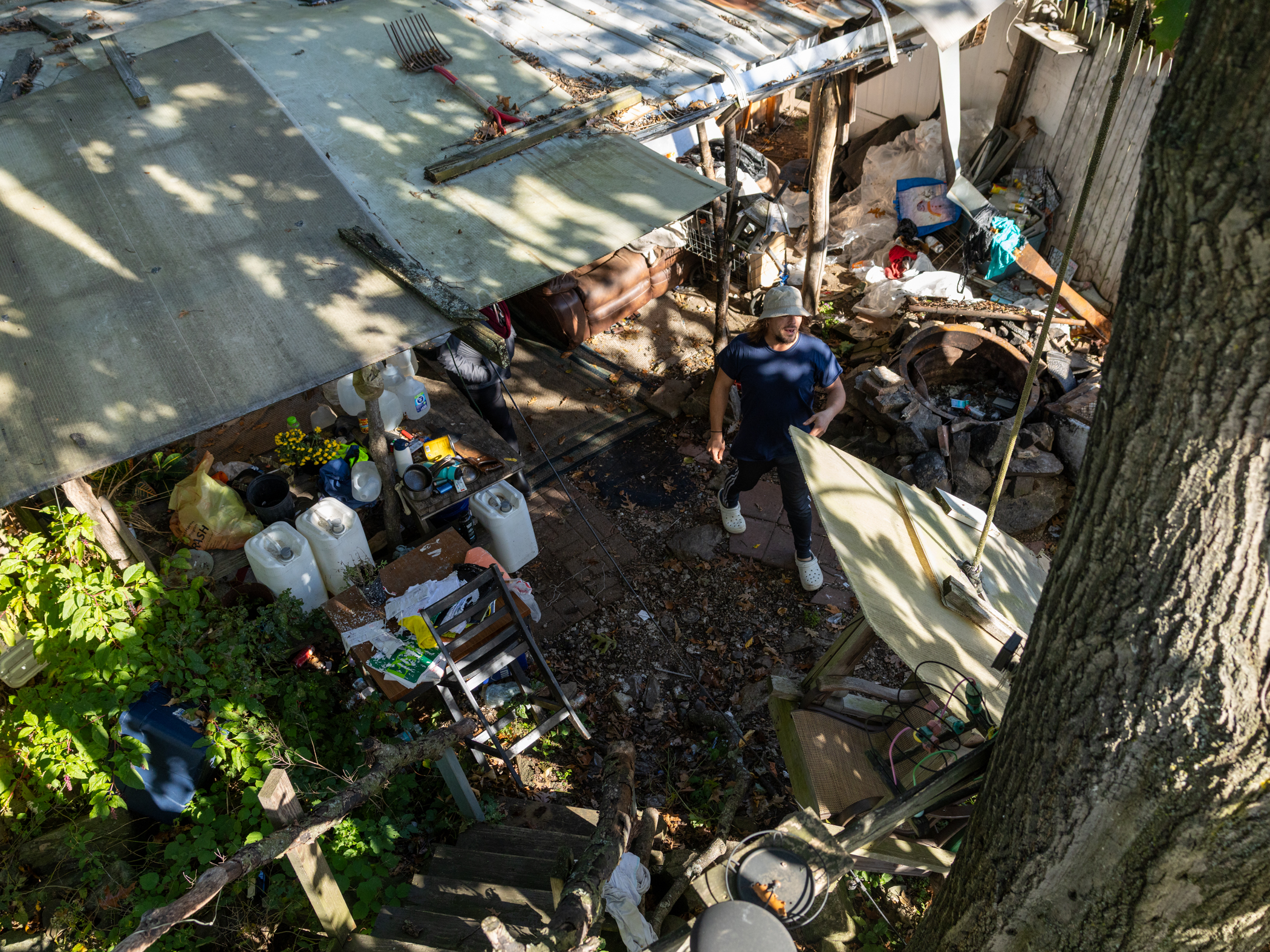
They are two of the three permanent residents of a homeless encampment that’s been built over decades into a village of sorts, complete with a television, decks built in the woods, and designated spots where they feed some of the animals that approach the camp from the surrounding forest. It’s also been the site of recent harassment, in which multiple people threw rocks and fireworks, yelled insults and painted swastikas on the trees outside the encampment.
Greenawalt has lived there the longest; over the last 20 years, he’s helped build it into what it is today, and is the de-facto mayor of the collection of sheds and buildings nestled among the trees. The residents of the encampment cook dinner together each night and have set up a spot to play music.
“It was nice and peaceful until this happened,” Greenawalt said. He’s planning to move soon, after successfully getting a housing choice voucher that will help him pay rent in a private apartment in the New Haven area.
The attack at the Milford encampment occurred at the end of September. Milford police have identified three suspects but haven’t made any arrests. They’ve also reported the incident as a hate crime, according to a statement from Police Chief Keith Mello.
The attacks are not limited to Milford. Late last week, a 22-year-old man sleeping outside was also hit in the head with a rock in a Bridgeport park. Bridgeport Police Chief Roderick Porter said officers have a person of interest in the case and are close to an arrest, and the victim is in critical but stable condition.
The incidents have left homeless service providers and the unhoused population shaken.
Advocates on Tuesday held a press conference in Bridgeport to call attention to the issue.
“At the federal level, we are seeing increased attacks on people experiencing homelessness, both through words and policies that criminalize poverty and treat people without housing as problems to be removed, rather than neighbors who need our care, love, and support,” said Sarah Fox, chief executive of the Connecticut Coalition to End Homelessness. “Even here in Connecticut, a state that prides ourselves on looking out for one another, we are not immune to the harm caused by this very dehumanizing rhetoric.”
This year, the National Coalition for the Homeless recorded a significant rise in serial attacks on people experiencing homelessness, including what the organization referred to as “shocking levels” of law enforcement involvement in attacks on people experiencing homelessness.
The coalition attributes the rise in violence to a corresponding increase in legislation and court rulings they say criminalize homelessness, leading to more “vigilantism and hatred directed towards people who are forced to live outdoors.” In addition to some state-level laws passed in states such as Kentucky, Florida and Missouri, the U.S. Supreme Court in 2024 ruled that it was legal for people to be arrested for activities such as sleeping outside.
Connecticut lawmakers for the past two legislative sessions have tried to pass a law that would prohibit arrests or fines for these activities, but the measures haven’t moved on the House or Senate floor. Local officials have opposed the bills, saying they need to be able to clear camps for health and safety reasons.
Homelessness in Connecticut and nationwide has also been rising since the COVID-19 pandemic, albeit more slowly over the last year than in the years prior.
President Donald Trump’s administration has also said it wants to shift to a practice of putting people experiencing homelessness in institutions for mental health or drug addiction, rather than the housing first approach that’s been used over the past decade.
“When those in power at the highest level demonize our homeless neighbors, they sanction society and institutions to act based on harmful beliefs, stoking the flames of the anti-homeless violence we see in our own communities,” said Sadia Rahman, of the National Homelessness Law Center, at Tuesday’s press conference.
State lawmakers on Tuesday said they want to focus on increasing funding or trying again to prohibit arrests and fines for sleeping outside to help the unhoused population. Republicans and Democrats also called for unity and kindness.
“Hate has a cost, and we are seeing that now here in the city of Bridgeport and in Milford,” said Housing Committee co-chair Rep. Antonio Felipe, D-Bridgeport.
Several speakers pointed to rhetoric and actions from the Trump administration and far right as roots of violence. Housing Committee ranking member Rep. Tony Scott, R-Monroe, steered clear of critiquing the Trump administration but said Connecticut’s politics aren’t as divisive as national politics, and that they’ll work on a bipartisan basis to help the homeless in the state.
“Screw D.C.,” Scott said. “We can do this ourselves.”
The people living at the Milford encampment attribute the attacks on their homes not to politics, but to hate and boredom. The people who attacked the encampment yelled at Greenawalt and his neighbors about not paying taxes, Greenawalt said.
Just last year, the Milford encampment was also the site of an intentionally set fire that killed one of its long-term residents, a man Greenawalt said was his best friend. Greenawalt bears scars on his arms and scalp from trying to pull Joe Kane out of the fire. Kane’s absence is felt deeply at the encampment. Greenawalt still says good morning and good night to his burned-out home each day.
Greenawalt said that given the attacks, he’s excited to be moving to an apartment where he can feel at peace and secure. It took a long time to secure all the documents and get him a voucher, he said.
He’ll return to the encampment, though. He has a groundhog he’s named Freddy who he feeds daily. The animal likes to scamper across Greenawalt’s front porch, sometimes sniffs at the man’s foot, then heads over to the spot where Greenawalt generally keeps some of Freddy’s favorites — apples, celery, and the occasional chicken nugget.
“It’s none of their business how I live,” he said, of the attackers.