Observer’s Guide to the Must-See Paris Art Week Shows
Following London’s busy art week, the French capital reclaims the spotlight, showcasing an ever-expanding ecosystem of galleries, institutions, fairs and private foundations. The latest arrival is Large, an art center backed by Groupe Emerige—with mega-collector Laurent Dumas as president—that turns a former Renault industrial site on Île Seguin into a cultural destination. Art Basel Paris, which draws international collectors and art world insiders to the city each fall, has also become deeply embedded in the local scene, extending its public program into the surrounding streets and gardens and partnering with institutions across the capital to turn fair week into a genuinely citywide event.
Buoyed by the post-Brexit effect and the arrival of Art Basel, the French art market has grown increasingly confident. Sales reached $4.5 billion last year, up 9 percent from 2024, making France the largest art market in the European Union and the fourth largest globally. With a packed Paris Art Week ahead, we’ve selected 10 must-see exhibitions you should make time for in between the dinners, the fairs and the flânerie.
The best art in Paris right now
-
u0022Imaginary Engineu0022 -
u0022Remember Meu0022 -
Thomas Houseago x Théo Mercier -
Kennedy Yanko’s u0022Ce qui nous rassembleu0022 -
Yu Nishimura’s u0022Towards a Seau0022 -
Ibrahim Mahama’s u0022The Harvest Seasonu0022 -
u003cbru003eDaisuke Fukunaga’s u0022Waiting as Time Shiftsu0022 -
Lee Bae’s u0022Attendingu0022 -
Lee Krasner’s u0022Works from the 60su0022 -
Kerry James Marshall and Simone Fattal at MAM
u0022Imaginary Engineu0022
- u003cstrongu003eLargeu003c/strongu003eu003cbru003eu003cstrongu003eThrough March 7, 2027u003cbru003eu003c/strongu003e
Large opened to the public last week, anchoring a new cultural district on Île Seguin in Greater Paris and becoming a point of reference for French contemporary artists. For its inaugural show, the center devotes its entire 2,500-square-meter exhibition space to “Imaginary Engine: From Masterpieces of the Collection Renault to Artists of Today.” Curated by Cecilia Alemani and organized in collaboration with the Fonds Renault pour l’Art et la Culture, the exhibition explores the relationship between humans and machines, particularly cars, a theme rooted in the history of a site once occupied by the automaker’s factories. Structured in five chapters—“The Factory of My Thoughts,” “Social Bodies,” “Motor Forces,” “Objects of Desire” and “The Human Machine”—the show examines both the industrial utopias of the 20th Century and the technological and social transformations that have revolutionized and continue to reshape contemporary life.u003cbru003e
© Mohamed El Khatib & Louise Sari. © Adagp, Paris, 2026. Photography © Aurélien Mole
u0022Remember Meu0022
- u003cstrongu003ePinault Collection – Bourse De Commerceu003c/strongu003eu003cbru003eu003cstrongu003eThrough January 18, 2027u003c/strongu003e
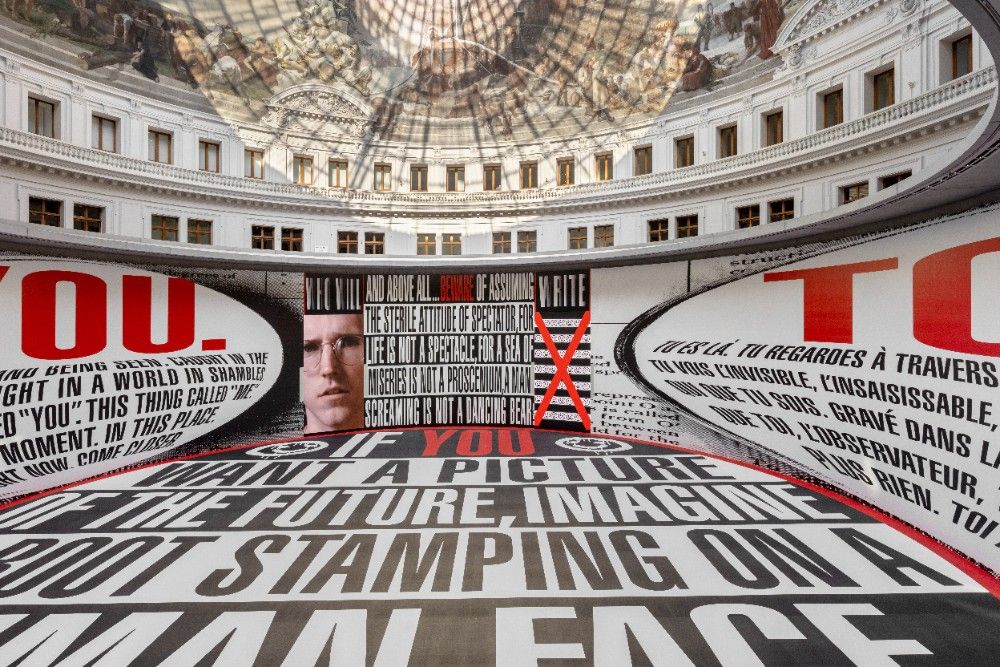
To celebrate the bicentenary of the invention of photography, the Pinault Collection presents a major group exhibition at the Bourse de Commerce, bringing together some 700 works by more than 70 artists. Spanning historical photography and contemporary image-making—from Gustave Le Gray to Cindy Sherman, Dorothea Lange to Wolfgang Tillmans, along with Man Ray and Louise Lawler—the exhibition embraces the full breadth of the medium. Rejecting strict chronology in favor of a more fluid, asynchronous structure, the exhibition traces the evolution of aesthetics and techniques across two centuries. It borrows its title from a work by Barbara Kruger, who also takes over the Rotunda in her largest presentation in France to date. Folding image, text and architecture into one of her characteristically confrontational environments, she turns the building itself into a field of address, probing how language shapes memory and the construction of the self.u003cbru003eu003cbru003e
Courtesy Pinault Collection
Thomas Houseago x Théo Mercier
- u003cstrongu003eReiffers Initiatives Foundation u003cbru003eThrough December 12, 2026u003c/strongu003e
Thomas Houseago and Théo Mercier each explore the expressive possibilities of the non-finito: form left in process, transitional and suspended in a liminal state, able to inhabit several temporal and spatial dimensions at once—hovering between a relic of the past and a new, alien entity emerging from a speculative future. Born of Reiffers Initiatives’ 2026 Mentorship Program, the exhibition unites the two artists in a shared exercise of world-building that grapples with ruin, transformation, globalization and obsolescence. In the weeks leading up to the opening, Houseago turned the upper floor into a studio, creating new sculptures now shown alongside recent works, including a monumental bronze owl and one of his celebrated masks. Mercier, a French sculptor and stage director, turns the ground floor into a hauntingly seductive, shape-shifting world, with an accumulation of sculptural presences and narratives that mirrors the way he reimagines forms in his own mind.u003cbru003e
© Jonas Unger © Kunstgiesserei St. Gallen
Kennedy Yanko’s u0022Ce qui nous rassembleu0022
- u003cstrongu003e Cité de l’Architecture et du Patrimoineu003cbru003eThrough January 3, 2027u003c/strongu003e
u003cbru003eKennedy Yanko’s practice has always been deeply concerned with transformation. In her work, found scrap metal—mechanical relics from heavy vehicles—fuses with skins of paint molded into veil-like forms. Through rupture, manipulation, layering, mending and reconfiguration, she plays with the particulate structure of matter to tease out the latent expressive and alchemical potential of these salvaged materials. Curated by Matthieu Poirier, the exhibition puts her work in dialogue with France’s architectural history. A new series of salvaged-metal and paint-skin sculptures appears among casts from churches and cathedrals across France, staging the timeless tension between earthly bonds and the desire for transcendence. Drawing on her religious upbringing and explorations of mysticism, sacred sexuality, Mary Magdalene and female spiritual authority, Yanko considers how desire, devotion and intuition inform the act of making.
© Kennedy Yanko
Yu Nishimura’s u0022Towards a Seau0022
- u003cstrongu003eLafayette Anticipationsu003cbru003eThrough January 3, 2027 u003c/strongu003e
After a stellar year in which he u003ca href=u0022https://observer.com/2025/05/artist-yu-nishimura-joins-david-zwirner-gallery/u0022u003ejoined David Zwirner’s rosteru003c/au003e and set new auction records, most recently u003ca href=u0022https://observer.com/2026/05/auction-news-sothebys-433-million-contemporary-evening-auction-new-york/u0022u003e$998,400 for u003cemu003eLeaves carpetu003c/emu003e (2017) at Sotheby’s New York in May 2026u003c/au003e, Japanese painter Yu Nishimura receives his long-deserved first institutional show in Paris. The exhibition focuses on his contemplative, poetic explorations of landscape as a space inhabited by presences and often bordered by the sea. His hazy, dreamlike, lyrical canvases are animated by a singular ability to reveal the beauty of the ordinary, dwelling with imagination on the mysterious, complex nature of beings and things. Transcending direct physical experience, his paintings are spaces of quiet psychological depth, marked by a universality that taps into the unconscious, archetypal essence of life.
Courtesy the artist, and Crèvecœur, Paris. Photo: Alex Kostromin
Ibrahim Mahama’s u0022The Harvest Seasonu0022
- u003cstrongu003eFondation Cartieru003c/strongu003eu003cbru003eu003cstrongu003eThrough February 28, 2027u003c/strongu003e
In his most ambitious presentation in France to date and his first institutional solo exhibition in Paris, Ibrahim Mahama takes over the entirety of Fondation Cartier’s new building, transforming it into a living ecosystem of relations and exchanges between individuals and between humans and nature. Extending the model of u003ca href=u0022https://observer.com/2024/09/interview-ibrahim-mahama-artist-white-cube-exhibition/u0022u003ethe art centers he founded in northern Ghanau003c/au003e, the exhibition embraces collaboration, featuring nine artists and collectives connected to the Ghanaian art scene with whom Mahama has longstanding relationships: Dorothy Akpene Amenuke, Gideon Appah, James Barnor, the Cercle d’Art des Travailleurs de Plantation Congolaise (CATPC), Courage Dzidula Kpodo, Postbox Ghana, Zohra Opoku, Tjaša Rener and Feda Wardak. Among the installations is his acclaimed u003cemu003eParliament of Ghostsu003c/emu003e, which serves as the stage for an extensive program of events that turns Fondation Cartier into a civic laboratory. Mahama also unveils his latest monumental work, u003cemu003eThings Fall Apartu003c/emu003e, which reconstructs a former glass factory—a major industrial project of the postcolonial era, later abandoned and now symbolically revived.
DHANUJ PHOTOGRAPHY | Courtesy of the Kochi Biennale Foundation.
u003cbru003eDaisuke Fukunaga’s u0022Waiting as Time Shiftsu0022
- u003cstrongu003eGalerie Crévencoeuru003cbru003eThrough November 28, 2026u003c/strongu003e
Having brought Yu Nishimura to wider international attention, Crèvecœur now debuts fellow Japanese painter Daisuke Fukunaga with a solo show timed to Art Basel. Fukunaga’s paintings emerge from an exercise in attuning to a different rhythm of the world: one of attention and contemplation rather than the accelerated pace of contemporary life. Working primarily from memory and sketches, he is drawn to the quiet theatricality of everyday experience and the extraordinary hidden within the mundane. His figures are often absorbed in forms of labor, yet it is less the gestures of production than the intervals between them that hold his interest: a pause, a walk, a moment of contemplation, a period of waiting. In these suspended moments, as the world’s cadence loosens, objects, landscapes and ordinary presences regain a heightened visibility. u003cbru003e
Courtesy of the artist, Tomio Koyama Gallery and Crèvecœur, Paris
Lee Bae’s u0022Attendingu0022
- u003cstrongu003ePerrotinu003cbru003eThrough December 19, 2026u003c/strongu003e
Building on the u003ca href=u0022https://observer.com/2024/08/artist-lee-bae-venice-la-maison-de-la-lune-brulee/u0022u003esteady demand for Lee Bae’s worku003c/au003e, Perrotin devotes one of its most prominent slots of the year to an extensive exhibition of the South Korean artist. Applying the aesthetic and philosophical approach of Dansaekhwa (“monochrome painting”) to his contemporary practice, Lee treats charcoal as both material and metaphor for the continuous processes of transformation that shape our lives. Beyond abstraction, his practice centers on charcoal’s alchemical nature: wood turned to carbon by fire, matter reduced to an elemental state yet still capable of reflecting light. Lee has described charcoal as the “final form” of matter, and his process reinforces that sense of metamorphosis—the wood is slowly carbonized in a kiln for roughly two weeks, then cooled for another two. The result is a material that reads as black but holds a surprising range of tones, from warm and soft to dense, reflective blacks.u003cbru003e
Courtesy the artist and Perrotin
Lee Krasner’s u0022Works from the 60su0022
- u003cstrongu003eGagosianu003cbru003eThrough December 18, 2026u003c/strongu003e
Timed to the much-anticipated Lee Krasner/Jackson Pollock show at the Metropolitan Museum of Art in New York, Gagosian stages a focused presentation in Paris of Krasner beyond her role as wife of the Abstract Expressionist hero whose reputation long overshadowed hers. The first solo exhibition of Krasner’s work in France, the show was organized with Olney Gleason and the Pollock-Krasner Foundation. Centered on her work from the 1960s, it illuminates Krasner’s standing as one of the most versatile and daring painters of the New York School. Dividing her time between Springs, in East Hampton, and her Manhattan apartment and studio, she entered an intense period of reinvention during this period, tackling canvases of unprecedented scale, increasingly lyrical compositions and more restricted palettes. Her experimentation gave rise to the Umber paintings (1959-62) and the u003cemu003ePrimary Seriesu003c/emu003e of the 1960s, now considered among her best work.
© 2026 Pollock-Krasner Foundation/Artists Rights Society (ARS), New York. Photo: Christopher Stach, courtesy Olney Gleason, New York
Kerry James Marshall and Simone Fattal at MAM
- u003cstrongu003eMusée d’Art Moderne de Parisu003cbru003eThrough January 24, 2027u003c/strongu003e
On the strength of its programming, the Musée d’Art Moderne de Paris has in recent years become an anchor of the city’s art scene. Currently, it’s showing a sweeping survey of work by Kerry James Marshall, organized by the Royal Academy of Arts in London in collaboration with the Kunsthaus Zürich. Featuring 70 pieces, including eight new paintings, the exhibition traces the evolution of Marshall’s storytelling as he chronicles Black communities in the U.S., filling historical gaps with monumental canvases that raise ordinary experience to the level of the epic. Drawing on both the Western art-historical canon and popular culture, Marshall addresses the Middle Passage and the legacies of the civil rights and Black Power movements without directly depicting violence or alienation. Running concurrently is a major exhibition dedicated to Lebanese American artist Simone Fattal. Bringing together around 100 works, the show spans more than 50 years of her practice, from early landscape paintings to ceramics and collages. Organized thematically rather than chronologically, it invites visitors to trace the recurring concerns in a remarkably diverse body of work.
© Kerry James Marshall Courtesy de l'artiste et Jack Shainman Gallery, New York Photo: M. Sean Pathasema