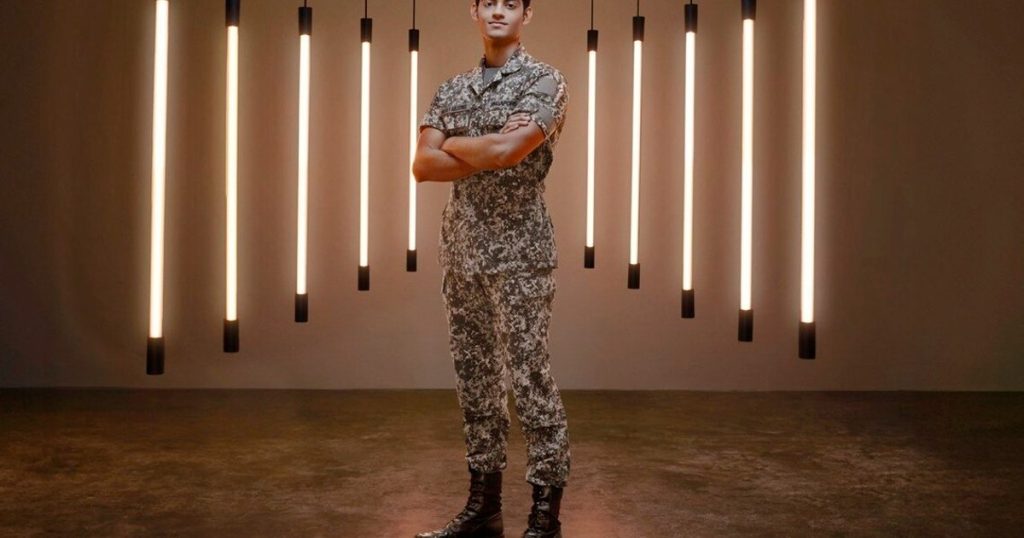
SAF scholar swaps the cockpit for military intelligence
When Military Expert 4 Apprentice Florian Ableitner first thought of joining the armed forces, he was convinced he was going to be a pilot.
Much of that certainty came from his time at the Singapore Youth Flying Club, where several of his instructors were former Republic of Singapore Air Force (RSAF) fighter pilots.
In and out of the cockpit, they would share stories from their flying days – of operating at speed, keeping track of what was happening around them and staying alert to potential threats.
For Ableitner, it offered an early glimpse of what a career in the Air Force could look like. And for a while, he expected to follow a similar path.
Then, at Officer Cadet School, another side of defence caught his attention. Recruiters from what was then the Command, Control, Communications, Computers and Intelligence (C4I) community spoke about work where the challenge was not flying an aircraft, but making sense of a security picture that could change in real time.
Being awarded the SAF Merit Scholarship in 2022, Ableitner (back row, third from left) marked the start of a path that would take him from aerospace engineering at Nanyang Technological University (NTU) into military intelligence.
“The situation never really stays still,” he says. “The picture changes daily, sometimes hourly, and the job is to keep analysing that shifting data and turning it into intelligence that decision-makers can act on.”
He was also intrigued by how emerging technologies such as drones and artificial intelligence were changing both the nature of warfare and the way information was gathered and analysed.
The combination of technology, analysis and a constantly evolving security environment gave him a different way to imagine his future in the armed forces.
Instead of following his instructors into the RSAF, Ableitner joined the C4I community, which would later become the Digital and Intelligence Service (DIS), and took up the Singapore Armed Forces (SAF) Merit Scholarship in 2022 to study aerospace engineering at Nanyang Technological University.
Learning how AI and drones change modern warfare
Before starting his degree, Ableitner was posted to the SAF Computer Vision Unit, where he worked with a team improving visual-recognition algorithms used to detect, identify and locate potential objects of interest more quickly and accurately.
It was his first opportunity to see how technology could help turn raw information into something useful for intelligence work.
At university, he began exploring the same idea from another angle: not just how machines could interpret what they saw, but how they could be made to act on their own.
For his final-year project, Ableitner and his teammates built a swarm of three autonomous drones from scratch. His main role was programming the drones to work out their own flight paths, including how to navigate around obstacles without human control.
“It is a different kind of flying,” he says. “Instead of reacting to the environment from the cockpit, you are designing rules the aircraft follows before it even takes off.”
On a computer, those rules could be tested under controlled conditions. The real test came when the team took them out to fly.
Wind, signal interference and even the air being pushed back towards a drone when it flew close to the ground could cause the aircraft to behave differently from the simulations. Suddenly, a flight path that worked neatly on screen did not always translate into a smooth flight.
Ableitner and his teammates had to redesign parts of the system and build in redundancies so the drones could cope with unpredictable real-world conditions without veering off course or crashing.
The experience taught Ableitner that technology rarely behaves exactly as expected once it leaves a controlled environment. That lesson has become increasingly relevant as warfare grows more data-driven, automated and dependent on systems that have to perform under uncertain real-world conditions.
For his final-year project at NTU, Ableitner (centre) and his teammates built three autonomous drones that could plot their own flight paths and avoid obstacles.
PHOTO: COURTESY OF FLORIAN ABLEITNER
After graduating earlier this year, Ableitner returned to the DIS, where he is now undergoing training to become a senior military intelligence expert with the Joint Intelligence Command (JIC). The JIC provides the Ministry of Defence and the SAF with intelligence for decision-making and early warning.
His training is focused on developing his analytical skills and deepening his understanding of the regional security environment before he is assigned to a formation.
Those earlier experiences with computer vision and autonomous drones also changed the way Ableitner thinks about where an advantage in modern warfare can come from. Increasingly, it is not just what a military can see, but how quickly it can make sense of that information and act on it.
AI, in particular, stands out to him for its ability to speed up this process of “sensemaking”.
“Warfare operates on a cycle: seeing, understanding, then acting,” he explains. “The side that can turn raw data into a decision in seconds rather than minutes has a real edge.”
Military intelligence in an uncertain digital battlefield
Warfare has also changed in another fundamental way: The battlefield itself has expanded into the digital domain, where the boundaries are far less clear. The army defends Singapore on land; the air force safeguards its skies; the navy protects its waterways.
But what about the digital space? “Much of it is still unexplored or unknown to us,” he says. “There are a lot of uncertainties and ambiguities in this space, so we are constantly thinking of what warfare is going to look like in the next five, 10 years.”
His posting to the SAF Computer Vision Unit before university gave Ableitner (standing, far left) an early look at how visual-recognition technology could support intelligence work.
PHOTO: COURTESY OF FLORIAN ABLEITNER
The uncertainty is not just about the technology or where threats might come from.
Ableitner points out that while international law applies in cyberspace, there is no single binding treaty covering every possible cyber incident. This can make the appropriate response less clear, particularly when an attack involves a state or non-state actor.
“So the question becomes: how do you operate in a space where the principles exist, but the practical rules of engagement are not always clear?” he asks.
To him, that uncertainty is part of what makes the field of military intelligence exciting. He is an aerospace engineer, after all – someone trained to solve problems where some variables are unknown and assumptions do not always hold once they encounter the real world.
It also brings him back to a lesson from his drone experiments.
“You can plan for every scenario you can think of, but the ones that get you are the ones you did not think of,” he says.
“So you have to stay curious and be comfortable about not having all the answers upfront. And that mindset is what I think this field demands.”
Explore the defence career pathways opened up by the SAF Merit Scholarship.