Labor Minister’s resignation deals a blow to Merz
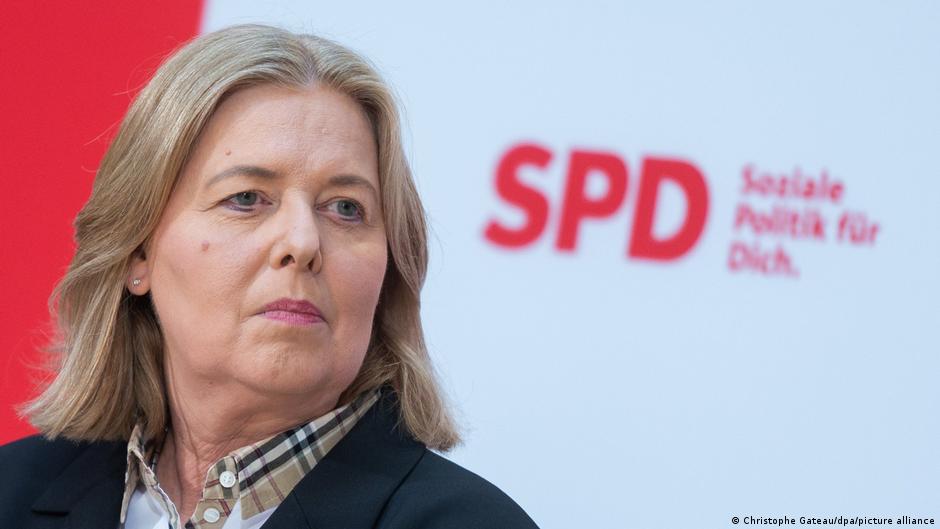
The week kicked off with a bang: On Monday morning, Bärbel Bas announced her resignation as Labor Minister and as Co-Chair of the center-left Social Democratic Party (SPD). “Following the death of my stepdaughter, I realized that I need time to come to terms with my grief,” Bärbel Bas wrote in a personal statement to party members.
However, she also cited “the public attacks against me — unfortunately, including some from within the ranks of our coalition partner” as reasons for her resignation. In fact, the pressure on Bas increased significantly in recent days. The centrist coalition government is urgently awaiting key legislative proposals from the Ministry of Labor.
Before the summer recess in July, a commission had already presented comprehensive proposals for reforming Germany’s statutory pension system. The coalition partners of SPD and the center-right Christian Democratic Union and Christian Social Union (CDU/CSU) wanted these proposals to be quickly turned into legislation. To date, however, no finalized drafts have been presented.
There had been calls for Bas’ resignation
“The minister is no longer tenable. For months, she has been blocking the reforms our country so urgently needs,” railed Christian von Stetten, head of the CDU/CSU parliamentary group’s caucus representing medium-sized enterprises, said in reference to Bas in September.
In early October, such criticism was echoed by CDU Economy Minister Katherina Reiche, who demanded that the pension reform be passed by the end of the year. Bas had to submit the bill “promptly,” Reiche said, although it was known at the time what a difficult personal situation her cabinet colleague was in at the time.
SPD co-leader, Finance Minister and Vice-Chancellor Lars Klingbeil reacted sharply on Monday, saying the political attacks against Bas had been “disgraceful.” Following a meeting of the SPD leadership, he told journalists in Berlin: “This poisons the political discourse, and — in the interest of preserving our political culture — I hope that everyone will take a step back and reflect on what has actually happened over the past few weeks.” He called on all centrist politicians to be careful “that we don’t destroy the good people in politics by attacking one another.”
Such accusations carry significant weight at a time when the coalition is already mired in a deep crisis.
Adding to this is the new vacancy at the top of the SPD. Without Bas, Klingbeil will lead the SPD alone. A party convention will be scheduled for December or January to elect new leadership for the Social Democrats. It is not certain whether Klingbeil will run again. He received a very poor result during his last reelection as party leader.
Swift replacement of Labor Minister
Alexander Schweitzer is to succeed Bärbel Bas as Federal Minister of Labor. The former state premier of the state of Rhineland-Palatinate had previously served as that state’s Minister of Labor and Social Affairs. Chancellor Friedrich Merz expressed confidence that Schweitzer’s experience would ensure ” good cooperation within the federal government,” adding that he hoped that the pending legislative proposals “will now be quickly approved by the cabinet and can be introduced into the parliamentary process.”
The chancellor refuted the accusations leveled by Bas, saying that he had never discussed personal matters with her. Friedrich Merz said he had explicitly advised Bas to take the time she needed to grieve.
Merz promises change
Mistrust between the coalition partners has increased significantly, with SPD lawmakers speaking of an increasingly toxic political climate.
For months, the CDU and SPD have been grappling with low poll numbers, disappointing election results, and disputes over key reform projects. Plans for changes to the electricity tax, the introduction of a sugar tax, the pension and the labor market reform — hardly any initiative has been able to proceed without public controversy.
Adding to this is the crisis within the chancellor’s party, the CDU, which saw a historic election defeat in the eastern state of Mecklenburg-Western Pomerania in September, when it even lost representation in a state parliament for the first time in history.
On Sunday and Monday, the party leadership met for a closed-door session to discuss the way forward.
They produced a four-page document which indicated a shift in priorities, putting more emphasis on social issues: affordable housing, lower electricity prices, better health care, and greater respect for citizens’ lifetime achievements are mentioned in the paper. This is seen as a response to criticism that the CDU had been focusing too much on economic and regulatory issues.
The chancellor admitted that voters feel that politicians are not taking their hardships and fears of social decline seriously enough. “We have to work our way out of this slump — and get out of a crisis of confidence,” Merz said. “You can’t just reinvent a party overnight over a weekend, but we want to show that we’re ready for change… and we have to be, given the election results.”
The chancellor announced that he would lower the electricity tax for everyone — a promise he had made before the general election in 2025 but had not kept.
With the closed-door meeting paper, the CDU is also sending a signal to the SPD. Instead of a programmatic shift further to the right, it is emphasizing its traditional social values — a stance that resonates well within the Social Democrats.
The chancellor made an effort to emphasize his intention to continue with the current coalition government: “The personnel changes will not call into question the basis of the coalition agreement.” He then repeated what he had recently said during a visit to Ukraine: “We need a stable federal government right now in order to remain capable of acting on the international stage.”
Both CDU/CSU and SPD know that calling early elections could primarily benefit the far-right Alternative for Germany (AfD), which is leading in the polls nationwide. So despite the deep rifts, Klingbeil and Merz currently see no alternative to their coalition.
This article was originally published in German.