Cynthia Erivo Says Intimacy Coordinators Don’t Get ‘Enough Credit’
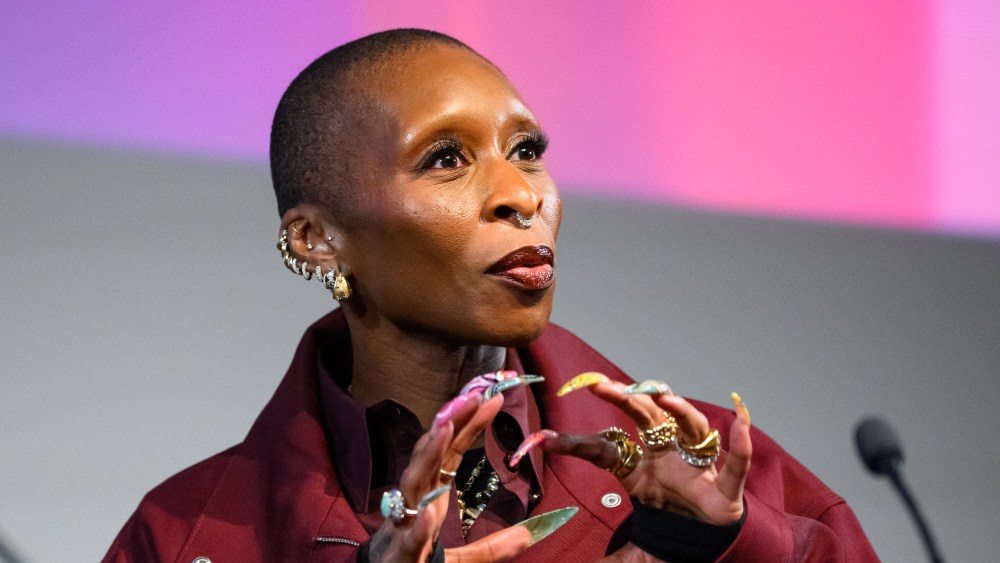
Cynthia Erivo spoke candidly about the importance of working with an intimacy coordinator on her new movie “Prima Facie” at a London Film Festival screen talk on Monday, saying that often “not enough credit is given” to them.
In her first film role post “Wicked,” Erivo leads “Prima Facie” as Tessa Ensler, a successful defense lawyer who finds herself at the center of a trial when she is sexually assaulted by a colleague. Based on Suzie Miller’s acclaimed stage play, the film premiered last month at Toronto Film Festival and has its U.K. debut at London Film Fest on Tuesday.
Erivo said she “knew immediately” that she wanted to sign on to the film, which she also produced. “I just had this feeling that it was more important than I was even aware of and I wanted to be apart of it,” she said.
She readily admitted that the intense legal drama was “really hard” to film, especially the scene involving the assault. This is where the film’s intimacy coordinator, Lizzy Talbot, came in.
“Lizzy, our intimacy coordinator, was really helpful with creating a space that felt very safe,” Erivo said. “I had to understand what it was like to be in your body but not there, so finding what that looked like for me, where you’re there but you have to check out to stay safe. And that was the thing that we had to figure out — how to do that and come back safely.”
She continued, “A lot of this was really hard to film, but the hardest thing was actually coming back from filming it. Getting your feet back on the ground, getting back into your body and finding the safest place again.”
Erivo said that she and Daniel Ings, who plays the lawyer who assaults Tessa, had many discussions about how to handle the scene in a way that made them both feel safe.
“He from the beginning was very, very kind and immediately wanted to have a conversation about how we could be protective of one another, and how we could be helpful in those moments so that we could go as far as we needed to go and then come back again,” she said.
“I think not enough credit is given to intimacy coordinators and they’re often given a hard time for the work they have to do on a set,” Erivo added, earning applause in the room. “But the work that they do is incredibly important. And it isn’t just about choreographing a sex scene, a love scene, it’s sometimes about how to not just choreograph these really hard, harrowing scenes, but make sure everyone comes back to their bodies safely.”
Erivo said she hopes the film sparks a wider conversation about consent, as well as about how Black women are often overlooked when it comes to discussions about sexual assault.
“We already have preconceived notions about how Black women, particularly, experience pain. And so what this does is it puts us in the eye of the beholder — we’re sort of front and center to have the discussion of what it looks like when this happens to us as well. It’s more often than you would realize, more than we discuss at all. It’s often not reported,” Erivo said. “Rarely do you see films where a Black woman has experienced this in this way, and I think now we can have a conversation about that as a whole because we’re often left out of that conversation.”
Of course, Erivo also spoke a bit about both “Wicked” films, the first of which earned her an Oscar nomination for her performance as Elphaba, who she said she “so loved playing.” When asked about how she first got into the character, Erivo said she sought to find the similarities between them.
“I know that the two of us are very different. I know that the two of us have strange relationships with fathers. I know that the two of us can get frustrated and can be stubborn. I know that the two of us also have a joy in us that no one really realizes and hasn’t been able to see. I knew all those things and I could start from there,” she said. “But I also knew, I’m not trying to make her different, but just trying to make her as true as possible. So when the words are on the page, how would I say them so that they mean something? So that they are connected to me, not connected to her or how I’ve heard them said before.”
She added, “The more I started to understand who this person was, I realized that, I think for a lot of people it’s like, ‘Oh, the green girl. The makeup is on.’ But for me it was like, no this is her DNA, this is the way she was born.”
As for what’s next for Erivo, she teased that it could be time for her villain era.
“I keep saying I’m in my villain era and it keeps coming up,” she said with a laugh. “I want to find those stories where we get to see faces that are different in leading roles that are complicated and not necessarily the hero, but are gritty and in the gray area and fun to play. I think I’m sort of seeking them out for myself, and I want to seek them out for other people.”