A day in detention with Neha Bora
Of the Rahul Gandhi-led opposition coalition, she said people are now looking towards it. “When communal venom, caste politics, and brutality against women and gender minorities are being unleashed on people, the opposition has to act.”
Ultimately, AISA hopes the CJP and the political opposition will help put up a united front. “Wouldn’t it be such a force to tackle if we all came together?” she said.
Arriving at the detention centre
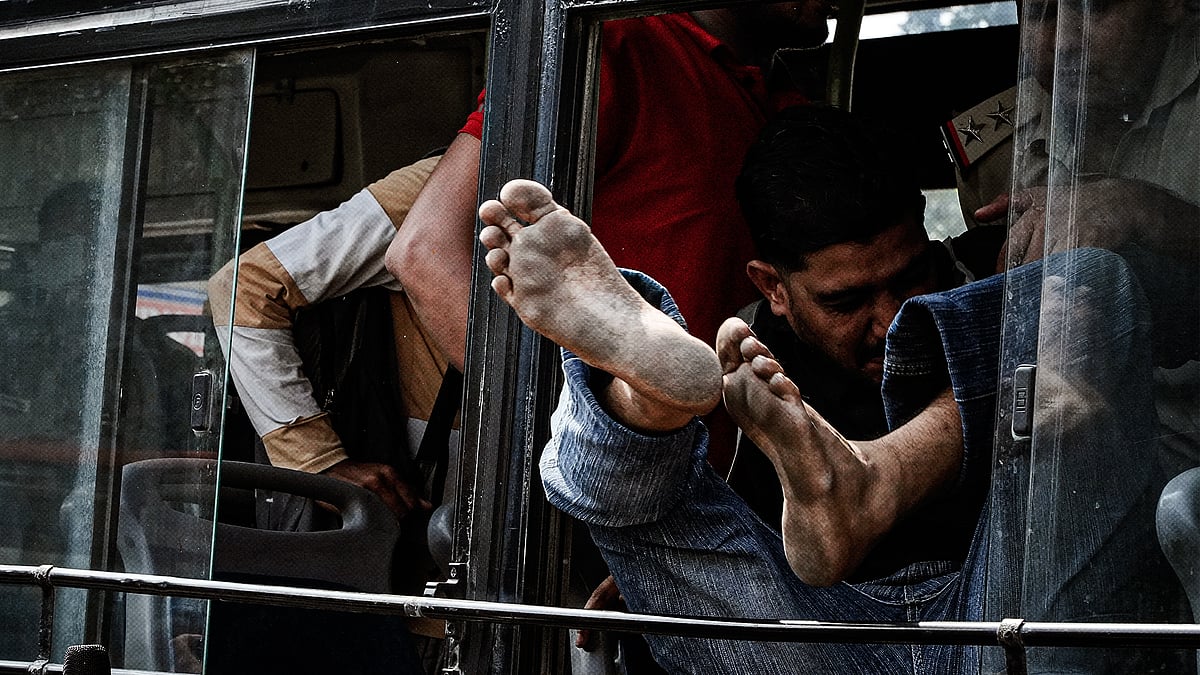
After about an hour, the bus stopped at a police station in the city’s outskirts. The signboard outside read ‘Chhawla Police Station, Delhi’. But no one was made to get off. Fifteen minutes later, the bus was on the move.
Another 30 minutes later, it stopped again, this time outside a large community hall. Close to 30 police and CRPF personnel were already there. With almost no phone signal, the detainees could not identify the location.
The bus doors were opened, and the men and women were asked to step out one by one. One of the protesters asked a CRPF official where we were. “Ask the police. We don’t know either. We’ve been posted here from outside,” the official replied.
A table, clothed in white and decked with blue frills like at a buffet, had been set up to take down each protester’s details: name, father’s name, phone number and address.
By 4.30 pm, every protester had been led into the hall through the large metal grille gate at its entrance.
The interiors had high ceilings, and there were green carpets laid out in rows. It looked like a banquet hall. Sixteen women and fifteen men, including the minors, were put inside, and the gates were latched from outside.
Even as the protesters calmly cooperated in giving their details, the police gave no information, written or verbal, about where they were being held, and no explanation for why they had been detained. No one, including the minors, was asked whether they were injured or whether they needed to make a phone call or notify a lawyer — all rights of a person under detention.
The only question the police asked was whether anyone needed to use the washroom. If so, a constable would be assigned to take them and bring them back.
Everyone found a corner, laid out their bags and lay down to rest for a while. “It’s going to be a few hours now,” said Neha as she lay down too, scrolling on her phone.
A few minutes later, she sat up and burst into laughter.
On social media, reports that Neha had strategically deceived the police to reach central Delhi were going viral. Videos and reports titled “How Neha Bora Tricked the Police with a Doppelgänger” showed a woman in a grey T-shirt, black pants and a red scarf being mistaken for Neha at RK Ashram. About twenty police personnel were seen forming a chain around the woman and dragging her into a bus.
But she was not Neha, only a lookalike.
The lookalike had even wound up at the same detention centre. The two took a photo together, and Neha immediately issued a humorous clarification on Instagram: “Not a strategy but simple coincidence.”
The hours go by
Aside from AISA activists, regular protesters who had been detained were busy reassuring their families that they were safe.
Momina, a 23-year-old, was walking along a street in Connaught Place with her elderly father when security personnel began dragging them both away.
“We just came to see the protest. We were simply standing there when they suddenly pulled us. I kept holding on to my father, but they dragged us apart,” she said.
This is not Momina’s first protest. She had also taken part in the 2019 agitation against the Citizenship (Amendment) Act (CAA). She was detained then too, she said, but recalled that everyone had been detained together and the police had only nudged them.
In another corner, Luci was busy telling her friends where she was. This was her third protest. The first two, she said, were against the 2026 Transgender Persons (Protection of Rights) Amendment Bill.
Today, she said, she was out on the street because “I have no rights in this country. Things are just getting more regressive now.”
It is clear that the protests on the street are about a lot more than the SIR. AISA is very aware of this.
“Yes, we might be articulating this through vote chori (vote theft) and the undemocratic decision by the CEC, but look around us. This is also a hopeful juncture in Indian democracy, where people are no longer afraid to come out on the street, despite being beaten up and detained.”