
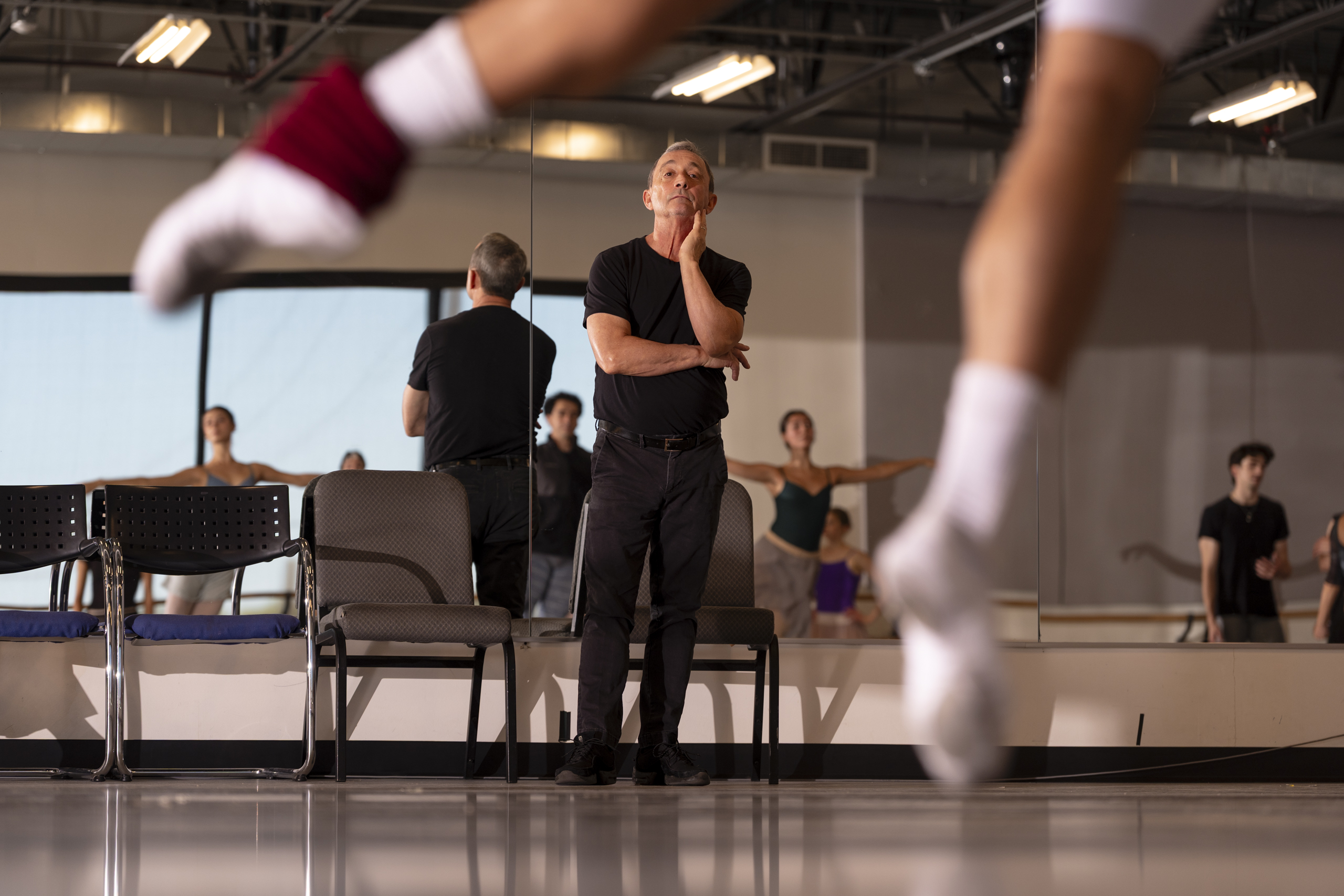
Colorado Ballet’s 20-year survival tale includes begging, borrowing and grit
Driving into Denver from the airport for a job interview with the Colorado Ballet, Sandra Brown looked at the flat, bleak winter landscape and said to her husband, Gil Boggs, “Please tell me it gets green in the spring.”
“I have no idea,” said Boggs, who in January 2006 was the prime candidate to become the company’s artistic director.
The two had been accomplished dancers with American Ballet Theater in New York City and were lifelong East Coasters. Now they were being asked to take over a debt-ridden ballet company out West.
The Colorado Ballet’s story — the struggle to survive — is one that it shares with the city’s other major classical arts companies, the Colorado Symphony and Opera Colorado.
The Colorado Symphony was born out of the bankruptcy of the Denver Symphony, but even the new version suffered a $1.2 million deficit in 2011 and had to cancel concerts. Opera Colorado for years has been on a teeter-totter between being in the red and the black.
This story first appeared in Colorado Sunday, a premium magazine newsletter for members.
Over next 20 years, Boggs and Brown would steer the Colorado Ballet through recession and pandemic, paying off debts, increasing the number of dancers, pushing to enhance the quality of productions and tripling its budget.
In 2025, the ballet company posted a $220,000 surplus on a $17.4 million budget, according to tax filings. It has a $15 million endowment and, on a percentage basis, covered more of its 2025 costs through ticket sales — $10.4 million — than either the orchestra or the opera.
However, in the winter of 2006 prospects looked grim.. The previous year had been rocky, with a wave of executive and board resignations culminating with the acrimonious firing of the company’s long-time artistic director Martin Fredmann.
The company also owed money all over town, an estimated $700,000, and was being sued by choreographer Christopher Wheeldon for breach of contract when it was unable to raise the $1 million for his “Alice in Wonderland” ballet.
“The board at the time was pretty sure that nobody would apply for the job,” said Holly Baroway, a retired dancer turned financial advisor, who was a member of the search committee for a new artistic director.
“I had to laugh,” Baroway said. “I told them, you know, there’s about 70 to 80 dancers who retire every year with nowhere to go.”
Boggs, however, had left American Ballet Theater six years earlier, and was the events manager and director of the golf academy at Chelsea Piers, a major sports and recreation venue in Manhattan.
A former American Ballet Theater executive living in Denver called Boggs and asked if he’d be interested in the Colorado Ballet job. Boggs tossed his hat in the ring with about 40 other candidates.
Boggs had a strong resume with a 17-year career with American Ballet Theater, or ABT, including 15 years as a soloist and principal dancer. He had performed with the Twyla Tharp Dance Company, Baryshnikov and Company, and Nureyev and Friends.
Brown was a bonus. She had trained at the American School of Ballet, the feeder to the New York City Ballet before jumping to ABT where she had a 16-year career dancing as well as appearing on Broadway.
Ironically, it was Boggs’ time at Chelsea Piers handling staff and a $2.5 million budget, as much as his years on the stage, that appealed to the search committee.
“We had some people that were interviewing had these just hugely lofty artistic goals, bringing in all these European choreographers,” Baroway said. “We were looking for somebody that had some other practical experience, who understood that you couldn’t just spend money that you don’t have.”
Boggs, she said, “came in with a really realistic view, and again had had some business experience, understood budgets.”
Boggs and Brown appeared at their January 2006 interview with their 3-month-old son in tow. “It was an exciting time,” Brown said. “We were building our vision of dance, building a family.”
When Boggs took over the company it had 27 dancers, a $6 million budget and debts to the city and to Kroenke Sports & Entertainment, which had stepped in to manage business, marketing and ticketing when the company was facing bankruptcy in 2002.
“One of my first meetings was with Denver Arts and Venues, and the director there said, ‘You owe the city a lot of money. What are you going to do about it?’” Boggs said. The company owed the city about $147,000 in rent and fees.
In his second year the budget was nudged up to $7 million “Then all of a sudden, the recession hit, and we had to cut it to $5.5 million,” Boggs said.
The 2009 season ended with a $500,000 deficit. In 2010 the season was trimmed to four productions from five.
On stage it was a battle to put on quality ballets. “We couldn’t afford to bring in stagers or choreographers so we had to do it ourselves,” Brown said.
Boggs, Brown, rehearsal director Lorita Travaglia and Maria Mosina, who was a principal dancer and is now a rehearsal director, collaborated on a colorful version of “Don Quixote,” which was reprised as this season’s opener.
“We wanted to bring whatever we knew from American Ballet Theater, but do it ourselves,” Brown said.
Begging and borrowing
The first time Boggs staged “Romeo and Juliet” was through a bit of charity. “The former artistic director of the Louisville Ballet, Alun Jones, basically gave me the ballet,” Boggs said, and waived the license fees.
There was also a lot of begging. “We had to beg people to be on the board,” Baroway said. “We had to beg creditors and the city.” Even the dancers in contract negotiations begged to go easy.
One creditor who was unmoved was the city, which insisted the company pay in advance to get into the Ellie Caulkins Opera House and required it hold in reserve all ticket revenues related to future performances at the opera house and not use the money to pay for current expenses.
“We didn’t want to run the risk that people who’ve bought a ticket for a show in our venue would not be able to get a refund if, for example, the ballet runs into more serious financial difficulties,” Jack Finlaw, director of the city’s Division of Theatres and Arenas, said at the time.
There were 2 a.m. phone calls and weekend morning crisis meetings. One board member suggested the company follow the route of the orchestra: declare bankruptcy and reorganize.
“We just refused to let that happen.” Baroway said. “We had a couple of really special board members who wrote some checks and just kind of kept things going.”
At one Saturday morning meeting, a recommendation was made to cut the orchestra. “If we don’t have live music, I have to leave, Gil said,” Baroway recalled. “He was just so committed to having quality productions no matter what.”
Proof of new life
By 2012 things were turning around and Boggs made a move to show the company’s growing strength.
Each year the company does one repertory program, called MasterWorks, where the dancers get to perform the ballets of some of the great contemporary choreographers — Twyla Tharp, George Balanchine, Jiri Kylian, Lar Lubovitch. They call it their bucket list ballets.
The problem was not many people came to see it. Boggs moved the program from the opera house to the smaller Newman Center for the Performing Arts at the University of Denver, where a 700-person audience would not get lost in a sea of empty seats. They also used recorded music.
Now Boggs proposed that for composer Igor Stravinsky’s 100th anniversary the company perform Glen Tetley’s “Rite of Spring” in MasterWorks repertory, with a full orchestra at the opera house.
The last production of the previous season had been “Peter Pan,” which brought in $800,000. When the board asked what kind of gate to expect from “Rite of Spring,” Boggs said about a third of “Peter Pan.” They went ahead anyway.
At the other end of the spectrum sits the ballet “Dracula,” which may be the most performed work. “Every time we do it, it sells out,” Boggs.
“Dracula” is the Colorado Ballet’s answer to the 1975 cult classic “Rocky Horror Picture Show.”
“One opening night a woman in the audience just shouted ‘It’s back!’” Boggs said.
New life in a new home
In 2015, the company moved into its new headquarters, the $6.5 million Armstrong Center for Dance. This enabled the company to expand its academy teaching ballet. It now serves 1,200 students and is a vital source of income.
The company began to take on new and bigger productions like its 2019. $1.1 million “Wizard of Oz,” which it co-produced with the Kansas City Ballet and the Royal Winnipeg Ballet, and is being performed again in March.
Tickets sales were setting records each year. “We were just paying down our debts very slowly, renegotiating things, and really focusing on ticket pricing and fundraising,” Baroway said.
Then the pandemic hit in 2020, turning off the lights in theaters across the county. The word came down March 13 that the city’s performing arts center was closing indefinitely.
Boggs met with his dancers that afternoon and “heartbrokenly” told them the season was over, the production MasterWorks would not be performed.
“Walking out of this building, I literally thought, we were done, that it was over. We’d never come back,” Boggs said. No revenue. No work for dancers, who really have to keep training. No audience.
Ironically, at least financially, the pandemic was something of a boon.
“We went into COVID with zero debt,” Baroway said, “and we had no expenses.”
Then the federal government COVID relief fund kicked in. The ballet — carrying a full company of dancers so it was eligible for the Paycheck Protection Program — received a total of nearly $6.4 million in federal backing over two years.
“They were able to continue to pay the dancers through their contracts that following year, and keep the staff,” Baroway said.
The company also received a $5 million donor gift to jump start its endowment fund.
“We came out of COVID stronger financially than the company had ever been,” Baroway said.
In 2025, the Colorado Ballet had $17.6 million in revenue with $10.4 million in ticket sales, $6.5 million in contributions and the rest coming from investments. In all, the company had $16.8 million in assets, according to tax filings.
A rejuvenated Colorado Ballet now draws in an estimated 100,000 theatergoers across 60 performances.
The company has grown to 43 dancers and it offers them a wellness program with physical therapists, massage therapists, a Pilates instructor and a trainer. “We want our dancers to thrive,” said Brown, the company’s ballet master.
Beyond the stage and into the community
And the ballet extends beyond the stage. In addition to the academy, the company’s education and community engagement department provides workshops, classes, assembly performances and residencies, where instruction is offered for a week.
“When we started in about 2000, we were in one school and there was one person,” said Emily Herrin, the department director. “Now we’re in about 173 schools, or about 200 different sites, including libraries and older adult facilities.”
There are now five full-time staffers and up to 15 part-time dance instructors.
The department has a dance program for children in Warren Village, which serves unstably housed, low-income single-parent families, and an adaptive dance class, Be Beautiful Be Yourself, for children with Down syndrome and other disabilities.
In addition, the department provides ballet performances online to another 150 sites in Colorado, as well as two free performances of the Nutcracker for students from Title I schools (where at least 40% of the children are from low-income families).
Herrin estimates that the department’s programming reaches an average of 17,000 people in person annually and some 25,000 online.
“Our whole effort is just increasing access to dance education … saying that dance is not just this art form that lives on the stage,” Herrin said.
Back on stage, Boggs said his goal moving forward is to stay relevant by diversifying, bringing works beyond the classical cannon, such as “Jekyll and Hyde,” “The Great Gatsby” and “Lady of the Camellias.” (And of course there is always “Dracula.”)
“We are also trying to diversify our audience, but there is a lot of work to do,” he said. For “Don Quixote” the ballet partnered with the Mexican Cultural Center with a free educational talk, Heroes del Ballet, before one of the matinees.
The company has also initiated free and pay-what-you-can programs for tickets. The free Bridge to Ballet is for schools, nonprofits and community organizations. The pay-what-you-can program makes tickets available for selected performances with patrons setting their own price.
In January, however, the company will return to the canon with “Romeo and Juliet.” Back in 2011, the company performed a hand-me-down version of the ballet, but in a sign of the change in fortune this time Colorado Ballet is mounting a nearly $200,000 production of John Cranko’s story of the star-crossed lovers.
Cranko, was one of the 20th century’s leading choreographers and, until his death, the artistic director of the Stuttgart Ballet.
Before the Colorado Ballet could even buy the license for the work, the John Cranko Trust sent an adjudicator from Germany to decide whether the company was competent to dance the ballet.
“They decided, OK, yes, you have the dancers that can make this happen,” Boggs said, “but it is very expensive.”
Back in 2005 when the company was on its knees and the search committee was interviewing prospective artistic directors some came with what seemed grand and unrealistic visions of bringing great European productions to Denver.
Well, it turned out not to be so improbable. It just took Boggs 20 years.