Why Malayalam daily Madhyamam employees are protesting
Employees at Madhyamam, a prominent Malayalam daily, have re-ignited their agitations against prolonged salary delays. After internal pressure did not improve matters, employees had staged a public protest last year. As their grievances allegedly remain unresolved, employees have held a sustained protest since September 3.
They have also accused the management of forcing them to give up permanent employment and come back to the same jobs as contract workers for lesser pay.
Close to 200 permanent staff members, with work experiences of 12 to 39 years, allege that they have not been paid regular salaries in the last eight months. The management has cited a financial crisis, they say.
They further allege that to be paid regularly, management has given them the sole option of becoming contract workers for lower salaries.
Despite several rounds of talks between the Kerala Union of Working Journalists (KUWJ), both current and former labour ministers, employee representatives and management, no acceptable resolution has been reached, union leaders say.
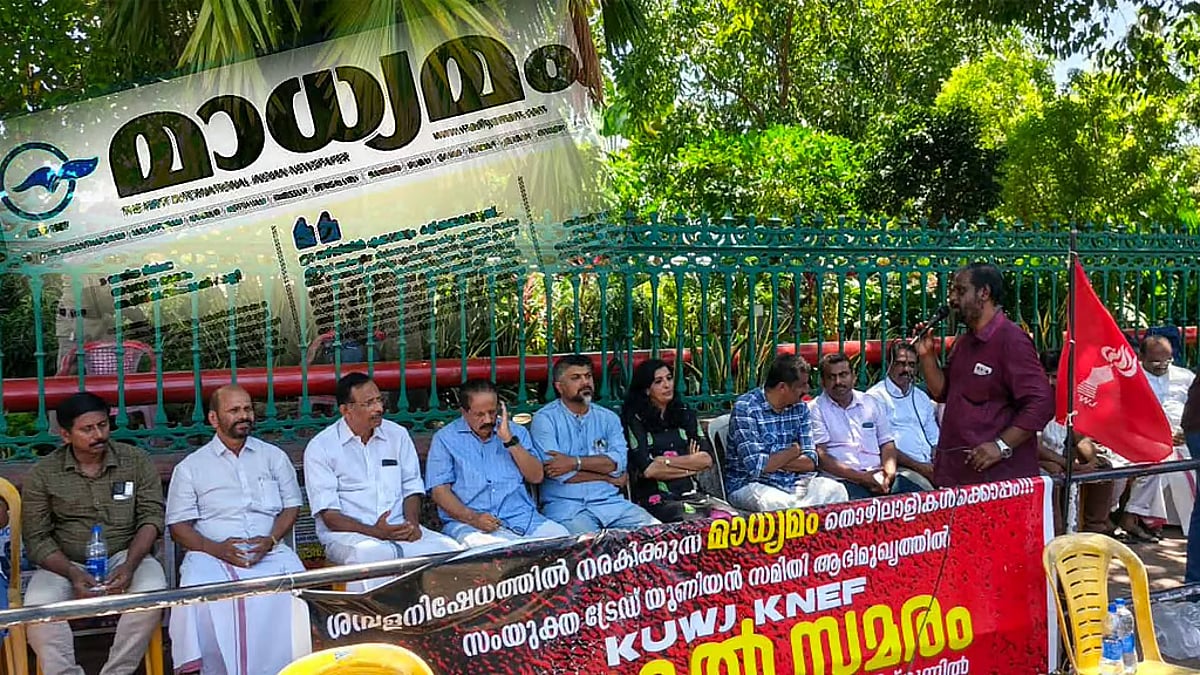
On September 29, employees held a day-and-night protest in front of the Keralam Secretariat in Thiruvananthapuram. The protest was jointly organised by the Kerala Union of Working Journalists (KUWJ) and the Kerala Newspaper Employees’ Federation (KNEF), backed by 12 national and state trade unions.
Leader of Opposition Pinarayi Vijayan inaugurated the demonstration and urged the state government to intervene.
Salary delays
Madhyamam is a popular Malayalam newspaper founded in 1987 in Kozhikode and is run by the Ideal Publications Trust. They are considered the fourth largest circulated newspaper in Kerala and the largest circulated Asian daily in the Gulf.
According to employees, salary delays began during the 2019 COVID-19 pandemic and persist until now. After protesting internally for years, they have made their grievances public, employees said.
“We used to wear badges and observe a black day, boycott meetings and conduct walk-outs. We’d even raise a few slogans,” recalled M Firoskhan, news editor and president, Madhyamam Journalists Union.
Later, the financial strain allegedly worsened significantly. In 2025, the salary delay led to widespread employee unrest and a series of public agitations.
Firoskhan added, “When we say that salaries are not being paid, it does not mean that we’re not being paid at all. For instance, the salary for January was paid only in July in instalments. This makes managing their daily lives a challenge for workers.”
The protesting employees aren’t strictly on strike. They’ve instead been taking scheduled breaks from work to sit in at the protest.
“It’s the same protesting workers who have also been producing the newspaper for the past eight months. We are all passionate journalists who want to continue our work. At the same time, it’s important to give a proper salary on time for the work we are doing here,” said Firoz.
Contract work
Employees say the only solution offered by management is to become contract workers for lower pay. Further, management has allegedly promised to settle dues and timely salary payments once current employees come back as contract workers.
Roughly 200 employees have now agreed to become contract workers. Employees said that severe financial hardship forced them to comply. “Despite the reduced pay, once we become a contract employee, the salary will be paid regularly each month,” an employee said.
A sub-editor with 12 years of experience has had his salary reduced to Rs 40,000 from Rs 51,000 after agreeing to return as a contract worker. “I used to put my PF balance into moving forward with life, but now the funds are almost over,” he said.
Many are also worried about job security, as the contract is valid only for a year with no assurance that it will be renewed in the following year.
But around 200 employees are also resisting the move to contract-based work, as they will lose other employment benefits.
Pointing out that he has 33 years of experience at Madhyamam, Firoz said, “Once we are shifted to contract-based employment, they can cut other benefits, including leaves and holidays. More importantly, people will be afraid to organise, form a union, or demand their rights. We believe that is the real reason behind what they are doing. We don’t believe the financial crisis is the only reason.”
Employees are also upset about losing other benefits like gratuity and pensions. They are legally entitled to the Employees’ Pension Scheme (EPS) and EPF benefits, which they will lose if they are contract workers, the Madhyamam union said.
The union added that if the management wants to lay off employees due to a financial crisis, they can do so after giving compensation. They also asked how salaries for contract workers are being paid on time and how the management is promising to also pay the arrears if there is a financial crisis.
KP Reji, the State President of the Kerala Union of Working Journalists (KUWJ), added, “There is no point in talking about a financial crisis, because contract employees are being paid their salaries properly. So, there is money to pay one group, but supposedly no money to pay another group?”
Reji also said that no media organisation in Kerala has shifted permanent employees to contract work. “New recruitments may be made on a contract basis, but existing permanent employees are not being shifted to contract employment,” Reji added.
Wage board
As Reji says, Madhyamam is not the only newspaper to hire contract workers. The concern for Madhyamam employees is that they are being forced to give up permanent positions at this time and accept contract work at a lower pay for the same job.
According to senior journalists in Kerala, many Malayalam media outlets, including prominent newspapers, shifted to contract work in the early 2000s.
This became a more prominent trend after the statutory Majithia Wage Board was established based on a Supreme Court order. The board typically functions as a government body that decides wages and hikes for employees in both the private and public sectors. Senior journalists also say that contract work usually comes with better salaries than what Madhyamam is offering.
The Wage Board cost-push mandated wage hikes for certain categories, along with retroactive arrears.
This led to many Malayalam newspapers actively discouraging permanent hires. They increasingly pushed new hires and even existing staff to move from permanent payrolls to fixed-term contract employment. As Wage Board regulations primarily protect permanent journalists and non-journalists under the Working Journalists Act, contract workers fall outside these mandated pay brackets.
TNM tried reaching out to Madhyamam for comments but did not receive any response.
This report was first published by The News Minute. Become a joint subscriber here.