
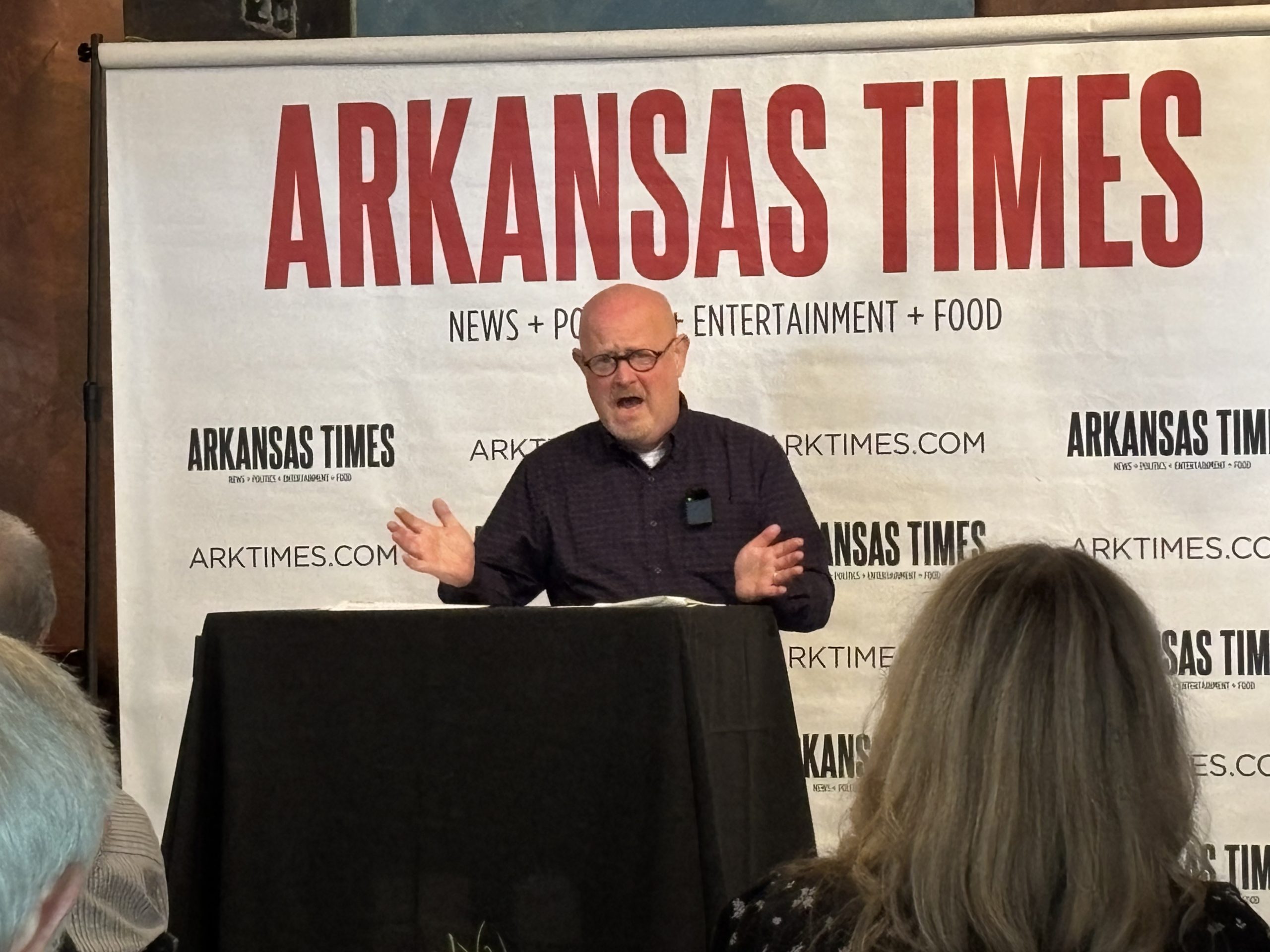
Politico Jay Barth makes his Nov. 3 predictions
Jay Barth may himself be a Democrat, but when it comes to analyzing cold, hard poll numbers and pegging the guys who suffer from what he kindly calls “candidate quality gaps,” Barth does not sugarcoat.
A trusted expert on all things political, from local to national levels, Barth provided a vibe check on the results we might expect to see November 3 during Thursday’s Arkansas Times Lunch Lecture series. A blue wave will indeed wash across this great nation, Barth predicted, but he was less sanguine about that blue wave cooling off red-hot Arkansas.
A former professor at Hendrix College and past director of the William J. Clinton Presidential Library, Barth is also a longtime columnist for the Arkansas Times. You can read his commentary monthly in our print magazine and online, but we highly recommend watching the political science professor in person if you get the chance. His enthusiasm for the subject sees him popping out from behind the lectern to pace and gesticulate, sometimes even unclipping his wrap-around reader glasses that join magnetically at the bridge of the nose to make more solid eye contact with his audience.
Here are Barth’s hottest takes as we start down the homestretch to Election Day.
A flipped U.S. House
“We can be quite confident Democrats will take control of the House,” Barth predicted. The only question is the size of that victory. Republicans currently hold 219 seats to Democrats’ 214. Barth said he believes Republicans will find themselves with only 200 seats after the election, while Democrats will claim 235.
What’s interesting here, Barth said, is “the failure of mid-decade redistricting,” that energetic show of gamemanship, encouraged by President Donald Trump, that saw Republican states redrawing their congressional districts in an attempt to further cement conservative domination. Some Democratic states, most notably California, clapped back by redrawing their own lines.
What Republicans, especially those in Florida and Texas, didn’t anticipate, Barth said, was the wholesale flip-flop of Latino voters who largely went red for Trump in 2024 but who polling shows have since changed their minds completely. Economics, not immigration, is behind the switch, Barth said.
When parties in power wield redistricting as a political tool to stay on top, it’s bad news, regardless of which party is doing it, Barth said. He pointed to California, where only four of the state’s 52 congressional districts now lean Republican.
One reason congressional Republican candidates will struggle this year, even in districts freshly redrawn to favor them, is the “red undertow,” a phenomenon describing the way Republicans in absolute power in D.C., with control of the White House and both houses of Congress, have failed to such a degree that even their tried and true supporters aren’t jazzed enough to go out and vote for them this go-round.
What about Arkansas, where all six members of the delegation are Republican? All eyes are on District 2, where incumbent French Hill is having to break a soggy sweat in his race against Democratic challenger Chris Jones. This is the Arkansas race to watch, Barth said.
Hill enjoys the benefit of a 2021 Republican-led gerrymander that added more conservative white voters to the district and split up reliably blue-voting Pulaski County among three separate districts. That well-curated recalibration saved Hill from having to work this hard in his 2024 race against Democrat Marcus Jones. But polls show Chris Jones, who enjoys broader name recognition thanks to an unsuccessful 2022 race for governor, is threatening to close the gap. He’s brought in national starpower including Mayor Pete Buttigieg and Joe Kennedy III to stump for him, and former Vice President Kamala Harris sent her regards.
Meanwhile, Hill just this week accepted $1 million from a cryptocurrency super PAC, a cash influx he may regret, Barth said.
A banker who recently helped roll back Biden-era overdraft protections for banking customers short on cash, Hill’s elitist tendencies blister more when the average voter is feeling the crunch of the affordability crisis that crypto bros scoff at.
Still, Chris Jones has a big job ahead of him. Fellow Democrat Marcus Jones pulled 41% of the vote against Hill in 2024. “Can Chris Jones pick up 9 points?” Barth asked. We’ll see.
A shift in the U.S. Senate
Barth noted a lot of “candidate quality gaps” in these races across the country. That’s his nice way of saying that a lot of these candidates lack charisma, good policy and/or a good track record. And in 2026, most of the gaps favor Democrats.
“I can never remember an election cycle where one party had such an advantage in terms of the quality of the candidates who were being offered, and at a minimum, you know, in most races, kind of nothing special on the Republican side, or in some cases, as in Texas, something very special but not very good,” Barth said.
In Alaska, for example, Mary Peltola is “just a good fit for that state in terms of her background, in terms of her culture, she just kind of speaks the language,” Barth said. She shines even against incumbent Republican Dan Sullivan.
“He’s not a bad candidate. He’s not been a bad U.S. senator for that state, but she is so much better,” Barth said.
Adam Hamilton of Kansas, a Methodist preacher, is another Democratic Senate hopeful making waves in a red state.
And here we’ve got Hallie Shoffner, the fresh-faced former farmer who’s running a traditional Arkansas-style campaign. Barth asked the audience of roughly 40 admittedly politically-minded Arkansans how many of them have met Shoffner in person. All but one hand raised. What about incumbent Sen. Tom Cotton, who’s represented Arkansas in D.C. for 14 years? Nobody had met him except former U.S. Rep. Vic Snyder, although Arkansas Times Managing Editor Byron Tate said he did once see Cotton in an airport.
Polling shows that Cotton, who’s remained in step with Trump on pretty much everything except daylight savings time, has suffered in popularity as Trump’s own numbers dipped.
Shoffner, on the other hand, is coming up roses, per Barth’s assessment.
“Hallie Schoffner has a monster candidate quality gap to her advantage,” Barth said. She is an incredibly good candidate. She is, I think, a political celebrity very quickly, partly driven by the fact that she’s run a traditional Arkansas campaign where she just goes everywhere.”
Barth compared Shoffner’s social media prowess to that of New York City Mayor Zohran Mamdani, and said her backstory, about a struggling family farm eventually lost, is a compelling one.
Contrast Shoffner to Cotton, and it’s not pretty.
“Tom Cotton is not a good candidate, and Tom Cotton has never been a compelling political figure,” Barth said. “He doesn’t have anything that makes him stand out. He’s super smart. He cares deeply about foreign affairs, but he doesn’t really stand out as an Arkansas candidate. But on the other hand, there is a monster money gap in this race, and there was a monster money gap when this campaign started.”
Perhaps surprisingly, and certainly to the disappointment of many a reader, Barth suspects another Cotton win, largely because he has nearly limitless money to spend and a voter base that’s as Republican-leaning as you’ll find anywhere.
“I think it is really, really hard when you have that kind of funding advantage to lose a race in a state where your party also has some built-in advantages,” Barth said.
‘A very embarrassing race’
The formula Gov. Sarah Sanders has long followed, to see what issues are polling with the MAGA base and then lean in, is not the path Barth would have recommended had she asked his advice, he said.
Her campaign commercials targeting non-existent transgender athletes, Alexandria Ocasio-Cortez and a welfare leech named Brad have little to do with Arkansas.
“I think that Sarah Sanders has run a very embarrassing race,” Barth said. Regardless, “She’s going to win this race comfortably,” despite challenges from Democratic state lawmaker Fred Love and Libertarian Franklin County prison opponent Colt Shelby.
The Arkansas Legislature
A Republican supermajority has long dominated the statehouse, and Democrats need six more seats to break the stranglehold on the House end. Barth said he’s following a number of races in Central and Northwest Arkansas and the Delta. He wrote about those races in August.
He noted that Republicans are picking up their spending in a number of races where competition is perhaps fiercer than it’s been in years past. Incumbent Republican state Rep. Steve Unger of Springdale has a solid challenger in Democrat Jamie Atkinson, Barth said, and Gov. Sanders’ PAC is throwing some money to North Little Rock, where Democrat Alex Holladay recently won what had been a Republican-held state House seat and is now trying to hold on to it.
A small but meaningful shift at Little Rock City Hall
The Little Rock Board of Directors is famously entrenched, with members tending to stick around, often for decades. This year, though, at least two chairs will change hands. Longtime Director B.J. Wyrick is making what Barth predicts will be an unsuccessful run for mayor, meaning a newcomer will take her seat. And Director Ken Richardson, who’s been absent from board meetings for literally years now, is not seeking reelection. The newcomers could shift the balance of power at City Hall in Mayor Frank Scott Jr.’s favor, Barth said. (Scott was in the audience, but we think Barth was being genuine here and not just flattering his mayor.)
“The mayor really may have a more solid governing majority than he’s had. He’s always had kind of a messiness in terms of his interaction with the city board,” Barth said, referring to breakdowns that have often cracked along racial, generational and ideological lines. “He’s had to work really hard on things. This would be building a majority, and so I think that for the folks who who say OK, the mayor should really be evaluated on his performance, this will be a better chance than has been the case in the past to evaluate him because he will have a much better chance of getting his agenda through.”
Source link