
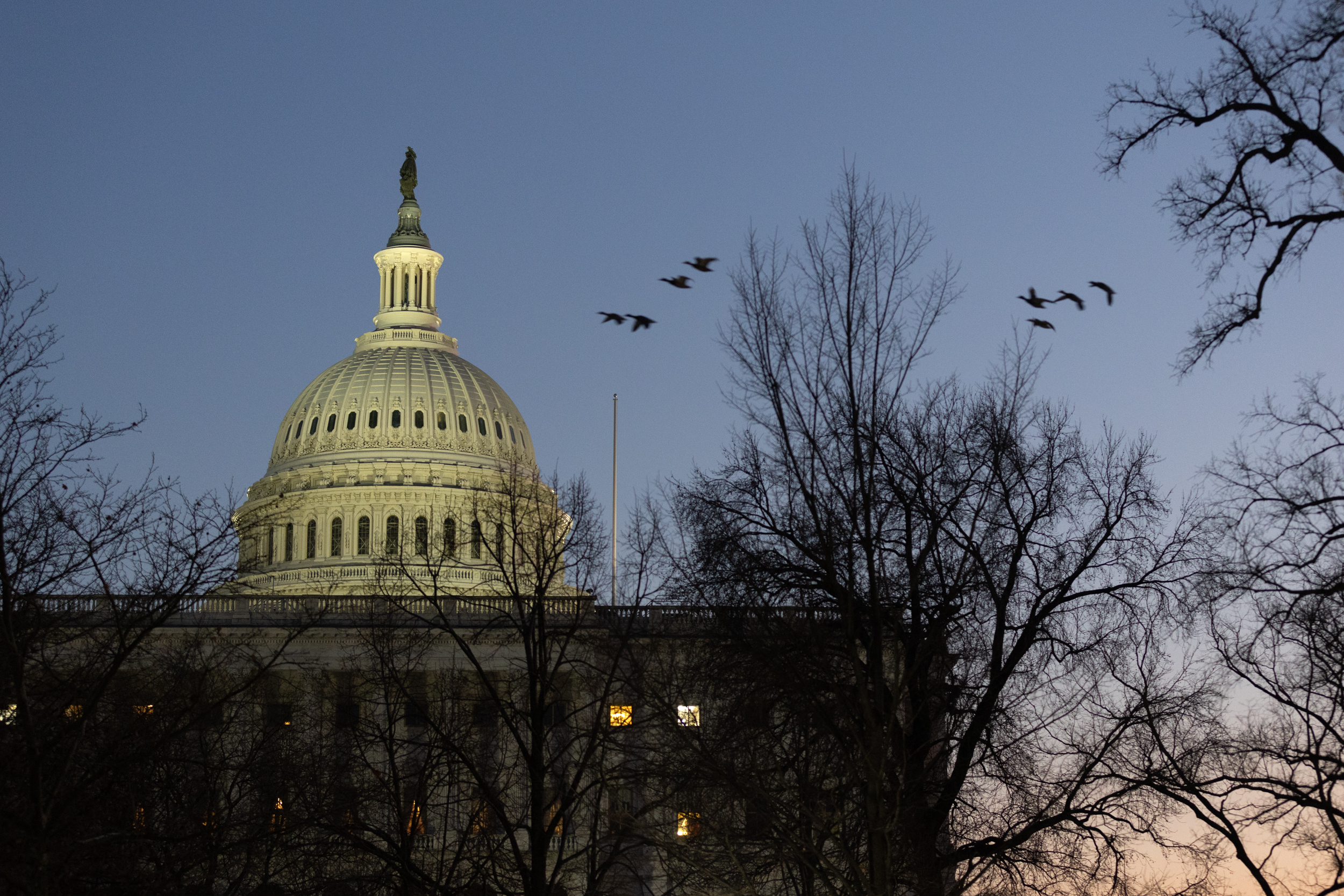
With eye on gavels, CT Dems envision oversight if they win majority
They first need to win their own reelection races — and their party needs to gain control nationwide — but members of Connecticut’s delegation are starting to sketch out what Democrats’ possible return to power could look like from some of the highest echelons in Congress.
If both of those scenarios happen, nearly all of the Democrats in the delegation will vie for the top spot on their committees, giving Connecticut’s delegation the potential for outsized influence in the new session of Congress next year.
Democrats are looking to take back the House and the Senate, though the odds look better in the former. While uncertainty remains, that hasn’t stopped Connecticut Democrats from giving early previews of how they envision their potential roles as leaders of committees.
And there’s a common theme in all those plans: oversight of the Trump administration.
“Connecticut, for a really small delegation, we’re going to punch well above our weight, and most of that is due to Rosa DeLauro’s likely appropriations chairmanship,” U.S. Rep. Jim Himes, D-4th District, said. “Rosa’s role there, Joe Courtney’s role on Armed Services, my role on Intelligence — from the standpoint of the power of the purse, I think is going to be really powerful check and balance.”
Some of these high-ranking positions wouldn’t be new for Connecticut’s House members. DeLauro, D-3rd District, was previously chairwoman of the Appropriations Committee and has served as the ranking member since 2023 when Republicans took back the majority.
Courtney, D-2nd District, has also served in both the majority and minority on the Seapower and Projection Forces Subcommittee. And Himes ascended the leadership ladder on the House Intelligence Committee, becoming ranking member in 2023. All three have maintained productive working relationships with the GOP chairs of their respective committees and subcommittees.
This time, U.S. Rep. Jahana Hayes, D-5th District, will make a foray into running for leadership, on the House Committee on Education and the Workforce. She’s mounting a challenge in what’s becoming a crowded race for either the gavel or ranking member.
Pursuit of the gavel
As a fixture on the Appropriations Committee, DeLauro sits on an influential panel that crafts spending bills, allocates money and funds the government.
Her current role as the Democratic ranking member comes at a time when there has been a major strain between the executive and legislative branch regarding federal funding. The power of the purse resides with Congress, but the White House, led by Russell Vought at the Office of Management and Budget, has sought to claw some of that back, whether through rescissions or the impoundment of appropriated money.
DeLauro, 83, said she doesn’t take either race for granted and currently doesn’t face any challengers for the chair. But in her potential quest for the gavel, she hopes to restore education and job opportunities that could help address the higher cost of living and restore her committee’s authority on grants and other funding.
“I want to, as I have done in the past, continue to use the appropriations committee as the way to look at how in fact we address this affordability issue, how we put money back into people’s pockets, how we provide the services in all of the areas that have a real effect on their economic security and their lives,” DeLauro said.
She also works on the defense budget that could top $1.5 trillion, based on the request by the Trump administration at a time when the war in Iran has stretched into its eighth month. DeLauro acknowledged the dependence of the defense industry and contractors on Connecticut’s budget but said she’d want to work on improving funding for domestic programs and social services.
“Understanding that Connecticut is a defense-dependent state, I vote for the defense budget,” DeLauro said. “I deal with helicopters, engines, submarines, but I want to address the balance between what we are spending for education and health and transportation and housing, etc., with what we are spending with regard to defense.”
DeLauro also envisions handling some oversight “in my lane” by taking a look at where federal dollars are flowing and whether some money “has been transferred illegally.”
“It won’t be frivolous, and I don’t want to take on anybody else’s jurisdiction,” she said, “but as it has to do with taxpayer dollars and the use of taxpayer dollars.”
Unlike most of Congress’ committees, Himes, 60, serves on one of the more secretive panels because of the confidential nature of intelligence matters.
His job as ranking member places him in the “Gang of Eight,” a group of the Republican and Democratic leaders in the House and Senate plus the chairs and ranking members of both intelligence committees. Because of that, he typically gets a heads-up on major military actions, though that wasn’t the case with Venezuela and Iran.
The House Permanent Select Committee on Intelligence has oversight over U.S. intelligence agencies as well as some issues concerning the Pentagon and other government agencies. As a potential chairman, Himes previewed oversight as a main objective.
“What I can talk about is an effort we’re going to make to try to shine a light on some of the entities who have bent a knee to Donald Trump’s demands,” Himes said, referring to law firms, universities and corporations that do business with the intelligence community. “We’re going to shine a light on instances where contractors and others did the administration’s bidding, either illegally or, if not illegally, at least in ways that raise pretty ugly conflicts of interest.”
Himes has already issued warnings to defense companies about cooperating with congressional oversight, specifically on a potential investigation into corporate donations for the construction of the White House ballroom. But if he gets the chance to become chair, he said, he’s cognizant he’ll need some amount of buy-in from Republicans during such a polarized time.
“I think it’s really important that our oversight efforts appeal beyond just the Democratic Party,” Himes said. “That people really understand why what we’re doing is important for the country and the health of the country rather than for Democrats who may be very angry at Donald Trump.”
Courtney’s work on the Seapower Subcommittee has a lot of crossover with the defense industries that power much of Connecticut’s workforce and economy.
Some of his focuses will be on the Department of the Navy, submarine programs, and the AUKUS agreement between the U.S., U.K. and Australia that will have to meet deadlines on the delivery of Virginia-class submarines.
“I think oversight of this administration is obviously going to be very strong in general with some of the executive orders and different actions that the president has taken,” Courtney said. “But I think we have our work to do too in Seapower, as far as making sure that the right investments are being made to deal with what’s happening out there in the world.”
Courtney, 73, also see opportunities for oversight, whether that’s on the Air Force One plane gifted by Qatar as well as the White House’s battleship proposal. He also believes oversight over the war in Iran and U.S. Secretary of Defense Pete Hegseth’s tenure will be “front and center” for the full House Armed Services Committee.
“That’s another one we would be looking at in terms of making sure it’s the property of the government and not an individual,” Courtney said, regarding Air Force One.
Hayes, meanwhile, would be a newcomer to leadership on the House Education and the Workforce Committee.
She recently threw her hat into the race to lead the panel for Democrats. So far, Hayes and Oregon Rep. Suzanne Bonamici are challenging the current top Democrat on the panel, U.S. Rep. Bobby Scott of Virginia.
Education is one of her top priorities, especially as a former teacher in Waterbury. She currently serves as ranking member of the House Agriculture’s Subcommittee on Nutrition and Foreign Agriculture.
Hayes, 53, didn’t offer details about what that could look like because of her reelection race in the 5th Congressional District against Republican Chris Shea. The sprawling district in the western part of the state is viewed as Connecticut’s most competitive seat at the federal level, compared to the races of her colleagues. This year, though, election analysts see it trending even more toward Democrats.
“I’m not commenting on a chair race because I am in a district where I have to win first,” Hayes said in a statement. “I have declared my intention to run for the top Democrat on the Committee of Education and Workforce and will shift my focus to that race after the Election Day.”
One loss in seniority for Connecticut’s delegation comes after U.S. Rep. John Larson’s defeat in the August Democratic primary for the 1st Congressional District. He lost a four-way primary amid calls for generational change.
Larson, 78, sought to leverage his seniority in his campaign, touting that if Democrats take back the House, he’d go back to holding the gavel of the Ways and Means Subcommittee on Social Security and get a vote on his bill to raise Social Security benefits, which has stalled for years. That will be a live issue in the next Congress after a recent report estimated that the retiree trust fund will dry up in the early 2030s.
Larson lost to former Hartford Mayor Luke Bronin, who’s favored to win the deep-blue district. Bronin faces Republican physician Amy Chai in the Nov. 3 general election.
The rest of the House delegation will also need to compete in the midterms to secure another term. Their Republican challengers — Chris Lancia running against DeLauro, Michael Goldstein challenging Himes, and George Austin looking to unseat Courtney — argue the Democrats’ work on committees hasn’t provided enough for Connecticut or has been a distraction as they focus on boosting their national profiles.
“I’d rather focus on things that are going to help the state of Connecticut,” Lancia said.
The view from the upper chamber
Taking the Senate will be a tougher feat for Democrats.
Democrats have been feeling more emboldened about retaking the Senate, though the map is more complicated than the House’s. Democrats will need a net gain of four seats to win the majority. That includes flipping GOP-held seats, some in deeper-red territory, while defending a few of their own vulnerable senators in tougher states.
Both of Connecticut’s U.S. senators currently hold minority leadership positions on some of their committees. Neither is up for reelection this year.
U.S. Sen. Richard Blumenthal said he’d hope to serve as chairman of the Homeland Security’s Permanent Subcommittee on Investigations — a role he previously held when Democrats were in the majority — and the Veterans’ Affairs Committee. He didn’t give a preview of what that work could look like if his party is in the majority.
“I’m not jinxing it,” Blumenthal said, adding that he’s “focused on electing Democrats, as many as possible, so we will be in the majority.”
But as the current ranking member on both of these committees, Blumenthal, 80, has already sought to wield some investigatory power, even from the minority, and without subpoena power. That includes a recent investigation into a cryptocurrency firm and a series of public forums on U.S. Immigration and Customs Enforcement’s practices.
U.S. Sen. Chris Murphy, meanwhile, currently serves as the top Democrat on the Senate Appropriations subcommittee that deals with funding for the U.S. Department of Homeland Security.
Funding for DHS got contentious over the last year, with Democrats pushing for any new money to be contingent on implementing ICE guardrails. The agency was in a record-long shutdown that ended in the spring.
But it’s unclear if Murphy, 53, would stay in that role or look to become chair if Democrats took back the Senate.
“I don’t know that I’d stay as DHS chair,” Murphy said. “I think there will be a lot of movement.”
Back to the majority?
A return to the majority in either chamber of Congress is not a guarantee, even with historical trends, polling and Trump’s sagging approval numbers.
And if Democrats have a good night on Nov. 3, it remains to be seen if it would be a “blue wave” election as it was for the party in the 2006 and 2018 midterms. There’s at least one unpredictable factor — redistricting — that could scramble the race for the House.
Plus, Republicans have a major money advantage over Democrats that’s expected to deluge the airwaves and other forms of media for the next four weeks.
And coming off of Democrats’ disastrous 2024 election that ushered in Republicans’ political trifecta the past two years — control of the White House, House and Senate — the party is still working to build back trust with voters.
While frustrations persist for some of Trump’s policies and decisions, Connecticut Democrats acknowledged voters still aren’t completely sold on their party’s brand. And they will need to use their time in the majority, if they get it, to reinforce that they’re paying attention to voters and try to quickly deliver on lower costs of health care, housing and other necessities — and not just being an anti-Trump vote.
DeLauro and Himes echoed an urgency that Democrats need to follow through on their rhetoric around affordability and balance that with their opposition to Trump and his actions.
“We’re not going to win because all of a sudden they have Kennedy-like inspiration about the Democrats,” Himes said. “The American people don’t much like the Democrats today. They despise what this president has done to their well-being.”
“If we ever win the presidency, we better implement those effing policies immediately,” he said about cost-of-living measures. “No more bullshit about rolling out stuff six years down the road, because that’s a recipe to get tossed right back in the minority.”
Constituents who are ideologically aligned with members of Connecticut’s delegation are pushing them to fight back against certain policies. Some want them to go even further, and that frustration at lawmakers and officials was palpable at a press conference following ICE’s operation in Danbury in August.
Even if Democrats are victorious in November, there’s a level of expectation-setting that Democrats say they’ll need to do, given limitations of being in the majority in either one or two chambers while Trump has another two years of veto power.
Beyond committee work, some of the priorities of the delegation include more work on the child tax credit, the renewal of the enhanced Affordable Care Act subsidies that expired last year, reauthorization of an apprenticeship law, lower costs of prescription drugs and more work on infrastructure.
DeLauro continues to point to the courts being a backstop, but she argues, “public outcry gets things changed.” She noted the quick reversal of the administration around $2 billion in federal grants focusing on mental health and substance abuse that were reinstated within 24 hours after their termination.
“What we have to do is to manage those expectations, because even if God’s in his heaven and all’s right with the world with this, it’s going to take some time to get things done,” she said. “It doesn’t happen automatically, and I’m saying that to people.”