Interview: Precious Okoyomon On Garden as Revolutions of Tenderness
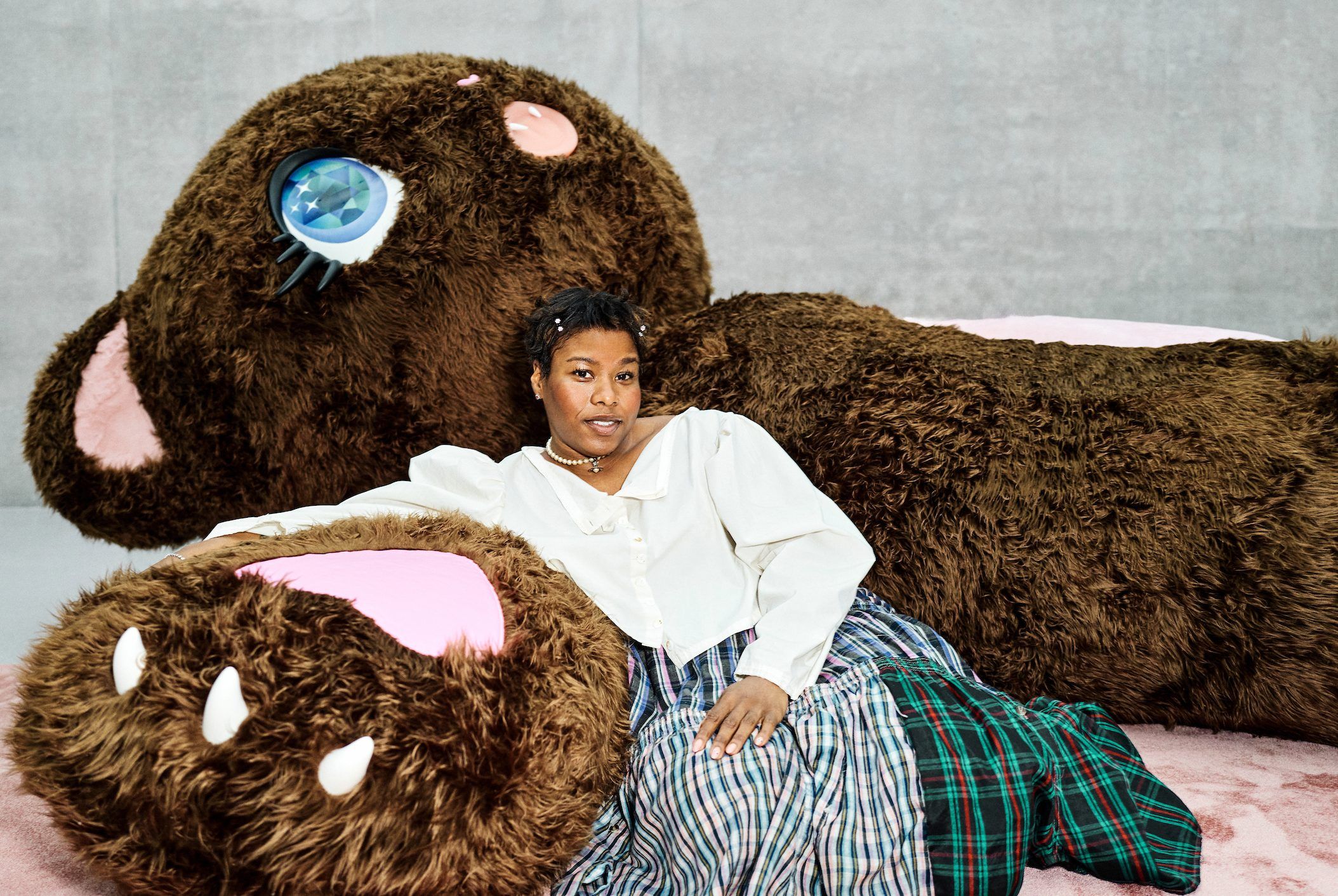
A garden of pollinators and perennials, twisting with native and invasive plants. A giant teddy bear slide inviting play. Resonant poetry competes with the sounds of the city. This is ‘Among The Flowers I Learned to Love: A Garden of Decreation,’ artist Precious Okoyomon’s MoMA PS1 courtyard commission. The artist, who uses they/them pronouns, comes from a lineage of matriarchal seed savers; they were introduced to plant life by their grandmother, who migrated from Nigeria to Texas to help care for them after their own migration with their mother. She arrived with seeds, and those seeds became her garden in a new place.
“The way she spent time with me was by having me take care of her garden,” Okoyomon tells Observer. They describe their grandmother’s character as stern, serious and headteacher-like, but in the garden, she could be tender. “My grandmother was the leader, and her garden was her kingdom. That’s where I learned how to tend, that was the only place she showed love.”
Okoyomon’s mother, who worked endless hours as a nurse, also made time to care for houseplants. This tenderness through gardening turned what began as a chore into a relationship with the natural world and a deep connection with ecological memory—the idea that nature holds cultural continuity that humans carry across displacement. “It taught me a different type of relationship to plants,” they say. “How to witness them, how to see them, how to carry things with love, and how important it is to save the memory of where you’re coming from.”
In Okoyomon’s work, plant life is not separate from human life. They are in synergy and synthesis. Weeds and other invasive species become synonymous with human migratory practices. Colonial and ecological histories are inextricable. They are affected by the same environmental conditions, the same societal prejudices, the same modalities to survive or thrive in new societies and new soil. “I’ve never been able to separate human extraction, environment, racism, capitalism, and industrial pollution from the oppression of the human.”
They want us to rethink and reframe our ideas around our relationship to nature, believing that the ecological revolution is part of the human cultivation of understanding. They cite the kudzu brought in from Japan to restore the soil after cotton overfarming, which failed and was cast as invasive: “So many of my favorite plants are invasive. Plants aren’t separate from colonial history. The earth remembers the things that we have done, and to have hubris that it doesn’t, is also part of the problem.”
These intersections also share a parallel with the artist’s practice. Sometimes ideas and questions yield poems, installations, sonic compositions, drawings or reimagined objects. Their creative world is borderless, with forms bleeding into each other, and what underpins the philosophy of this practice is an insatiable hunger for play: “I am porous about trying new things and being around new people. Sometimes the poem needs to be a meal, and sometimes the meal needs to be a garden, sometimes you’ve got to eat the flowers, then we’re back at the table again. Sometimes flowers weren’t enough, so we need to go back to language. The hunger is endless, and everything blurs together, and then that’s the joy, that’s the miracle. How everyone else chooses to categorize it isn’t my problem. I just enjoy very serious play.”
They give credit to their time at Shimer College for this ethos of play and experimentation. The small liberal arts college in Chicago is where they studied Pataphysics, often described as the science of the imagination. Shimer was another space of cultivation, fueling their obsession with psychology and providing other ways of articulating what seemed existential when language became insufficient. “I was thinking through things about end-of-the-world studies and what are the futures of our imaginative dreams together. I fell in love with Jung very early, so all my problems were coming from a place of the unconscious. I was very lucky that a lot of people allowed me to grow with space and safety,” they recall.
Before the age of 18, Okoyomon had moved homes 17 times. Just before an abrupt move to Ohio, they recall the devastation of losing a teddy bear turned emotional support toy gifted by an aunt. The bear slowly became a symbol of stability for the artist, eventually evoking it as an omnipresent motif across their work. “It is the comfort object, but also, it’s this place we try and return to. I think a lot of people can project themselves on it. They can see this childhood innocence. It’s a place of safety and softness but also violence. I think a lot about how violence can happen within innocence.”
In many ways their work, which amalgamates plant life and the bear, is encoded with childhood memories of safety and care, yet holds space for dualities of environmental and childhood fracture. “So much of my work is about making safe spaces. My inner child needed those safe spaces. I want to make a space where you can rest. Where you can let go a little bit of this primordial fear and anxiety of others and yourself.”
When installing a garden, Okoyomon is not just thinking about visual and spatial composition. They consider themselves alchemizing, deeply considering the temperature and smells. It is an attempt to force the viewer to surrender and return to nature. “Sometimes, I make the space so hot that it feels like you’re in a whole different reality. And sometimes it’s raining ash, and you can’t breathe. I really want to push you to these limits of otherness and release. I’m trying to hack the environment,” they explain, excitement evident in their voice.
Precious Okoyomon’s sentences read like reams of free verse poetry; there is always an underlay of romanticism, yet they harbor a deep fury around planetary disaster. Alongside ecological tenderness is a preoccupation with the climate apocalypse, not as a calamity to come but as a creeping action where we all bear witness. “The apocalypse isn’t like now the world is ending in fire and brimstone,” they say. “It’s a small collapse of people’s environments, homes, and realities, until they have no home to go back to. It is continuous migration and flux, looking for somewhere to land.”
At the moment, what excites them is how the garden at MoMA PS1 will change over the next three summers—watching the passionflower fruit, the paw paws become harvestable and the river birch shedding.