U.S.-China rivalry and government debt loom large
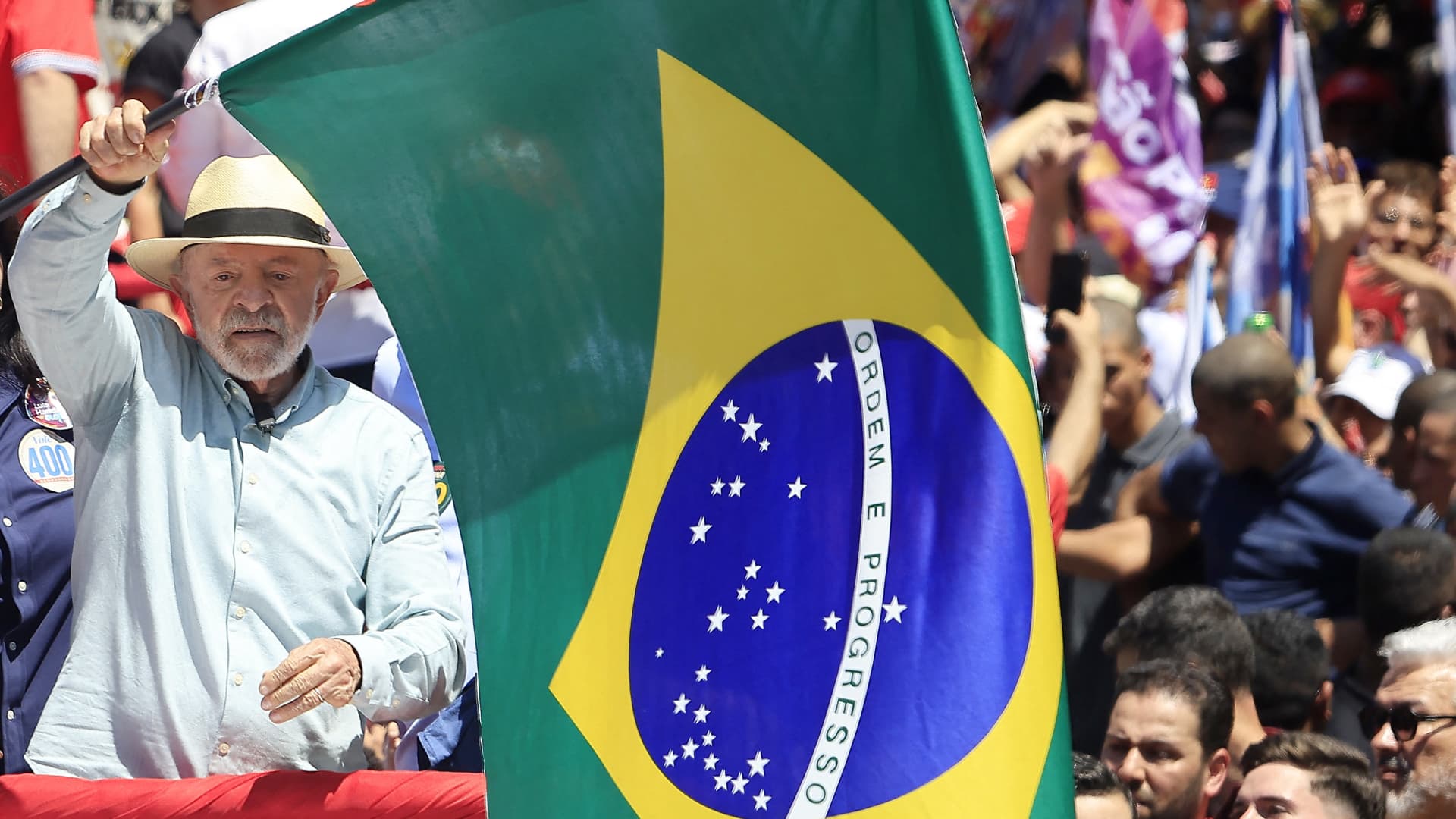
Brazil’s President and presidential candidate Luiz Inacio Lula da Silva waves a national flag during a campaign rally in Sao Paulo, Brazil, on Sept. 26, 2026.
Miguel Schincariol | Afp | Getty Images
Brazil will hold a knife-edge vote on Sunday as its presidential race kicks off — but the election’s outcome is likely to be felt far beyond the country’s borders.
Voters will head to the polls to decide whether incumbent Luiz Inácio Lula da Silva — known colloquially as Lula — should remain in office or be replaced by one of 12 alternative candidates.
If no candidate wins more than 50% of votes in Sunday’s first round, the two candidates with the most support will progress to a final runoff vote on Oct. 25.
Polls point to a tight race, with frontrunners Lula and Flávio Bolsonaro effectively tied for support among voters.
A win for left-leaning Lula would mark his fourth presidential term, while victory for Bolsonaro is expected to mark a shift back to his father’s right-wing movement.
Lula versus Bolsonaro
Lula’s center-left Workers Party (PT) has been a pioneer of social programs aimed at lifting millions of people out of poverty — but it has been stained by corruption scandals. Lula himself spent 18 months in prison after receiving a coastal property from an engineering firm involved in the so-called Car Wash corruption investigation. Former president Dilma Rousseff, who succeeded Lula in 2010, was impeached in 2016, having been accused of budget manipulation.
Flávio Bolsonaro is a senator and son of former president Jair Bolsonaro, who is currently under house arrest. Jair Bolsonaro was sentenced to 27 years in prison for plotting a coup after losing the 2022 presidential election to Lula.
Bolsonaro is widely viewed as the political heir to his father, with his policy mix favoring privatization, spending cuts and close alignment with the U.S. — policies that have had recent successes across Latin America, with Bolivia, Chile, Colombia and Peru all inaugurating conservative leaders in the last 12 months.
Lula, meanwhile, has put Brazilian sovereignty at the center of his campaign. He has also pledged to reduce Brazil’s traditional six-day work week, cut income tax for low-earners and enact policing reforms.
The president has endured a rocky relationship with the Trump administration, which treated Jair Bolsonaro – dubbed colloquially the “Trump of the Tropics” – as a close ally. U.S. President Donald Trump announced 50% tariffs on Brazil in July 2025 in response to what he labeled a “witch-hunt” trial against Jair Bolsonaro.
Senator Flavio Bolsonaro, son of Brazil’s former President Jair Bolsonaro, holds dolls depicting U.S. President Donald Trump and Jair Bolsonaro during an interview with Reuters in Brasilia, Brazil, on Dec. 19, 2025.
Adriano Machado | Reuters
Brazil’s relationship with China
Otaviano Canuto, a nonresident senior fellow at The Brookings Institution and a former executive director at the Board of the International Monetary Fund for Brazil, told CNBC that the upcoming vote was a “hinge election” for the broader region with respect to the U.S. and the so-called “Donroe Doctrine” that has seen the Trump administration take a greater interest in Latin America.
“Brazil is the largest economy in the region and if you take the region as a whole, 20 republics [in Latin America] are now are ruled by right-wing leaders,” he said. “And of course, if a victory by Flavio Bolsonaro happens, that would deepen the strategic alignment of the region with President Donald Trump’s plan for America. By contrast, if Lula obtains a fourth term, that will frustrate Washington’s bid to dominate the neighborhood, and squeeze out the Chinese influence.”
Paulo Nogueira Batista Jr., a Brazilian economist and former vice president of the BRICS New Development Bank, told CNBC that the outcome of the election will have “a substantial effect on all parts of Brazilian life” because the two leading candidates are “radically different.”
“Flavio Bolsonaro has declared to be closely aligned to Donald Trump, and this might affect Brazilian-Chinese relations — [and] China is our main trade partner,” he explained. “The geopolitical situation of Brazil that will change enormously if Bolsonaro wins, and will continue more or less like it has been in recent years if Lula wins his re-election bid.”
According to Canuto, part of Brazil’s appeal to the U.S. administration is the country’s abundance of critical minerals.
“Trump has been very proactive in trying to guarantee the access to critical minerals, and Brazil is the second source rare earth reserves on the planet, [behind] China,” he said.
“So, the U.S.-China rivalry spills over to access to critical minerals and rare earths, and as we all know, all signals coming from Washington point in the direction of demanding the countries in the region establish restrictions to the Chinese access and so on.”
Economic pressure
Another major issue at the center of the election is Brazil’s mounting debt pile.
The vote is being closely watched by investors across the globe, with questions swirling around whether the incoming administration can deliver fiscal credibility.
Brazil’s debt has steadily risen in recent years, and stood at 82.9% of gross domestic product in August.
Meanwhile, Brazil’s budget deficit stands at 9.48% of GDP, fueling concerns about whether the next administration will be able to deliver fiscal discipline and bring the national books under greater control.
But while the wider economy has come under pressure, with inflation hovering above 4% and the government trimming its economic growth forecasts, Brazil has also been an economic beneficiary of higher oil prices as a net oil exporter.
“The war in Iran, economically speaking, benefited Brazil in terms of trade gains with the rising price of oil,” Canuto told CNBC. “Of course, nothing is for free, and the shocks in terms of prices ended up creating challenges in Brazil in terms of controlling inflation.”
Whoever wins, he added, will be obliged to present a plan on bringing the public finances under control.
“In the short term there is no [imminent risk of] crisis, but the levels of nominal debts are reflecting the high interest rates that in turn reflect fiscal fragility. As time passes by, they tend to enter into an unsustainable trajectory, and markets see this and will charge rising premiums and higher interest rates, which would make things worse.”
China’s President Xi Jinping speaks as he and Brazil’s President Luiz Inacio Lula da Silva give a joint statement to the press after a meeting at Alvorada Palace in Brasilia on November 20, 2024. China’s President Xi Jinping is on a state visit to Brazil, fresh off a warm reception at summits of the G20 and APEC groups, both held under the cloud of Donald Trump’s White House return. (Photo by Evaristo SA / AFP) (Photo by EVARISTO SA/AFP via Getty Images)
Evaristo Sa | Afp | Getty Images
Brazilian assets in focus
The yield on Brazil’s benchmark 10-year government bond was last seen trading at around 14.16%. In comparison, the yield on the U.S. 10-year Treasury note hit a 24-year high of 5.3338% on Thursday.
“The fact of the matter is that Brazil, like other countries in the region, will have to undergo some process of fiscal adjustment, and that’s a challenge when you have to negotiate with a divided Congress,” Canuto added.
But according to Christine Reed — who manages an emerging markets fixed income portfolio at Ninety One — a tightening presidential race means the risk-reward weighting across Brazilian assets is improving.
“We see the most positive risk-reward asymmetry in local rates: tighter polls increase the odds of fiscal adjustment in 2027, while tight monetary policy and the removal of pre-election stimulus should weigh on economic activity and support disinflation, leaving room for further rate cuts regardless of who is elected,” she said in an email.
“The Brazilian real should continue to benefit from high interest-rate carry, tight monetary policy and improving polls, while in hard-currency debt, fiscal fundamentals remain the key risk of a potential Lula re-election and current spreads do not price that risk,” she added.
Batista Jr. agreed that the new leader would have to address Brazil’s economic difficulties, telling CNBC the best-case scenario for Brazil would be a president who “would not throw caution to the wind, but would recognise the fact that we have a difficult macroeconomic situation to face up to.”
“Both candidates, if they are elected, will have to take measures to control expenditure, possibly to increase taxation,” he said — but he cautioned against immediate, wide-reaching reforms.
“I would not, in any case, recommend a strong, drastic fiscal adjustment in the first year of the government, because that would harm the level of economic activity, which is already weak,” he said. “GDP growth has fallen below 2% according to recent projections for this year, so the economy is not growing well — and a very tight fiscal policy imposed suddenly by the incoming government would be, I think, a [worst-case] scenario.”
— CNBC’s Thomas Da Graca Barlow contributed to this article.