Saint Kitts and Nevis Explained 2026
SAINT KITTS AND NEVIS · COUNTRY GUIDE
Key Facts
- —What it is A two-island independent federation in the eastern Caribbean, with Basseterre as its capital and the Eastern Caribbean dollar as its currency.
- —Why it matters It pairs a tourism economy with one of the world’s oldest Citizenship by Investment programmes, making it a reference point for investors and a case study in small-state diversification.
- —The numbers The International Monetary Fund projected economic growth of about 2.0% in 2026, while the government reported 61,374 air arrivals through April 2025 and 690,244 cruise passenger arrivals in the same period.
- —The catch The government says Citizenship by Investment has fallen from roughly 22% of GDP to under 10%, but the programme still carries regulatory scrutiny and revenue volatility.
- —What it means for you A foreigner can live, invest or retire here with US-dollar-linked currency stability, but must navigate import-driven prices, hurricane exposure and strict due diligence on property and citizenship routes.
Saint Kitts and Nevis explained is a story of two volcanic islands, one federal government, and an economy trying to move beyond the Citizenship by Investment programme that made it famous. For a newcomer, it is a place of beaches and bureaucracy, opportunity and exposure, all in a country smaller than many cities.
This guide explains how the federation works, who lives there, what the economy runs on, and what a foreigner should know before signing anything or booking a one-way flight.
One-stop reference
Company Intelligence
Every listed company in Latin America — financials, ownership and structure for 1,450+ companies across 26 exchanges, in one place.
Ask Rio Times
17 years of Latin America reporting, on demand.
Answers are generated from Rio Times reporting only â every claim links to its source article.
What Saint Kitts and Nevis Is
Saint Kitts and Nevis is an independent federation of two islands in the eastern Caribbean, close to Antigua and Barbuda, Saint Martin, Sint Eustatius and Montserrat. Saint Kitts is the larger and more commercially developed island. Nevis is smaller, quieter and more dispersed, with Charlestown as its principal town.
The official name is the Federation of Saint Christopher and Nevis. Basseterre, on Saint Kitts, is the capital and main commercial centre. The country became independent from the United Kingdom on September 19, 1983, and remains a constitutional monarchy with the King as head of state, represented domestically by a governor-general.
The currency is the Eastern Caribbean dollar, written EC$ or XCD, pegged to the United States dollar at approximately EC$2.70 = US$1. Driving is on the left. Electricity runs at 230 volts and 60 hertz, and the time zone is Atlantic Standard Time, UTC−4, with no daylight-saving change.
For a foreigner, the first impression is of a small, orderly, English-speaking country with a Caribbean pace. The second impression is that everything from fuel to food to construction materials is imported, which shapes prices, policy and daily life.
Geography and Environment
Saint Kitts is a volcanic island dominated by Mount Liamuiga, which rises to approximately 1,156 metres. Nevis is also volcanic, centred on Nevis Peak at approximately 985 metres. Both islands have steep, forested interiors, lower coastal plains and settlements concentrated around the shoreline.
The two islands are separated by The Narrows, a channel crossed by ferry services and small aircraft. Basseterre is the main port and administrative centre. Charlestown is Nevis’s historic capital and the seat of the Nevis Island Administration.
The climate is tropical, with a relatively drier period generally associated with winter and spring and a wetter season later in the year. The Atlantic hurricane season runs from June through November. Exposure to hurricanes, drought, coastal flooding, sea-level rise and imported fuel costs makes climate resilience a central policy issue.
The government’s long-term development framework aims to make Saint Kitts and Nevis a Sustainable Island State by 2040. Its stated priorities include water security, renewable energy, food security, sustainable industries, resilient communities, the circular economy, health and social protection.
People and Identity
The population is predominantly of African descent, reflecting the islands’ history as plantation colonies. There are also people of mixed ancestry and smaller communities with South Asian, European, Middle Eastern and other backgrounds. English is the official language and the language of government, education, business and formal media. Residents also use local speech varieties influenced by Caribbean English.
Christianity is the dominant religious tradition, with Anglican, Methodist, Baptist, Moravian, Roman Catholic and other churches present. National identity is strongly tied to the twin-island federation, but Kittitians and Nevisians also have distinct local identities. Nevis retains a particularly strong sense of institutional and cultural autonomy.
The Federation observes public holidays associated with Christian traditions, emancipation, independence and national celebrations. National Heroes Day and Independence Day are important markers of national identity. The annual carnival season, known as Sugar Mas on Saint Kitts and Culturama on Nevis, combines music, parades, pageants and community events.
For a newcomer, the social fabric is close-knit. People know their neighbours, and local reputation matters. That can be welcoming for foreigners who integrate, and isolating for those who do not.
Political System and Leadership
Saint Kitts and Nevis is a federal parliamentary constitutional monarchy. The legislature is bicameral: the National Assembly consists of an elected House of Assembly and an appointed Senate. Members of the House are elected from constituencies on Saint Kitts and Nevis. The prime minister is normally the leader who commands a majority in the elected chamber, and the governor-general appoints the prime minister and other ministers according to constitutional rules.
The country is also a federation. Nevis has its own constitutionally recognised Nevis Island Administration, headed by a premier and supported by the Nevis Island Assembly. Matters such as local development, land and community administration have an important Nevis dimension, while defence, foreign affairs, citizenship and several national functions remain federal responsibilities.
As of October 2026, Dr. Terrance Michael Drew is Prime Minister, Dr. Denzil Llewellyn Douglas is Minister of Foreign Affairs, and Samal Mojah Duggins is Minister of Agriculture.
The Drew-led Labour Party government took office in August 2022. Ministerial titles have been adjusted over time, so the official Cabinet page should be treated as the controlling source for any final published list.
The Economy in 2026
Saint Kitts and Nevis is a small open economy. It imports much of what it consumes, including fuel, food, manufactured goods, machinery and construction materials. That makes domestic prices sensitive to freight charges, global commodity prices, exchange-rate conditions and weather disruptions.
The main economic pillars are tourism, construction, financial services, agriculture, remittances and Citizenship by Investment. The government’s principal policy narrative is a shift from dependence on Citizenship by Investment toward a more diversified economy. Its stated Sustainable Economic Expansion and Diversification, or SEED, approach emphasises tourism, agriculture, renewable energy, construction, technology, the creative economy and sustainable infrastructure.
The government says that Citizenship by Investment’s contribution to GDP has declined from roughly 22% to less than 10%, although it remains an important source of revenue and investment. That is a government-reported estimate and should not be treated as an independently audited national-account figure without checking the underlying fiscal and statistical publications.
The International Monetary Fund’s 2026 assessment projected economic growth of approximately 2.0% in 2026, with tourism recovery identified as a supporting factor. Forecasts are not final outcomes and should be replaced with the latest national accounts when available.
Tourism
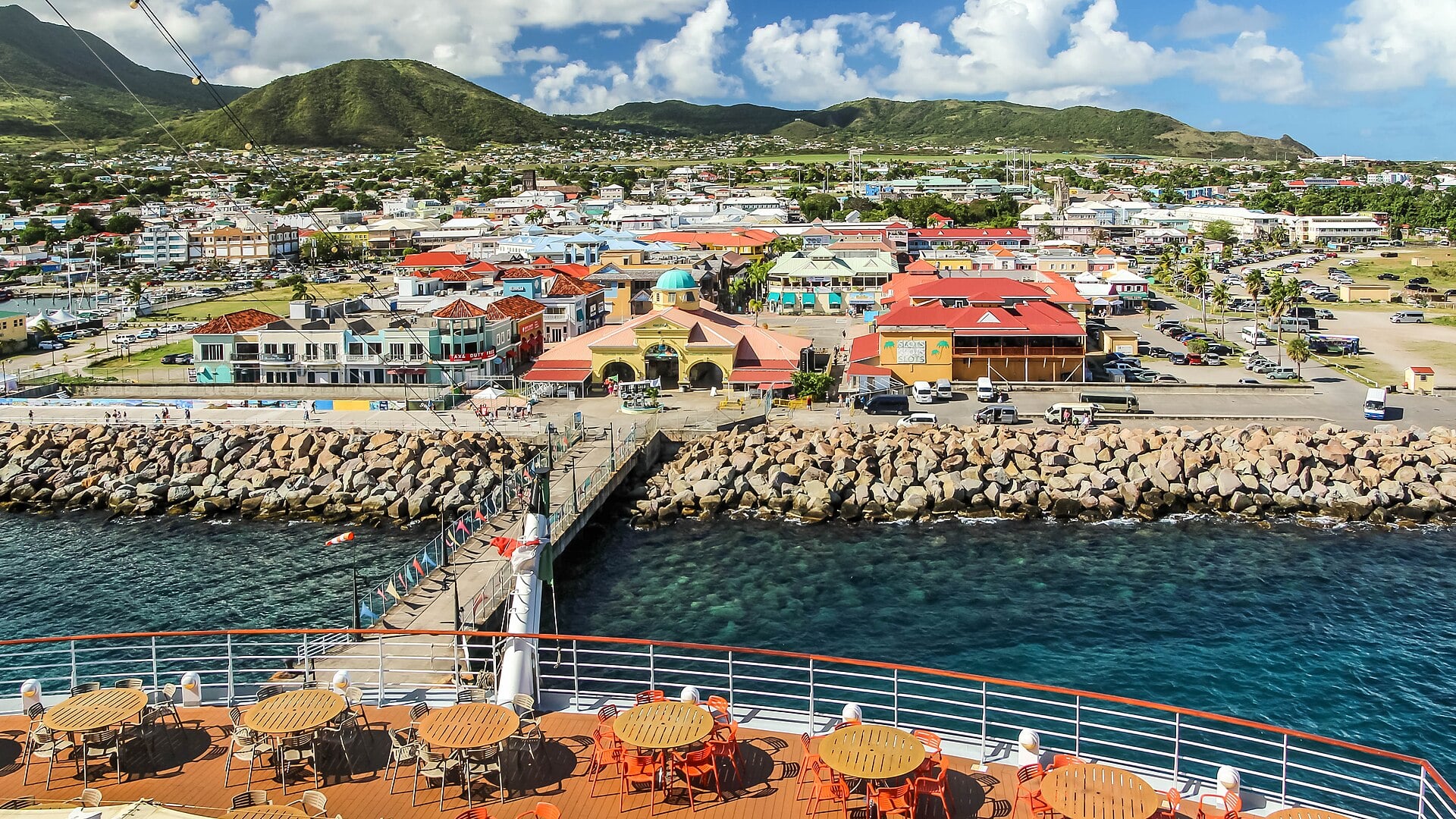
Tourism is one of the country’s largest sources of foreign exchange and employment. The offer includes cruise tourism centred on Port Zante and Basseterre, resort and hotel tourism, beaches and marine activities, hiking and nature tourism, historic sites associated with sugar production and colonial-era settlement, and Nevis’s lower-density, wellness and heritage-oriented tourism product.
Official tourism figures cited by the government recorded 61,374 air arrivals through April 2025, a 14% increase over the comparable 2024 period, and 690,244 cruise passenger arrivals. These are visitor-arrival measures, not necessarily unique visitors or overnight tourists.
Citizenship by Investment
Saint Kitts and Nevis pioneered one of the world’s earliest Citizenship by Investment programmes. Approved applicants can qualify for citizenship through routes such as a contribution to an approved national fund or investment in approved real estate, subject to legal requirements, due diligence and government approval.
For investors, the important point is that the programme is politically and internationally sensitive. It has historically generated substantial public revenue and construction activity, but it has also exposed the country to regulatory scrutiny, reputational risk and revenue volatility. The Drew government says it is tightening the programme and reducing economic reliance on it.
Applicants should use only the official Citizenship by Investment Unit and authorised-agent information. Rules, minimum investment amounts, approved developments, processing requirements and eligibility conditions can change.
Construction, Agriculture and Financial Services
Construction is supported by tourism projects, housing, public infrastructure and private real estate. Foreign investors commonly encounter resort and condominium developments, hotel projects, residential property, commercial property in Basseterre and surrounding communities, and land purchases on both islands. Due diligence is essential: buyers should verify title, planning permission, development approvals, infrastructure commitments, taxes, homeowners’ association rules and whether a project is eligible for any investment programme.
Sugar was once the dominant export crop, but commercial sugar production ended in 2005. Agriculture remains important for food security, employment and rural livelihoods, although the country imports a large share of its food. Current policy emphasises greenhouse production, livestock, fisheries, higher-value crops, irrigation and the use of underutilised land. The government’s 2026 programme includes greenhouse expansion and development of a planned 110-acre farm in Cayon.
The country has banking, insurance, trust, legal, accounting and corporate-service providers. The Eastern Caribbean Central Bank supports monetary and financial stability across the currency union, while domestic regulators supervise areas such as banking, securities, insurance and international financial services. Licensing, anti-money-laundering checks and beneficial-ownership requirements are significant parts of the operating environment.
Cost of Living and Prices
Because the Eastern Caribbean dollar is fixed to the US dollar, exchange-rate risk against the dollar is limited, but residents remain exposed to imported inflation. Official government reporting stated that consumer-price inflation fell from 3.6% in 2023 to 1.1% in 2024, and stood at 0.6% as of August 2025. The Department of Statistics reported a 2024 GDP growth rate of approximately 1.2% and a 2024 inflation rate of approximately 1.13% on its statistical portal. The presentation and revision status of these figures should be checked before publication.
In April 2026, the government announced temporary cost-of-living measures: a 50% reduction in the excise tax on gasoline, from EC$1.95 to EC$0.98 per gallon, a reduction in the Customs Service Charge on gasoline from 6% to 3%, and removal of VAT, Customs Service Charge and import duty on specified items. These are temporary measures, not permanent structural changes.
For a foreigner budgeting a move, the practical lesson is that local salaries and local prices do not always move together. Imported goods cost more than in larger markets, while services and property can be more affordable than in North America or Europe, depending on location and expectations.
What It Means for Foreigners and Investors
For an expat, retiree or remote worker, Saint Kitts and Nevis offers an English-speaking, politically stable environment with a fixed exchange rate and a small, legible bureaucracy. The main visitor markets are the United States, Canada, the United Kingdom and other Caribbean countries, so services and infrastructure are oriented toward those travellers.
For an investor, the country presents a clear trade-off. Real estate and tourism projects can offer returns tied to visitor flows and construction cycles. Citizenship by Investment can offer a fast route to a second passport, but it comes with regulatory scrutiny, changing rules and reputational considerations. The government’s stated goal is to reduce reliance on that programme, which means the rules may tighten further.
The 2026 programme also includes preparation for a 50-megawatt solar energy facility, housing construction with more than 800 homes completed and projects expected to take the total above 1,000 during 2026, and measures intended to lower energy costs and improve food and water security. These are government-reported figures and targets, not independently audited outcomes.
The main risks are environmental and economic. Hurricane exposure is real, and insurance costs reflect it. Import dependence means global price shocks arrive quickly. And the Citizenship by Investment programme, while still important, is no longer the reliable fiscal cushion it once was.
What to Watch
The most important indicator is the government’s diversification effort. If tourism arrivals keep rising and the solar and agriculture projects move from announcement to operation, the economy becomes less exposed to Citizenship by Investment revenue swings. If those projects stall, the fiscal picture tightens.
The second indicator is the Citizenship by Investment programme itself. Any change to minimum investment amounts, due diligence requirements or approved developments will affect both government revenue and the real estate market. The official Citizenship by Investment Unit is the only reliable source for current rules.
The third indicator is climate and infrastructure. Water security, energy costs and hurricane preparedness are not abstract policy goals here; they are daily concerns. The government’s Sustainable Island State Agenda is the framework to watch, with 2040 as its stated horizon.
For a newcomer, the practical checklist is short: verify title and permits before buying property, use a local attorney, check the official Cabinet page for current ministers, and treat any investment or citizenship offer that sounds too easy as a reason to slow down.
Frequently Asked Questions
Is Saint Kitts and Nevis one country or two?
It is one independent federation of two islands, with a federal government in Basseterre and a separate Nevis Island Administration for local matters on Nevis.
What currency does Saint Kitts and Nevis use?
It uses the Eastern Caribbean dollar, written EC$ or XCD, pegged to the United States dollar at approximately EC$2.70 = US$1.
Can foreigners buy property in Saint Kitts and Nevis?
Yes, foreigners can buy residential, commercial and land property, but due diligence on title, planning permission and development approvals is essential, and a local attorney is strongly advisable.
How does Citizenship by Investment work in Saint Kitts and Nevis?
Approved applicants can qualify for citizenship through routes such as a contribution to an approved national fund or investment in approved real estate, subject to legal requirements, due diligence and government approval. Rules and minimum amounts can change, so applicants should use only the official Citizenship by Investment Unit and authorised agents.
Is Saint Kitts and Nevis expensive to live in?
It depends on lifestyle and location. Imported goods cost more than in larger markets, while services and property can be more affordable than in North America or Europe. Inflation was reported at 0.6% as of August 2025, but import dependence means global price shocks arrive quickly.
When is hurricane season in Saint Kitts and Nevis?
The Atlantic hurricane season runs from June through November. Exposure to hurricanes, drought, coastal flooding and sea-level rise makes climate resilience a central policy issue.