Singapore supports 71% of human rights recommendations by UN member states
SINGAPORE – Singapore has supported 243, or 71 per cent, of the 342 recommendations made by United Nations member states as part of a regular review of the country’s human rights record.
The recommendations the Republic supported in its Universal Periodic Review (UPR) ranged from advancing women’s empowerment to enhancing protections for groups like persons with disabilities, migrant workers and low-income groups, and were adopted on Sept 28.
The UPR looks at the human rights records of all 193 member states every five years, and this was the fourth cycle. Singapore submitted its report to the UN in February and participated in its review in May, when countries provided their views and recommendations.
The city-state’s support for 71% of the recommendations is higher than in previous UPR cycles, when it accepted 65% of the recommendations in 2021 and 53% in 2016.
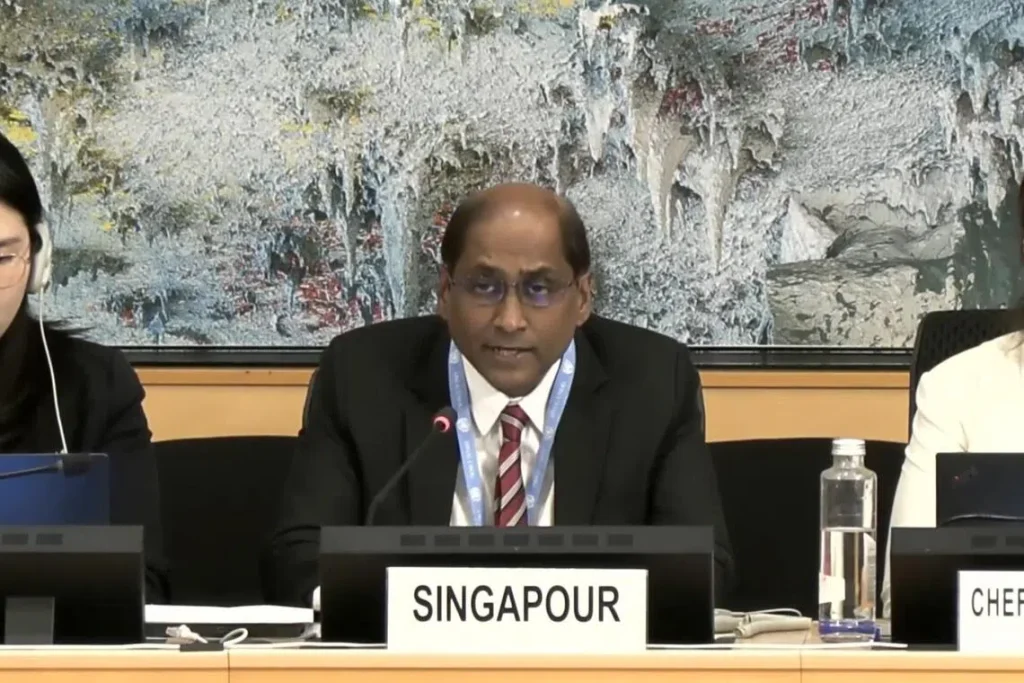
Delivering the city-state’s national statement at the adoption of the UPR outcome on Sept 28, Singapore’s permanent representative to the UN Office in Geneva Jaya Ratnam said the country’s approach to human rights rests on the simple premise that progress should always be measured by tangible outcomes for its people.
Two principles that it has held on to in this regard is pragmatism, with a focus on steadily improving lives; and the rule of law, where the law is applied predictably and firmly in service of the principles of fairness, secularism, meritocracy and multi-racialism.
The ambassador said Singapore has supported recommendations that complement its efforts to build a more inclusive, cohesive and resilient society.
“Singapore’s approach to human rights has always been shaped by our diverse peoples and a pragmatic outlook,” he said. “In this spirit of continuous improvement, we will continue advancing human rights in ways that improve lives, safeguard dignity, and expand opportunities for our people.”
At the Sept 28 session in Geneva, several UN member states and civil society organisations noted Singapore’s progress in enhancing support for vulnerable groups like children, the elderly and migrant workers.
The Singapore Council of Women’s Organisations (SCWO) said the Workplace Fairness Act enacted in 2025 was an important step in strengthening protection against workplace discrimination. It also noted that the city-state has strengthened legal protections through amendments to the Women’s Charter.
Meanwhile, local charity for persons with disabilities SPD noted that Enabling Services Hubs have broadened support for those with disabilities within their neighbourhood.
Accessibility has also improved as a result of revisions to the Code on Accessibility in the Built Environment that took effect in November 2025, mandating stricter standards such as on lifts and barrier-free connectivity, it noted.
However, some civil society organisations expressed disappointment that Singapore did not support a number of recommendations on what they termed “fundamental rights”.
Of the 99 recommendations that Singapore did not support, 22 were on Singapore’s use of the death penalty, and 12 concerned rights to freedom of speech, expression and assembly.
For instance, the representative from CIVICUS – an alliance of civil society organisations – called on the Government to repeal the Protection from Online Falsehoods and Manipulation Act (POFMA), and said the Public Order Act had been used to criminalise the right to peaceful assembly.
In its national report, the Republic said every Singaporean has constitutionally protected rights to freedom of speech, freedom of expression and peaceful assembly. However, these rights were not absolute and had to be exercised responsibly.
Singapore also fully recognises the irreversibility of capital punishment, and took great effort to ensure that every such case proceeded with due, fair and transparent process.
“Capital punishment remained fundamentally a criminal justice matter and a sovereign decision for states,” it added. “The Government would continue to safeguard the right of citizens to live in safety and security.”
In his speech, Ratnam noted that about one third of the recommendations that Singapore did not support related to the ratification of international human rights treaties.
He said the city-state does not regard treaty obligations as an aspirational exercise, and only accedes to them when it is sure it can fully implement every aspect.
Singapore’s commitment to human rights is not abstract, the ambassador added.
Its efforts have been recognised internationally, he said, citing how the Republic ranked 13th globally on the UN’s 2025 Human Development Index, 2nd for the absence of corruption, and 8th for gender equality, among other international metrics.
“But we care more about the lived realities of our people than about rankings, and the work is never finished,” he said. “Every generation inherits a Singapore made by the choices of those before them.”