
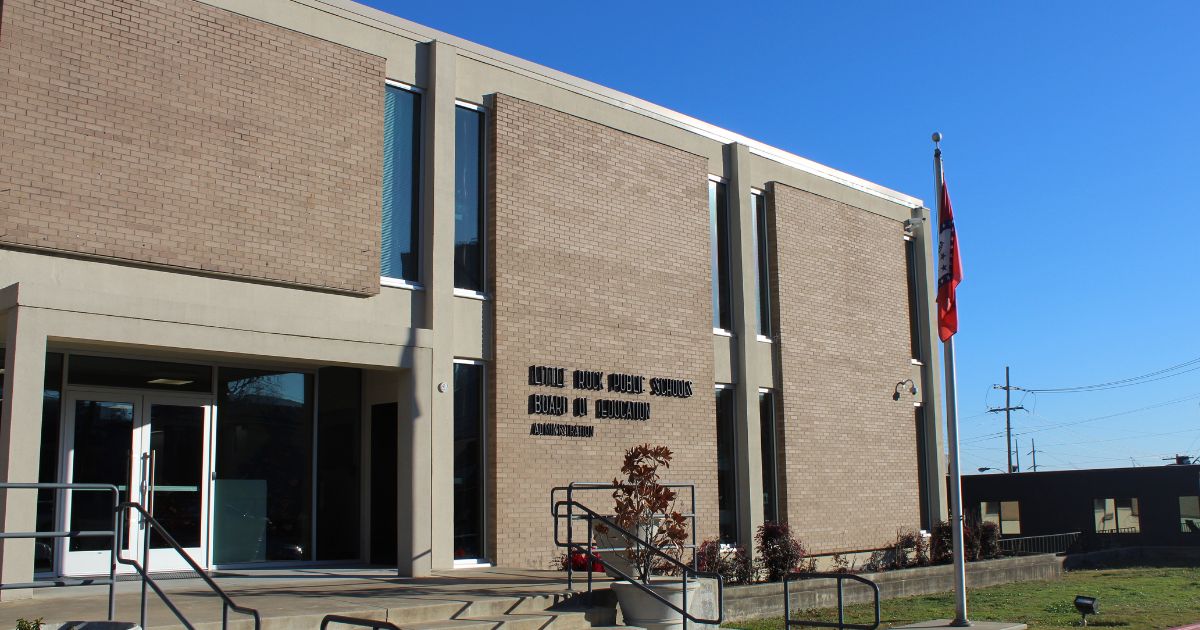
LRSD board discusses school closures, 2027 budgeting and revised hiring plan
During a lengthy meeting on Thursday evening, the Little Rock School District Board of Directors heard a report on expanding accelerated classes to every middle school, received more news about the LRSD FORWARD plan and learned of important changes to the 2027-2028 hiring process.
The meeting also featured some celebration about ongoing successes within the district. The Arkansas Department of Education recently released its 2026 district and school grades, and the results show significant progress district-wide. When Superintendent Jermall Wright began serving in 2022, 20 LRSD schools were rated F. That number has fallen every year since: 15 in 2023, 13 in 2024, 10 in 2025, and just three in 2026, an 85% reduction in four years. At the elementary level, F-rated schools fell from 15 to two; at the middle-school level, from four to none. Hall High School also moved from a D to a C.
The first new business before the board was a middle school acceleration update. As a part of LRSD Forward, Wright and his team are focused on expanding access to advanced and accelerated coursework across all LRSD middle schools. The district has offered honors and accelerated courses in some schools and subjects for years, but this plan aims to create more consistent opportunities in English/language arts, math and science across the district. Staff also outlined plans for a summer bridge program and continued engagement with families and schools as the new coursework is developed for the 2027–28 school year and beyond.
The district has also developed a much more specific process for determining which students are ready for accelerated coursework. Rather than relying on a single test or teacher recommendation, the proposed system uses several measures of student readiness. Teachers will also evaluate the academic behaviors that students need to succeed in a faster-paced course, including persistence, independence, communication, collaboration, organization, and overall performance.
School closures
The board then turned to another discussion on the LRSD Forward plan. The latest LRSD Forward proposal comes down to a straightforward financial goal: reduce the district’s annual operating costs by roughly $5 million to $6 million to account for declining enrollment and underuse of about one-quarter of the district’s building space.
The administration’s first recommended option is to close Western Hills, Mabelvale Elementary and McDermott Elementary. The district estimates that the three closures would produce approximately $4.68 million to $5.26 million in recurring annual savings. The plan would keep the changes at the elementary-school level, with no middle-school closures. Western Hills’ autism program would move to Williams while continuing to provide the same services.
The district is also presenting a new option that would close Western Hills, Watson and McDermott and would combine Watson and Mabelvale into a new school at the larger Mabelvale facility. The estimated annual savings are $4.37 million to $4.92 million. Because the maximum projected savings fall below the district’s $5 million target, the option would require an additional $600,000 in central-office reductions.
Along with the closure options, the district has developed scenarios showing how students would be reassigned and how receiving schools would absorb the additional enrollment.
If Western Hills closes, the proposal is to move the entire school including the autism program to Williams. Williams would have a projected enrollment of 488 students, or 82.9% of building capacity. This would require approximately three additional self-contained classrooms.
If Mabelvale closes, one option would distribute its students among Chicot, Watson and Otter Creek. The projected utilization rates at those schools would be 88.1%, 88.8% and 96.9%, respectively.
The alternative would close Watson and keep Mabelvale open. Under that plan, Mabelvale would have a projected enrollment of 545 students in a building with capacity for 544. The report identifies additional enrollment questions that would need to be resolved before that projection could be considered final.
In closing McDermott, one boundary option would divide its students between Terry and Jefferson. Both receiving schools would be projected at roughly 111% utilization, leaving them over capacity. This is not recommended by the district administration. A second option would divide McDermott students among Fulbright, Terry, Jefferson and Bale. Terry would initially be about 15 students over capacity, while the other three schools would remain under capacity.
Moving approximately 20 of Terry’s new students to Fulbright would bring all four receiving schools under capacity.
Budgeting for next year
The board next discussed the proposed LRSD budget for Fiscal Year 2027. The budget provides step increases for eligible employees while also reducing spending across schools and departments. The district says those reductions include changes to staffing models, operational support and non-essential programs and services.
The proposed budget projects $285.75 million in operating revenues, compared with $290.91 million in actual operating and debt-service revenues in FY2026. Operating expenditures are budgeted at $132.84 million, compared with $145.36 million in actual expenditures last year. Teacher salary expenditures are budgeted at $121.68 million, compared with $124.57 million in FY2026. The budget also includes $31.01 million for debt service, up from $26.80 million in FY2026.
One additional concern in all of this is the operational fund balance. This is the rainy-day fund for emergencies and, for the current fiscal year, that balance was $6.7 million. In 2020, the fund was at $20.7 million. Even with the savings from the planned school closures, the fund balance is only projected to be $7.6 million.
Hiring process changes
With school closures on the horizon, the district is changing the 2027–28 hiring process so that effective LRSD employees whose positions are affected by school closures, consolidations, or other changes will be given priority for another job in the district rather than simply losing their jobs.
The process will begin in January 2027, when the district will review enrollment projections and determine how many employees each school and department will need. Human Resources, network leaders, and school administrators will then review those staffing needs. The district will also identify employees who may not be recommended for the following year and require the Superintendent to review those cases.
The first hiring round, February 16-24, will focus on keeping effective LRSD employees. This includes effective teachers who can remain in their current schools, employees whose positions are eliminated because of school closures or consolidations, employees in critical-shortage positions, internal transfers and employees and vacancies at priority schools.
Employees who lose their positions because of a school closure or consolidation will be recommended for another job in LRSD that matches their license or current position, even if the district has not yet determined which school they will work in. Other effective classified employees, including clerical staff, paraprofessionals, and custodians, as well as specialty teachers such as art, music, physical education, reading interventionists, and gifted and talented teachers, will be considered for available positions after the first round.
The second round, March 8-17, will make remaining positions available to employees who want to transfer to another school or department, while continuing to give priority to effective employees who lost their positions because of school changes. Principals will be able to interview candidates throughout the process, and HR will review recommendations every week.
The third round, April 5-21, will address the positions that remain open, including vacancies caused by late resignations, retirements, enrollment changes, new positions, emergencies and teacher residency or university partnerships. Employees who were previously considered at risk but have shown improvement can also be reconsidered with the Superintendent’s approval.
This new three-round process replaces the previous plans with multiple recommendation periods. It is designed to get strong employees committed earlier, give principals more flexibility to fill vacancies and keep effective LRSD employees in the district whenever possible.
Source link