
Review: Bing McGilvray’s Tribute to David Hockney in Gloucester, MA
Those open to venturing a bit off the beaten path for an art experience will be well rewarded by heading up to Gloucester, Massachusetts, for a David Hockney show unlike most others. There are just a few original artworks in the cozy wood-beamed gallery barn of the Manship Artists Residency, but the late artist himself guided the show’s creation, and you’ll see his signature many times over in sign-offs directed toward his longtime friend Bing McGilvray. Throughout “Hockney Reproduction(s),” it also appears on posters, prints and missives, which are presented across two floors alongside seldom-seen fax works, photographic composites, digital drawings and video.
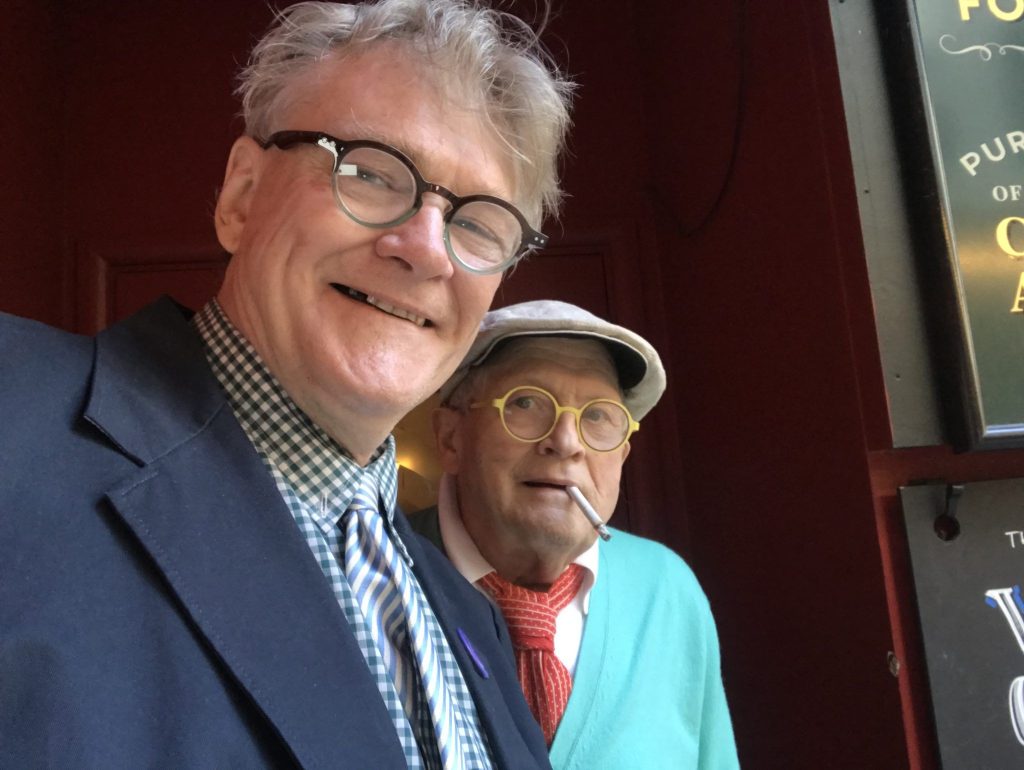
McGilvray, whose large collection of Hockney ephemera initially inspired “Hockney Reproduction(s),” describes himself as a real “Gloucester character,” which he certainly is today. But in the late 1970s and early 1980s, he was an aspiring illustrator, fresh out of art school and sick of Boston. Longing for something different, he drove across the country with a friend, landed in L.A. and loved it. It wasn’t long before he encountered a book by Hockney and found himself utterly blown away. “Going to art school in the early ’70s, it was all abstract, conceptual, minimal—very interesting, but I’m a cartoonist,” McGilvray, who also curated the show, told Observer. “I was determined to meet him, and it happened, and I found out that was the same thing he’d been dealing with. He said, ‘Yes, yes, this is what I’ve been telling them at the Royal Academy—more drawing classes, not less.’”
|
“Hockney Reproduction(s)“ |
That conversation sparked a close friendship that lasted more than 45 years, evidence of which is peppered throughout the show: paintings and digital photo collages of McGilvray (a frequent Hockney sitter), exhibition posters inscribed by the artist, invitations to visit overlaid on iPad sketches. “We always kept in touch, even in the last few years. I haven’t been able to travel and he hadn’t, either, but thanks to FaceTime, we were always talking to each other,” he said. In the two years before Hockney’s passing, those conversations were often about “Hockney Reproduction(s),” which evolved out of McGilvray’s 2025 Manship residency. Initially, the artist was skeptical, but he came around when Richard Benefield, the first executive director of The David Hockney Foundation and a friend of McGilvray’s, joined the project as an advisor.
“David calmed down, and then the more I started saying ‘we can do this, we can do that, we can show the faxes,’ he got very excited about it,” McGilvray recalled. (Hockney sent elaborate faxes in the late 1980s and early ’90s to friends and galleries, building images across multiple sheets, and these were often shown at the time of their creation but have largely dropped from view, possibly because the medium is now so thoroughly obsolete. The fax drawings in the show are, more than any other pieces, artifacts of a very particular moment.)
With both Hockney and Benefield on board, things accelerated. David Hockney Inc. in L.A. provided 25 posters. Salt’s Mill in Saltaire, U.K.—a former textile mill turned into a cultural destination by another friend of Hockney’s, and which now houses one of the largest collections of the artist’s work—provided more posters and merch. Friends and collectors contributed additional materials, including original illustrations Hockney made for Grimm’s Fairy Tales, loaned by Diane Chen Koch-Weser. Cultural historian and curator Charlie Scheips, another close Hockney confidant and one-time studio assistant, also contributed to the exhibition’s creation and gave a lecture on the opening weekend.
Hockney was a lifelong experimenter, so it’s fitting that the curatorial throughline here is experimentation, with the whole of “Hockney Reproduction(s)” being itself something of an experiment. There are distinct thematic groupings of works—fax drawings, items related to the artist’s engagement with the theater, photo collages, museum posters and books—around the space, which McGilvray maintained Hockney would have loved. But don’t come expecting a chronological walk through Hockney’s oeuvre or an in-depth exploration of the artist’s career. There are no placards or explanatory wall texts accompanying the objects on display, which some may find frustrating. That aside, what the exhibition lacks in detail, it makes up for in heart, color and panache.
“There’s a lot of joy here—I can feel the vibrancy Hockney surrounded himself with,” one exhibition-goer commented during our visit. Ultimately, it’s not just a show about the work of an artist most of us will miss greatly, even those who never met him, but also a show about what he meant to the people who knew him best. “It’s grown far beyond anything we initially imagined,” McGilvray said. “But of course, whenever David got involved with something, everything changed.”