Conflict on the streets, battles in parliament, war in the cinema

From the ongoing protests and strikes to the battle of words in the French parliament over the budget – via a brief diversion to Brets crisps – and the warlike trend of French cinema, we look at the latest news and talking points from France.
Most of the focus on France right now is the politics ‘de la rue‘ – the ongoing protests, blockades, strikes and demos, but what’s happening in parliamentary politics has the potential to be considerably more dramatic and destructive.
This week the MPs of the Assemblée nationale rejected the first part of the 2027 Budget (French budgets come in two parts – revenue and social security, with social security usually generating more controversy).
The reaction to this, both inside France and out, was muted – partly because it was widely expected and partly because it’s only one stage on the complicated and convoluted parliamentary journey that French budgets must take.
Don’t miss our journalists’ daily news roundup from France
As the EU analyst Mujtaba Rahman put it this week: “Trying to understand French budgetary politics is like trying to understand quantum mechanics explained in Finnish.”
Nevertheless, despite being both boring and brain-achingly complicated, the latest steps of the budget are important – the rejection confirms what most people had predicted: that prime minister Sébastien Lecornu has no chance of getting next year’s budget through parliament via the normal processes, and will have to resort to emergency constitutional powers, triggering the risk of bringing down another French government.
But this time, the financial watchdogs and hedge funds are circling – confirmation that France is essentially incapable of addressing its spiralling deficit by passing even a modestly cost-cutting budget could trigger downgrades of the country’s credit rating, spiralling borrowing costs and chaos on the financial markets that has the potential to destabilise the eurozone.
In short, something far more destructive than burning bins and smashed shop windows.
Street life
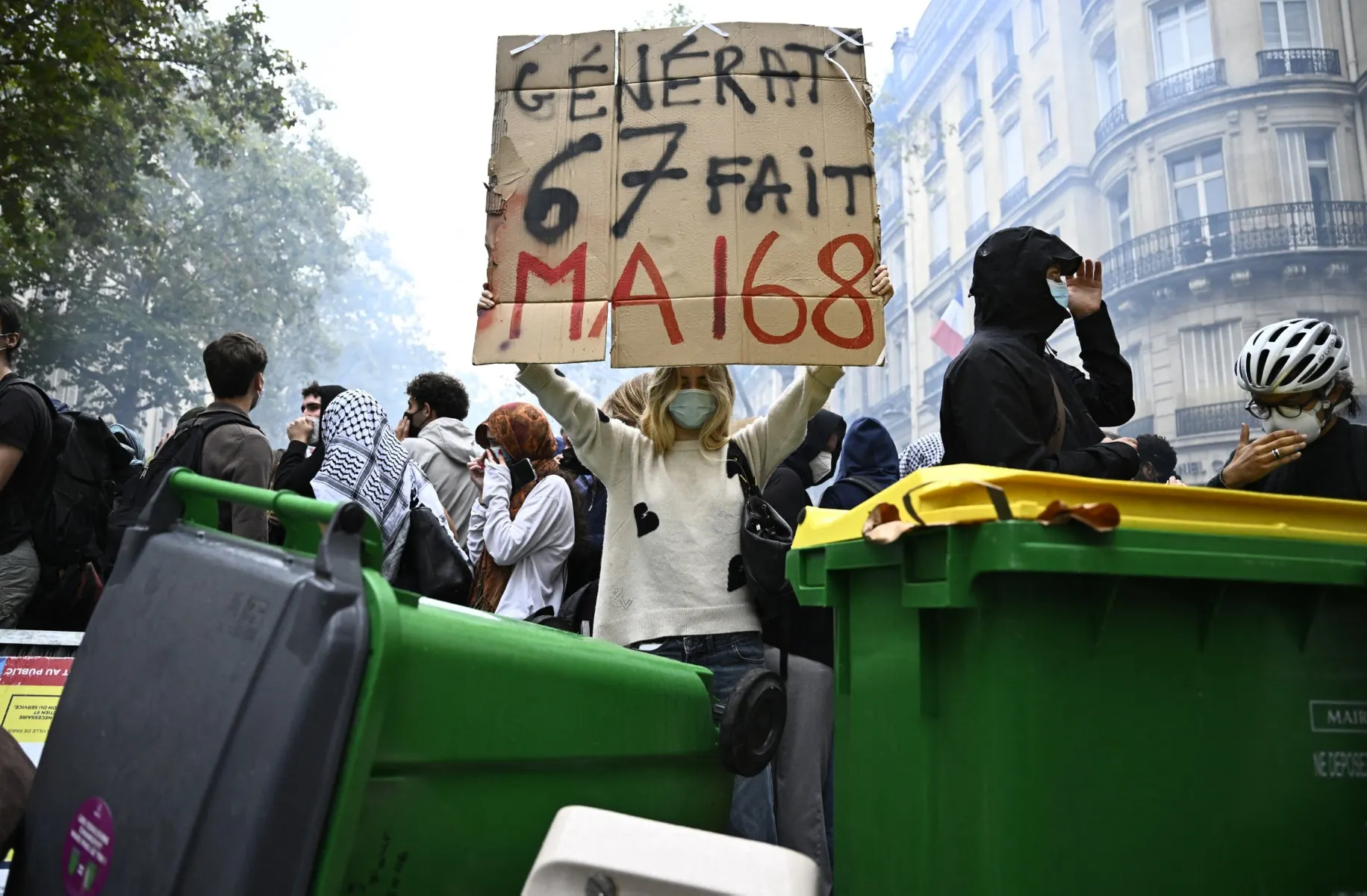
But the politics of the street continue – among the myriad protests that took place this week alone – school blockades, a nationwide strike, another Saturday of demos – was a call for young people to join a ‘generation 6-7 mobilisation’.
I notice that French youngsters have really embraced the idea of being ‘the 6-7 generation’ – named after the internet meme that began life in the US – perhaps just because it makes a pleasing slogan to say that ‘géneration 6-7 refait ’68‘, referencing the huge student protests in May 1968 that very nearly brought down the government (president Charles De Gaulle briefly fled the country).
But I do enjoy the fact that what began in America as a silly internet meme has, on arrival in France, mutated into a call for Revolution.
Talking France
We discuss the latest from the protests on the Talking France podcast, as well as the plan to ease the doctor shortage in rural France, best cheeses and the town where the most ‘perfect’ French is spoken. Listen here.
Art
Another thing that protests have over budget debates is better images – below is my favourite placard from this week’s demos, featuring the Breton crisp brand Brets. Brets are known for their dizzying range of flavours, from the excellent – jalapeno cheddar – to the weird and horrible (pastis), so here the protesters have imagined two new flavours: ‘burning bin’ and ‘tear-gassing kids’.
@ronanmaenardo.bsky.social la Bretagne toujours sûre.
— veroservat (@veroservat.bsky.social) 5 November 2026 at 17:11
There’s also a new song doing the rounds at the protests, with the highly elevated lyrics: “On fait caca sur Bardella, on fait pipi sur les Nazis” – we poo on [Jordan] Bardella, we pee on the Nazis, with the most childish words possible for poo and wee, caca and pipi.
It didn’t take long before a keen DJ made a remix.
Please note, The Local supports reasoned and adult political debate rather than scatological insults of one’s ideological rivals. Unless it’s funny.
Maybe if the MPs come up with a song we’ll all find it easier to pay attention to the budget?
Wartime drama
It’s hard to get away from the sense of next year’s election dominating the discourse, even at the cinema. There’s a striking glut of World War II films released this year – Les Rayons et Les Ombres in May while the two De Gaulle films, Notre Salut and Moulin are all in French cinemas now.
All of these films essentially focus on the choice between resisting a regime or collaborating with it – De Gaulle of course led the French French from abroad while Jean Moulin led the Resistance within France before being betrayed, captured and tortured to death.
Meanwhile Les Rayons et les Ombres and Notre Salut focus on people who took the other path and collaborated. Both are based on real people – the high-profile collaborationist journalist Jean Luchaire in Les Rayons et Les Ombres and the director’s own great-grandfather in the case of Notre Salut.
It’s hard to escape the modern parallels – I was lucky enough to attend a De Gaulle screening that included a Q&A with the director, who was very explicit that he had made these films at least in part to appeal to young people and to show them that resistance is always possible, no matter how hopeless things seem.
READ ALSO: ANALYSIS: Why are there so many WWII films in French cinemas right now?
They all also happen to be excellent films in their own right, well worth a watch and if you are in Paris you can see them with English subtitles thanks to the Lost in Frenchlaction cinema club.
Inside France is editor Emma Pearson’s weekly look at some of the news, talking points and gossip in France that you might not have heard about. It’s published each Saturday and members can receive it directly to their inbox, by going to their newsletter preferences or adding their email to the sign-up box in this article.