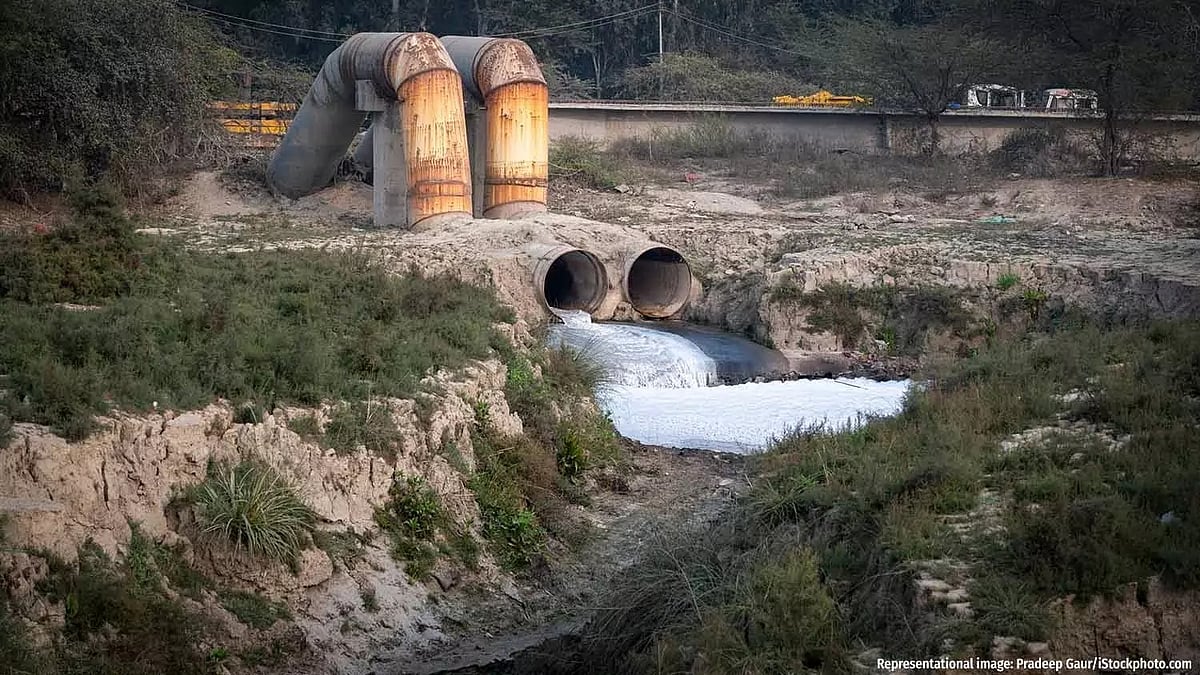
On Sunday walks along Ludhiana’s Buddha Darya, a citizens’ group counts what is left to fix
Why CETPs need oversight
A CETP relies on the idea that a collective effort towards treating effluents by a cluster of small-scale industries reduces treatment cost for industrial units, while protecting water bodies. The hope is that a centralised end-of-pipe facility, planned even before industries are set up, will ensure pollution abatement. It is similar to the concept of a municipal corporation treating sewage of all the individual houses that fall in its jurisdiction.
As of 2023, India had 201 CETPs operating across 20 States and Union territories. Their combined design capacity was 1,917 MLD, while operational capacity was 1,137 MLD (nearly 60% of design capacity).
But a 2024 study, by authors from Pandit Deendayal Energy University, found that only one of seven CETPs in Ahmedabad demonstrated consistent compliance with effluent discharge standards.
On October 1, 2025, the Indian environment ministry, through a draft amendment in the Indian Environmental Impact Assessment Notification, 2006, proposed to exempt CETPs from environmental clearances. The draft of this amendment was finalised in January this year.
This, despite the finding that in 2025, the Central Pollution Control Board (CPCB) of India identified 296 polluted stretches with poor water quality in 271 of 623 rivers assessed. Untreated or partially treated industrial effluent discharge is a major contributor to this pollution, the CPCB has found.
And it’s not just about an environmental clearance (EC) before setting up a CETP, but also about monitoring that a CETP follows the conditions laid out in the EC. As the example of the Buddha Darya shows, the existence of effluent treatment infrastructure does not automatically mean clean rivers or surface water.
Other plants have seen issues as well. In Gujarat’s Vapi, the CETP was found to be operating with inlet and outlet water parameters above safety limits in 2022, the CPCB told the National Green Tribunal. The Unnao CETP and associated industries were closed down by the National Mission for Clean Ganga in 2023 for flouting discharge norms.
In addition, the new amendment gives the responsibility of approving and monitoring CETPs to the state pollution control boards, which experts say are already burdened with their existing work, and lack the manpower to effectively monitor treatment plants.
Lessons from the regulation of sewage treatment plants in India suggest that removal of environmental clearance may also compromise their design, monitoring and enforcement by the government, as well as public participation in planning and site selection, experts say.
Weakening protections
Currently, under the Water Act of India, the state pollution control boards (SPCBs) grant consent to establish (prior to construction) and the consent to operate (after construction) industries and treatment plants that are likely to discharge harmful waste into waterbodies. These are granted with certain conditions or environmental safeguards that industries should comply with, monitored by the boards.
In addition, CETPs hitherto required an environmental clearance from the Union ministry of environment.
The government argued that removing environmental clearances for CETPs will make it faster to establish treatment plants for industrial clusters, particularly small and medium enterprises, that may not have the wherewithal to operate individual treatment systems. In the proposed change, it also emphasised that in absence of an environmental approval, the existing ‘robust regulatory oversight’ will suffice.
The Union ministry of environment issued a set of safeguards to be followed by CETPs. It includes a siting criteria, stipulation that untreated and treated effluents pass only through covered pipelines, a continuous online monitoring system at inlets and outlets of CETPs, which are to be connected with pollution control board (PCB) servers, and Zero Liquid Discharge from the CETPs, among others.
But a comparison of the listed conditions in the environmental clearance (EC) letter and consent to operate (CTO) of the 15 MLD Bahadurke CETP in Ludhiana shows why experts say the EC system is better. The EC lists several conditions pertaining to treatment procedure, including zero discharge, reuse of the water separated after treatment, destruction of the final reject using evaporation, particulars on treatment and handling of hazardous waste and the concentrate left after evaporation, and compliance with all recommendations of the environmental management plan and the environmental impact assessment report submitted to get the EC.
But no such conditions are included with the consent letters of the 15 MLD Bahadurke Plant.
The government further argued that the process for getting an environmental clearance is not needed as plants already require consent to establish and operate under the pollution control laws of India.
Experts, however, suggest that the pollution control boards are not equipped to appraise or monitor CETPs.
Shibani Ghosh, a Supreme Court lawyer, practising environmental law, explained that unlike appraisals under the EC procedure, which is done by a committee with some relevant expertise, consent applications go through standard protocol and a basic check. Moreover, the state pollution control boards lack context-specific knowledge. “For instance, they are unlikely to have much experience with ecologically sensitive areas,” she says.
The amended Uniform Consent Guidelines, followed by the State Pollution Control Boards, notified in January this year altered the common framework across states and Union Territories for granting, refusing and cancelling consent. The guidelines gave the consent to operate, which used to be for a specific time period depending on the polluting capacity of an industrial unit, an indefinite validity, unless cancelled.
Theoretically, a consent can be cancelled if an industry is found to be violating the consent conditions. However, SPCBs suffer from lack of resources and an increasing load of work.
Since 2000, monitoring and enforcement of 11 new legislations has been added to the PCB’s role, while they continue to struggle with existing constraints of limited resources and enforcement powers, according to a 2025 study by the Council on Energy, Environment and Water (CEEW). “They (SPCBs) don’t have the capability. Their sanctioned strength has not been updated for over 15-20 years. Overloaded SPCBs are not the best placed to handle this additional task of compliance monitoring,” said Ghosh.
“We have a lack of manpower, especially technical staff. Even with EC, the monitoring work falls on us. We do the same work with or without EC. Monitoring is carried out every six months,” said a regional PCB officer from Karnataka, who did not want to be identified, as they were not authorised to speak to the media.
Even though EC violations are inspected by state pollution control boards, they are better handled because of some context-specific safeguards given in an EC letter, and the regional offices of the Union environment ministry are also often involved in the checks, said Ghosh.
To reduce the pressure on PCBs, the amended guidelines allow third party auditors to conduct site visits and verify compliance. Because of this, in the last few years, the boards’ mechanism to verify compliance has shifted from routine inspections by their officers to third-party inspection and self-declaration by industries. The number of inspections have come down over the years, as ISignal reported in January 2020.
Experts say third party audits are unreliable unless there is “counter-monitoring”.
Even when pollution control boards issue show-cause notices and closure directions to defaulting units, they have a limited effect on the ground. For instance, for the Ludhiana dyeing clusters, between 2022 and 2025, the Punjab PCB levied an environmental compensation totalling about Rs 10 crore on the three CETPs, and yet the violations continued.
In addition, there are reported cases of misappropriation of funds, corruption and extortion within the State Pollution Control Boards. For instance, in case of contamination of the Buddha Darya, in August 2024, the public action committee filed a police complaint against officials of the Punjab Pollution Control Board alleging that they were colluding with the dyeing industry. However, Lakhanpal said the first information report (FIR) was not registered yet. ISignal reached out to the Punjab PCB and the Punjab Dyers Association for comment. We will update this report when we receive a response.
Under the centrally sponsored schemes for the Micro, Small and Medium enterprises, the Union and state government grant CETPs a subsidy of 25% each. Recently the government announced a goods and services tax reduction for CETPs from 12% to 5%. “If the Centre is supporting a project shouldn’t it take some responsibility of ensuring that the right design and plan is in place for its execution?” Lakhanpal asked.
We reached out to the Union environment ministry and the Central Pollution Control Board for comment on the planning to strengthen the functioning and regulatory monitoring and enforcement of treatment plants. We will update the story when they respond.
What does the STP record show?
Like CETPs, Sewage Treatment Plants (STPs) are also environment abatement facilities. Unlike CETPs though, they never required an environmental clearance. They only require consent from the pollution control board before establishing and operating.
Yet, these plants do not cover 100% of sewage generated in the country, and are rife with several problems, showing that removing the need of an EC does not solve the myriad problems of polluted discharge in water bodies, experts say.
The tenth report of the parliamentary committee on housing and urban affairs released in August 2026 notes that the urban areas of India generate 52,644 MLD of sewage—equivalent to 21,000 Olympic-sized pools. In comparison, the installed sewage treatment capacity in India combined with the treatment capacity added under Namami Gange, a flagship programme by the government launched in 2014 to clean and rejuvenate the river Ganga, barely reaches 70% of the sewage generated.
State governments report to the parliamentary committee that delay in execution of sewage treatment plants is due to many factors: slow tendering/procurement process, delay in statutory approvals and land acquisition, lack of capacity within urban local bodies and problems related to contractors.
According to Sharachchandra Lele, fellow, environmental policy and governance, Ashoka Trust for Research in Ecology and Environment, a Bengaluru-based think-tank, missing last-mile connectivity, outdated technology and disconnected pipe networks often contribute to the poor performance of treatment plants.
Closing the door to public participation
Without an environmental clearance, communities also lose the chance to weigh in on where a CETP is sited and how it is designed. “If the EC is removed, there must still be a place for public hearing as a mandatory part of the process,” Lele said. He added that peoples’ concerns about setting up of a wastewater treatment plant near their homes “need to be heard and addressed upfront, else protests erupt later on and stall completion of the project”.
“Site-suitability and design possibilities are the key focus areas during this (environmental) appraisal. Whereas, the consent mechanism focuses on compliance and comes into play only after a project is commissioned,” explained Shubhrajit Goswami, program officer at the Centre for Science and Environment in New Delhi. “There is a substantial possibility that the people will have things to say and hear at a public hearing of such a project regarding its discharge, how the waste material will be transferred, what if there is a leakage, etc.”
Without environmental clearance there is no scope for challenging a CETP before the consent given to it is made publicly available, added Ghosh. Compared to consent decisions from the PCB, “proceedings of public hearings and project appraisal meeting minutes under the EC regime are mostly available online making the process relatively more transparent and allowing some opportunity for concerned citizens to intervene,” said Ghosh.
That said, the EC system too needs improvement. Experts agreed that the EC process may be better than the consent regime, but it has several systemic flaws, such as limited space for public participation in project decisions, shoddy environmental impact assessment reports, and tight appraisal timelines. “Environmental clearance doesn’t ensure a treatment plant will function, even a consent to operate doesn’t ensure it will function,” said Lele.
This report is republished with permission from ISignal, formerly IndiaSpend, a data-driven, public-interest journalism non-profit. It has been lightly edited for style and clarity.