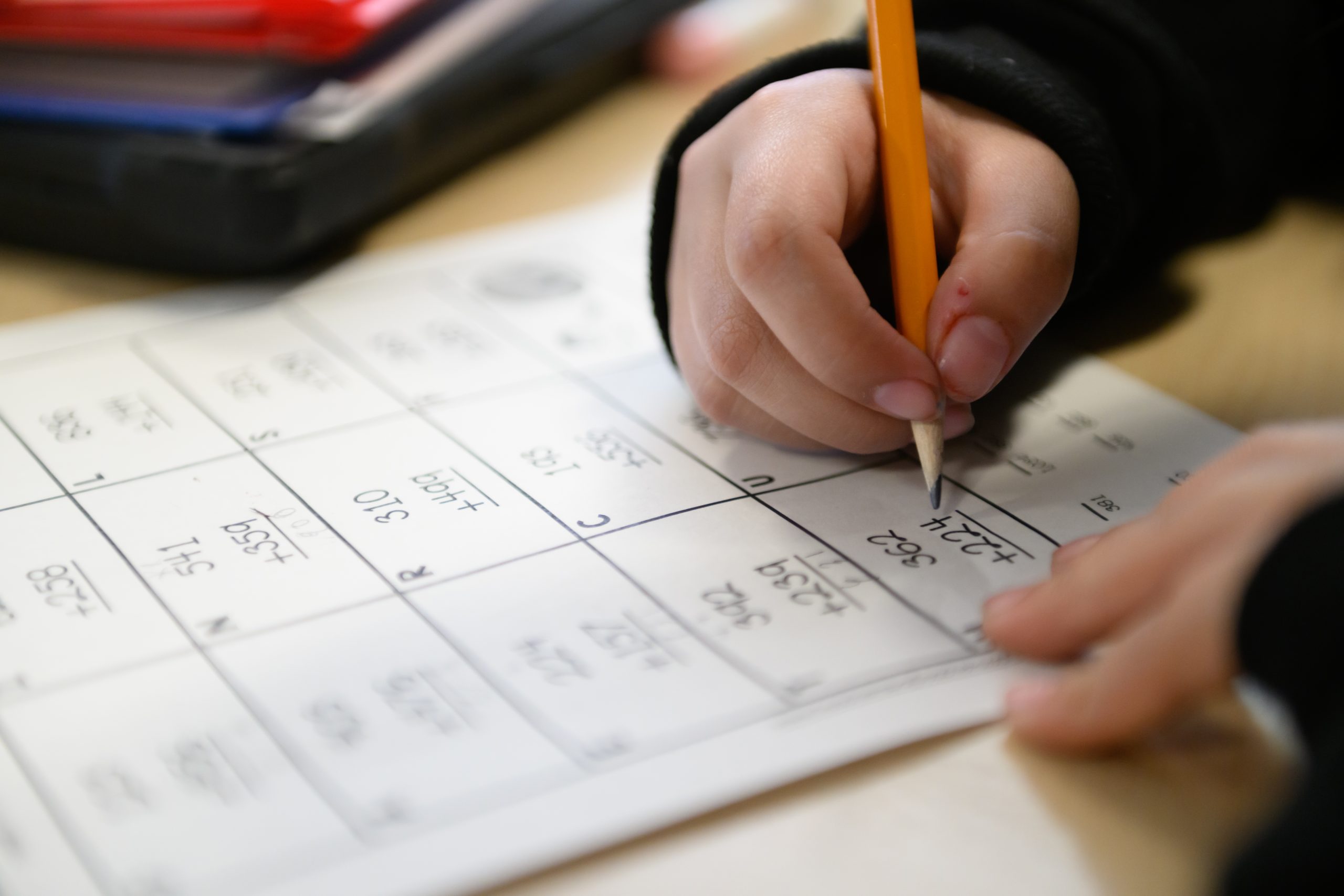
Colorado students will spend fewer hours on CMAS testing this spring
Colorado elementary and middle school students will spend fewer hours taking state standardized tests in math and science this spring, a decision the state education department says will give kids more time for classroom learning.
The changes announced Monday mean students will sit for the Colorado Measures of Academic Success tests for a shorter period of time and will have one to two fewer testing sessions during testing season in April.
“We know that the fewer of those sessions that we can have, the less of a burden it is on districts and schools from an administrative perspective and the easier it is for students not to sit through as many sessions,” Christina Wirth-Hawkins, chief assessment officer for the Colorado Department of Education, said Monday.
Every year across elementary and middle schools, students in third, fourth, sixth and seventh grades take CMAS tests in reading and writing and math. Students in fifth and eighth grades, meanwhile, take CMAS exams in those subjects as well as in science. And students in grades 4 and 7 at some schools complete a social studies exam.
Proponents of the state tests say they help schools and districts understand how well their students are meeting state academic standards in core subjects. They also equip parents with information about their child’s academic strengths and struggles and are used as a tool to measure student proficiency and academic progress statewide.
Not all education leaders or teachers, however, are convinced that the tests accurately reflect Colorado students’ abilities in the subjects they’re tested on.
The cuts mark the state’s latest push to reduce testing time for students after consistently scaling back assessment time over the past decade: Eighth grade students, for example, sat for close to 15 hours for state tests in 2015. That fell to 11 hours this past spring and is projected to drop again to 9.5 hours next spring, according to state figures. Fourth graders spent 10 hours on the exams in 2015. That number dropped to 7.75 hours this past spring and will drop again next year to 7 hours.
The way Colorado conducts state standardized tests and the amount of time kids spend in test mode have stirred up regular debates among legislators. A bipartisan group of lawmakers who wanted to shrink the number of hours kids take the assessments failed to pass a bill into a law during the most recent legislative session.
But lawmakers eager for the state to take another look at how it tests kids made some headway during the 2025 legislative session with a bill-turned-law focused on the state’s school accountability system. Among other priorities, that legislation ordered a study to, in part, explore what shorter assessments would look like and figure out how to improve test administration. That study, along with input from technical experts and educators, helped inform the changes for next year’s testing cycle.
The state department has also submitted a report outlining the planned changes to the General Assembly.
The same amount of material will be tested in less time
Even with less time for tests, students will still answer the same breadth of questions the tests have challenged them with in past years. State education officials decided against removing any content from CMAS tests, finding that eliminating content made the tests less reliable, especially when it came to a detailed breakdown of students’ performance on specific parts of each test, according to Wirth-Hawkins.
Being able to analyze how students do in different content areas of a subject really matters to schools and districts, she said.
“If we’re reducing content to save time, but we’re then creating tests that aren’t actually as valid, reliable, giving as much useful information, then from that perspective all the time is wasted,” Wirth-Hawkins said. “So what’s the point?”
Under the state’s changes, students will cover the same amount of test content in fewer sessions. In previous years, students have sat for tests during three sessions per subject and schools decided their own testing schedule. Some schools would test students with one session per day before returning to regular classes and others would test students over two sessions per day before resuming regular classes, Wirth-Hawkins said.
Last year, students spent three sessions on math, each lasting 65 minutes. The same was true for science.
A state analysis of how much time students need to complete the tests showed that students generally don’t need as long of a testing window, according to Wirth-Hawkins.
Next spring, schools will test students over two sessions in those subjects instead, spending 75 minutes in each session.
The state will integrate content that would have been covered during the third testing session in math and science into the two testing sessions. That will require schools to add 10 minutes to each testing session.
“It means fewer of your days will have the testing involved than you would have in previous years,” Wirth-Hawkins said.
The adjustments are also meant to ease educators’ workloads by simplifying test schedules and helping proctoring and make-up testing be more efficient — all of which will give teachers and students time back for learning, which Wirth-Hawkins said is “the most important thing ever.”
“We don’t want to take more (time) than what is needed,” she said. “So we just always have an eye on, ‘Where can we reduce? Is it possible?’”