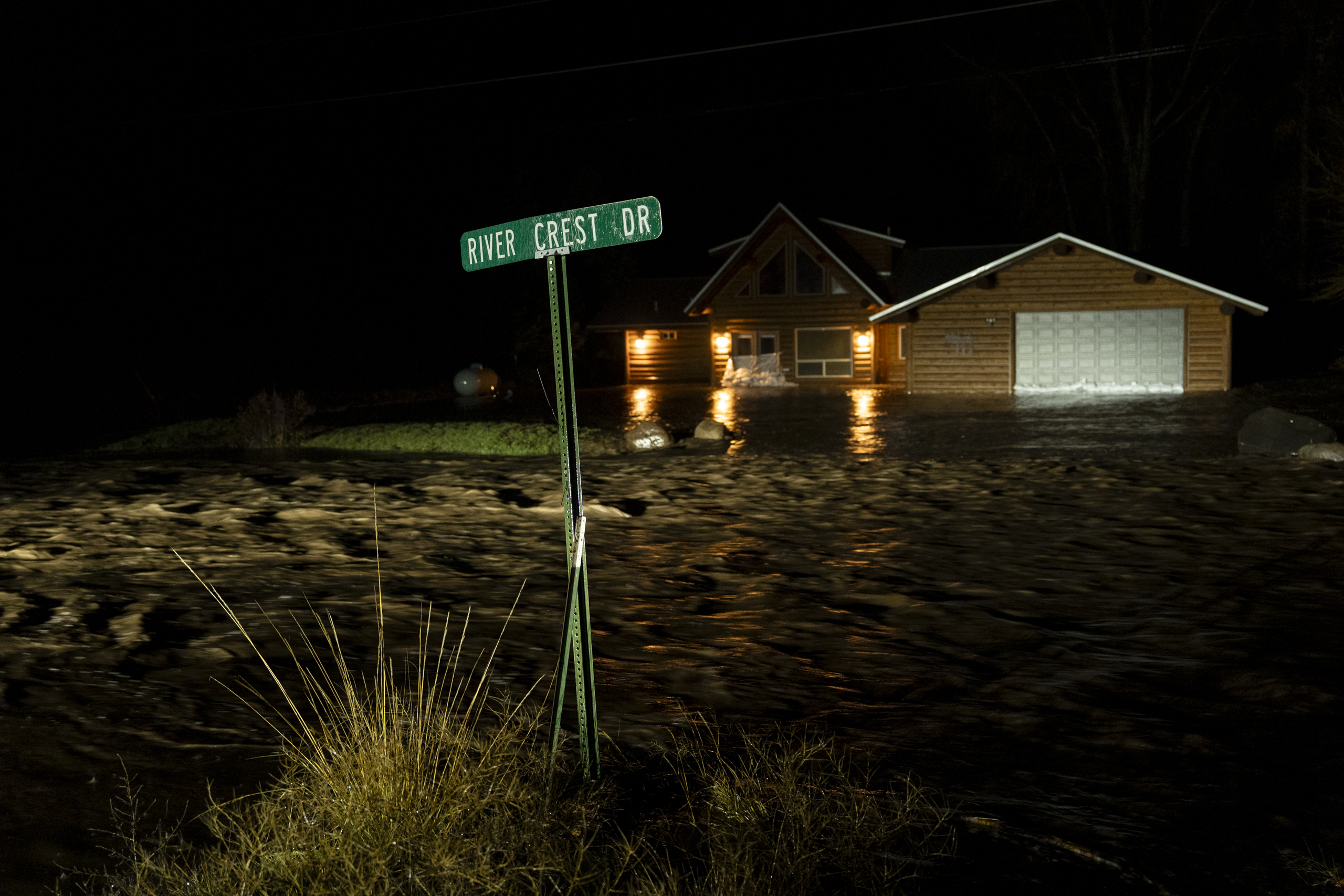
Back-to-back storms swamp southwestern Colorado
The San Juan River crested below historic levels officials had feared, but flooding continued across southwestern Colorado on Monday as saturated ground and additional rain heightened the risk of more water inundating communities and roads.
As of 6 a.m. Monday, the San Juan River stood about 16 feet, which is above major flooding levels but below the levels forecast Sunday. Those forecasts had warned the river could rise to 22 feet — more than 4 feet above the historic 1911 flood that wiped away much of what was then the town of Pagosa Springs.
Still, the river rose higher than levels reached just a week ago. Sunday morning, the river flowed at about 6.5 feet — by 8 p.m., it appeared to crest at 16.81 feet, according to the National Weather Service, before beginning to recede. That’s nearly 2 feet higher than last week’s peak of about 15 feet.
With the ground already saturated and infrastructure damaged by last week’s storm, Sunday’s rain compounded flooding problems across the region. Videos posted to social media showed muddy torrents surging through Pagosa Springs and taking out bridges and pathways.
Rain is forecast to continue to fall Monday and widespread flooding and washed-out roads will make travel nearly impossible, the National Weather Service said. The agency also warned of a high risk of landslides, rockfalls and debris flows. Heavy snow is expected through Monday in the eastern San Juan mountains, with 8 to 14 inches possible above 10,000 feet.
Many streams and rivers will see moderate to major flooding in the mountains and western parts of the San Luis Valley from runoff rain and melting snow.
The South Fork of the Rio Grande was about 3.8 feet as of 3:30 a.m. Sunday. It peaked at about 8.8 feet at 9:30 p.m. Sunday. It was 8.2 feet as of 7:15 a.m. Monday.
As of Monday, no injuries or missing persons have been reported in Rio Grande County, according to the South Fork Fire Rescue.
The Mancos, Dolores, La Plata, Animas, Navajo rivers are also flooding, the agency said.
Officials issued preevacuation orders Monday morning in Montezuma County for many people living along the Dolores River.
Water levels were rising Monday across Conejos County, parts of which are under mandatory evacuation orders.
“Althought there are blue skies, the water is still coming,” Sheriff Garth Crowther said, reminding residents that during last week’s flooding event, it took 24 hours after the crest in Conejos Canyon for flooding to arrive in Manassa.
He urged residents to keep flood preparations, like sand bags, in place.
“It’s a little bit deceiving — this morning looked good and we were thinking maybe we were through it,” Crowther said. “But the water hasn’t reached us yet.”
The threat of catastrophic flooding prompted widespread evacuations Sunday across several counties in southwestern Colorado, including Archuleta, Conejos, La Plata, Rio Grande. As rivers rose and water spilled onto roadways, some counties ordered all residents to shelter in place and avoid nonessential travel for the duration of the storm.
As floodwaters recede, Monday is expected to bring a clearer picture of the damage across southwestern Colorado, though it could take days for officials to survey the full extent of the destruction.
Displaced by floodwaters
In La Plata County, water was collecting in every ditch, dip and low surface it could find. Officials were quickly announcing road closures, issuing evacuation orders for some areas and telling residents in safe areas to shelter in place.
By Sunday afternoon, residents along Junction Creek were among those ordered to evacuate. The creek had overcome its banks on its path through Durango toward the Animas River, which was at 8.5 feet Monday morning. The river was flowing at about 4.1 feet 24 hours prior.
Sam McCall, a nurse with the skilled nursing facility Durango Health and Rehabilitation, had been watching Junction Creek all day.
He was tracking its water levels in relation to the flood stages that would trigger an evacuation. Level 4 is the highest, marking when water would actually enter the facility, he said.
The water was almost at Level 3 late Sunday afternoon when water started flowing in from a different direction.
“It was like a rush of water, and it came into the back of the facility and came in the back doors,” McCall said. “We stopped it about halfway down the hallway, but at that point we had to evacuate the building.”
By Sunday afternoon, ambulances, the fire department and buses carried patients to the evacuation center at La Plata County Fairgrounds. Most were older adults, some in wheelchairs.
Two American Red Cross volunteers raced to help dozens of residents from the facility, offering blankets, snacks, water and cots.
At 6:30 p.m., the evacuation center housed about 60 people, Alyson Shaff, an American Red Cross volunteer, said.
The fairgrounds building was outfitted with rows of cots. Local groups, like Manna, the Durango soup kitchen, and Bread, a local bakery, donated food. Search and rescue workers sat at a table at the entrance, logging evacuees as they arrived.
One woman came in with her service dog after walking for blocks down Junction Creek. She arrived drenched in water up to her waist, Shaff said.
“This came on so quickly. We had no socks. We had no slippers, no shoes. We had no seats,” Shaff said. “They’re walking in, literally, their feet are drenched. They’ve been trying to escape and a lot of them are older.”
She and her business partner bought supplies for people coming into the center. By Sunday evening, she felt they had the supplies they needed for the day.
Normally, they would have everything set up, Shaff said. More volunteers were supposed to arrive at 7:30 p.m., but she wasn’t sure if they would be able to make it into town because the road from the airport was closed. It had standing water and a CDOT vehicle blocking the road by 3 p.m. that day.
Sunday evening, the center’s volunteers shut off the overhead gym lights for sleeping evacuees as rain continued a steady drum on the roof.
By 9:30 p.m., they were setting out more rows of cots as the evacuation orders continued to roll out. The Durango Regency Mobile Home Park was evacuating, they said. Two hours later, five mobile home parks were ordered to evacuate alongside neighborhoods around the county.
County officials didn’t know how many people had passed through the center as of Sunday night.
They were waiting, and preparing, for more to arrive.
A city shutting down
On the other side of the La Plata County Fairgrounds, volunteers rushed to fill sandbags in the rain as dump trucks dropped off sand at the “sandpit” at the La Plata County Fairgrounds.
Each bag weighed between about 10 and 20 pounds, and they had thousands of bags ready to fill.
“We’ve had folks showing up all day long to help support this by filling bags,” Jeff Hughes, interim La Plata County manager, said. Prior to joining the county, he spent 12 years working on international disasters for the U.S. Agency for International Development.
The county has been sending anyone who wants to volunteer to fill bags to the sandpit, where anyone who needed sandbags could fill them up.
“I don’t even know how many dump trucks we put out here today,” Hughes said.
Many La Plata County residents were without electricity Sunday, with more power outages expected. The county closed its roads as floodwaters damaged streets and bridges.
In Durango, about 15 people walked along the river trail at Santa Rita Park on Sunday afternoon, watching the Animas River roaring through the city’s whitewater park. Some even stood dangerously close to the surging river’s edge, throwing in driftwood to watch it go through the rapids or allowing children to see the river’s flow.
The city was quieter than usual, but many travelers were still out on the roads Sunday afternoon. Water overwhelmed the stormwater drainage system along parts of Camino del Rio, the main street through the city, forming deep pools of water near the bridge over Junction Creek.
The creek overflowed its banks, filling the parking lot and the bottom floor of rooms at The Junction Hotel and Hostel. Sandbags and street barricades protected part of the road. As the creek raced toward the Animas River, it filled backyards and flooded houses along Alamo Drive, one of the city’s evacuation zones.
Some residents were using rakes to try to clear debris from the street drains. Others stood on the sidewalk and street, talking about flood insurance or walking through the water to try to see the damage in their homes. Water ran in a sheet over the street, reaching more than 6 inches deep along the gutters.
Leonard and Beverly Hofmann, two Alamo Drive residents, decided not to evacuate.
“This’ll be the fifth flood we’ve had on this street. It’s not bad. The other flood we had was clear up to here on me,” Beverly Hofmann, 70, said, gesturing to her waist.
She’s lived on the street since she was 5 years old. In the past, the water has come halfway up her driveway, but it has never come up to her house. Neither of them thought the floodwaters would damage their home this time either.
“This is as far as it’s coming up, the bottom of our driveway,” Leonard Hofmann said.
Both planned to stay the night despite the evacuation order.
“It doesn’t scare me to live here,” Beverly Hofmann said.
This is a developing story that will be updated.