What Germany thinks of Audi’s $4 billion deal with Trump
1. What is Audi’s $4 billion US investment plan?
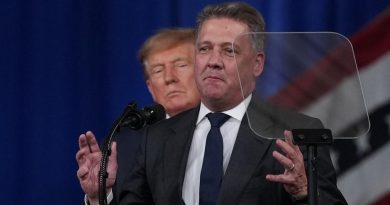
US President Donald Trump announced the investment on Saturday, during a campaign rally in Georgia, a key battleground state for his Republican Party in the midterm elections next week.
Audi quickly confirmed the plan, saying it would build its first US factory near Macon, Georgia, costing around $4 billion (€3.6 billion) and creating some 4,500 jobs.
The German automaker said construction would begin next year, with a planned annual production of up to 200,000 vehicles due to start in the early 2030s.
The firm plans to build premium SUVs for the US market at the plant, marking a “long-term commitment” to what it said was “one of the world’s most important premium markets.”
The US investment comes as German automakers face unprecedented pressure from China, rising costs and two conflicts.
Backed by huge government subsidies, Chinese rivals have stolen a march in the transition to electric vehicles (EVs), scaling up production of new models that are fast gaining market share in a crowded global auto market.
BMW, Mercedes-Benz and Audi’s parent company, Volkswagen— the world’s second-largest automaker — have all issued profit warnings in recent months as margins come under pressure.
They’ve also announced major cost-cutting. VW is preparing to axe up to 100,000 jobs by 2030, while Audi’s factory in Neckarsulm, which has around 15,000 staff, is one of four plants at risk of closure.
2. Why is Audi investing in US car production?
Trump credited his 15% tariffs on European-made vehicles for Audi’s investment, saying it “would not have happened without tariffs.”
While the commitment does feed into Trump’s plan to bring manufacturing back to the United States from abroad, Audi said it was making the huge outlay for growth and resilience.
“We have much greater ambitions for Audi in America,” said the carmaker’s CEO Gernot Döllner, who appeared alongside Trump at the Republican’s campaign rally.
“The United States is one of the world’s most important premium markets, and we have not yet realized our full potential. We are determined to change that … This is about building a stronger Audi business in America — not only about building a factory,” he said.
However, Trump’s tariffs have undoubtedly added to the automaker’s woes.
Audi, which currently exports to the US market from Europe and Mexico, said the additional costs amounted to about €1.2 billion ($1.3 billion) last year.
With more than 160,000 vehicles sold, Audi’s US sales last year fell 16%, amid intense competition and after Trump scrapped subsidies on electric vehicles in its second-biggest market.
By building a US factory, Audi should be able to avoid or reduce Trump’s tariffs, industry analysts say.
3. What is the reaction in Germany amid huge cuts in the domestic auto sector?
There’s been fierce criticism of the deal due to the severe pressure facing German automakers and because the new US investment could mean further job losses at home.
Much of the criticism focused on Döllner’s rally appearance alongside Trump.
The center-left Social Democratic Party (SPD)’s transport policy spokesperson Isabel Cademartori described it as campaign assistance for an autocrat who is waging a trade war against Germany.
“This is a disgrace, especially considering the history of the Volkswagen Group,” she stated, referring to the party’s links with Adolf Hitler’s Nazi party during World War II.
Christiane Benner, president of the powerful IG Metall union, labeled the rally appearance as “extremely embarrassing, politically unacceptable and not worthy of the company.”
VW works council chief Daniela Cavallo went further, saying Döllner had let himself be turned “into a puppet in [Trump’s] propaganda show.”
Cavallo, however, noted that the US plant could make sense from a business perspective, as VW needs to grow its market share there.
An Audi spokesperson defended the US investment, saying it was “not a decision against Germany, but rather a step toward strengthening our global competitiveness.”
Manfred Döss, chairman of Audi’s supervisory board, insisted the automaker’s future cannot be secured by cost-cutting and efficiency alone.
“We need the courage to invest, to seize new opportunities and to make decisions that will shape our company for decades to come,” he added.
4. Will Audi’s investment help Trump in the US midterms?
The announcement certainly appears timed to coincide with the US midterm elections on November 3.
Voters will decide whether the Republicans or Democrats hold the balance of power in Congress during Trump’s last two years in office.
Holding the announcement in the key battleground state of Georgia is seen as a strategic move to boost the fortunes of local Republican candidates.
Since he returned to the White House last year, Trump has used tariffs and political pressure to force global automakers to relocate their factories to American soil.
Audi’s investment follows moves by Stellantis and Japan’s Toyota to expand US production, while Honda is in talks to build a new US plant.
US auto giants General Motors and Ford have also promised to increase domestic production.
While one investment announcement may not be enough to sway many voters, it serves one of Trump’s main election promises — to revive industrial production in the US.
Edited by: Rob Mudge