AI-assisted dying? Doris Dörrie considers robot caregivers
Hamburg in the near future: Instead of human drivers, robots deliver parcels. In cafes, robots roll between the tables, serving diners. On the streets, one encounters humanoid robots walking dogs — or the other way around, people taking their robot dogs for a walk.
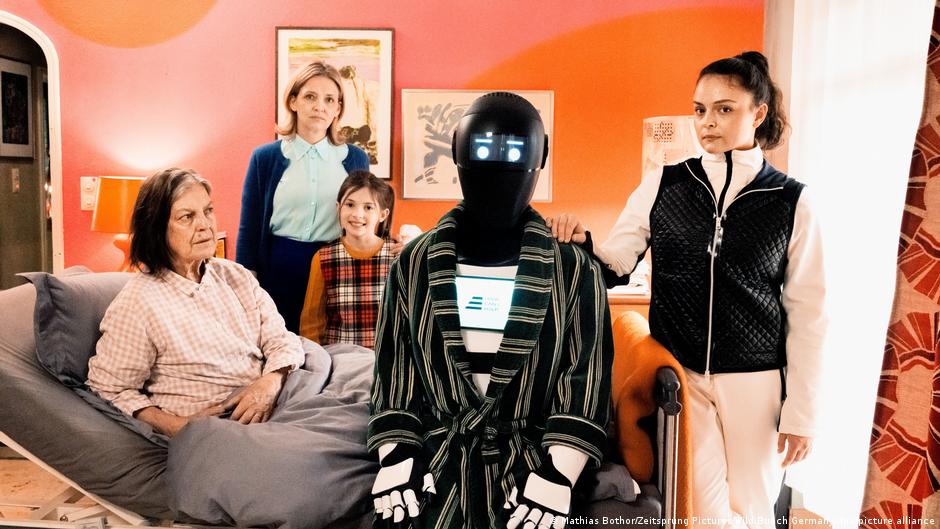
This is the setting of Doris Dörrie‘s new film, “Frau Winkler verlässt das Haus” (“Mrs. Winkler Leaves the House”). At the core of the plot is an elderly woman who can no longer live on her own after a fall. With her only daughter unable to provide permanent care, the solution seems simple enough: a care robot with a built-in EOL program, or “End of Life” mode. This robot not only assists with everyday life but can also provide assisted dying under certain conditions, namely when the person explicitly wishes to end their life and meets the relevant medical criteria.
Dörrie’s film tackles several major social issues with remarkable lightness. These include the challenges facing aging societies such as Germany, Japan and China, the question of dying on one’s own terms and a mother-daughter relationship that raises questions of guilt and responsibility. Even though the story is set in Germany, such issues resonate globally.
“I write about what personally moves and interests me,” Dörrie told DW.
One of the best-known contemporary German film directors, Dörrie achieved her breakthrough in 1985 with the comedy “Men…” She gained further international recognition with films such as 2008’s “Cherry Blossoms” and “Greetings from Fukushima” (2016).
Who decides when we die?
Assisted suicide is one of the most complex ethical questions of our time. Laws vary around the world. Though some countries permit active euthanasia under certain conditions, others prohibit and criminalize all forms of assisted dying.
In her film, Dörrie asks what happens when artificial intelligence begins calculating the cost of caring for an elderly person and weighing whether that cost is still “worth” bearing for society.
The underlying idea isn’t new, Dörrie said, pointing to the Japanese legend of Narayama, which is also mentioned in the film. According to the legend, the eldest children were responsible for taking their ageing parents to a mountain and leaving them there to die because there was not enough food for everyone. “And that’s also the debate we are currently facing to a certain extent: Can we really afford to let older people live longer and longer?”
In Dörrie’s film, elderly people are allowed to make their own decisions once they reach a certain state of health — but they can’t change their minds afterwards. Yet what does it really mean to make a decision freely? “It’s a tricky situation,” says Dörrie, because the question is to what extent one is also pressured into making this decision, “not only because it makes more economic sense, but also because one is no longer a burden on one’s loved ones — in this case, one’s daughter…”
The film often raises these questions indirectly and with plenty of dark humor. At one point, a care adviser presents the EOL feature to Mrs. Winkler as an attractive and, above all, straightforward additional option, making it sound as though there would be nothing more for her to worry about.
Staying close despite the algorithm
Dörrie is not interested in demonizing AI in her film — quite the opposite. In the film, the care robot, which Mrs. Winkler names Pavlovich, helps the elderly woman rediscover some of her zest for life and get out of the house.
“When you travel through Germany, you see small houses everywhere, and statistics show that an elderly person lives alone in every other house,” Dörrie said. “If AI can help in these circumstances, why not use it?” She said she sought to explore this ambiguity in her film. Dividing things into black and white would neither be interesting nor, in her view, accurate.
Dörrie and her crew were surprised during filming by how quickly people can develop emotional bonds with robots. She attributes this to the human brain. “We regard anything that moves and speaks as a living being. We can’t help it,” she explains. And that is precisely what we need to pay attention to when interacting with AI, Dörrie says. “How often are we truly aware that we are talking to a machine rather than a living being? These are things we still have to learn.”
The difference between humans and machines
As AI develops, it seems that the boundaries between humans and machines are becoming increasingly blurred. That is precisely why we need to talk about it, Doris Dörrie says. In her view, things become problematic “when we can no longer distance ourselves from technology and stop forming our own thoughts.”
Human beings need to ask who we are and what truly defines us, Dörrie said. “I believe there is a major difference between robots and us, and that is the ability to play. A robot might be able to initiate a game, she explains, “but play itself is something profoundly human because it has no particular meaning or purpose.”
Alongside these philosophical questions about what it means to be human, Dörrie makes a clear call for AI regulation. “At some point, we had to discuss nuclear weapons internationally, too. We’ve talked about all kinds of issues in the past, and we haven’t just talked about them — we’ve also managed to find solutions,” she points out.
“And I believe we need to move very quickly on this, too,” Dörrie said.
This article was originally written in German.