Germany’s heated politics drove labor minister from her job
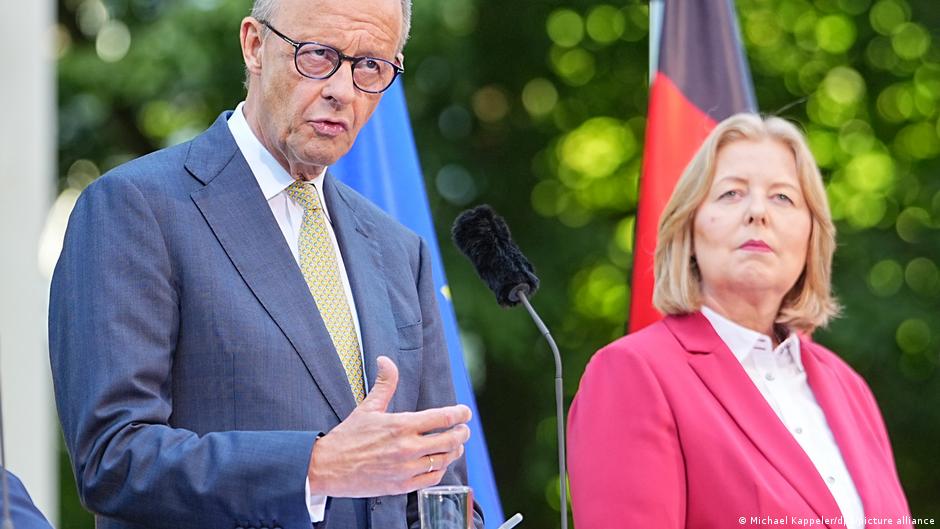
For a brief moment, a sense of quiet sympathy could be felt in Berlin’s often unforgiving political arena: On Monday morning, Bärbel Bas, Germany’s labor minister and the co-leader of the center-left Social Democrats (SPD) announced her resignation from all government and party positions. The 58-year-old politician cited a personal tragedy as the reason for her decision: “Following the death of my stepdaughter, I have come to realize that I need time to work through my grief,” Bas wrote in a statement.
Bas also wrote that sustained criticism from the conservative governing parties, the Christian Democratic Union (CDU) and Christian Social Union (CSU), had contributed to her decision to step down. In her statement, she wrote that she had been forced to “conclude that public attacks on me, unfortunately also from within the ranks of our coalition partner, continued to intensify during this personally difficult time.”
The labor minister had recently been responsible for implementing complex changes to Germany’s public pension system — including increasing the retirement age — and had been urged by some conservative politicians, in rather harsh terms, not to delay the project any further.
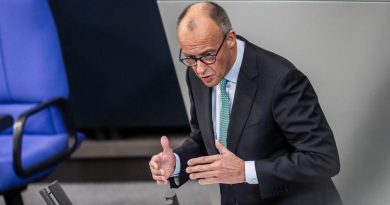
According to a report in the Süddeutsche Zeitung newspaper, one remark in particular appears to have weighed heavily on her: During an off-the-record briefing with journalists, Chancellor Friedrich Merz, of the CDU, reportedly criticized the pace of her efforts despite knowing that she was working through a personal tragedy.
Did Bas feel so overwhelmed by pressures both personal and political that she chose to step down rather than continue to endure them?
Mirco Liefke, a researcher with the Institute for Media and Communication Studies in the Department of Political and Social Sciences at the Freie Universität Berlin, told DW that unfairness and harshness have always been part of politics. However, he added: “What I do think is new is the potential for escalation and the speed that social media have brought to public debate. Along with that has come an incentive for individual actors to adopt ever more radical positions.”
Politics and media
There are few public spaces left in which politicians can speak with the expectation that their remarks will not be reported. Merz is said to have made critical remarks of Bas during an off-the-record briefing whose contents were not intended for publication.
Though he was fully aware of her personal circumstances, Merz reportedly said Bas was barely visible in public and failing to put forward proposals of her own.
“It has effectively become a business model to leak information that is meant to remain confidential and thereby generate attention,” Liefke said.
A spokesperson for Merz declined to confirm or deny the report.
Politics and misogyny
Felix Banaszak, the co-leader of Germany’s center-left Greens, has known Bas fior years, with both hailing from Duisburg, in the state of North Rhine-Westphalia, albeit born a couple of decades apart.
“Toughness and ruthlessness are nothing new in politics,” Banaszak told DW. “But we still need to find a different way of doing things if we do not want to keep wearing people down.”
Banaszak said the SPD was partially responsible for the treatment of Bas. “The fact that Bärbel Bas encountered so little understanding for her personal situation from within the ranks of the coalition partner, and that apparently no one in the SPD was willing to step forward, defend her, and take her out of the line of fire, is simply not a good sign,” he said.
“It would be naive to pretend that the attacks on a man would have unfolded in a similar way,” he added.
Liefke offered a similar view: “Women politicians are subjected to an extraordinary degree of misogynistic and sexualized abuse — and they face a level of public exposure that is entirely new.”
CDU pushes back
The debate over how Bas and her grief should have been treated soon took on some of the same characteristics as the attacks that had preceded her resignation. Manuela Schwesig, the SPD state premier of the northeastern state of Mecklenburg-Western Pomerania, described the attacks by the CDU/CSU as “inhuman,” drawing sharp criticism from many conservative politicians. Merz publicly expressed his regret over the labor minister’s resignation and wished her all the best.
Liefke said this was another tremnd in German politics. Once a politician decides to step down, he argues, public expressions of concern are often far more intense than they used to be and come from all sides: “This is a facade of concern,” he said. “There is something ritualistic, almost reflexive, about it. People react this way because they are following another major trend: Emotionalization.”
The attacks on Bas are just one example of the increasingly harsh tone of political debate. Formal reprimands in the Bundestag have risen sharply, particularly since the far-right Alternative for Germany (AfD) entered parliament in 2017. High-profile resignations have also made headlines, including that of Kevin Kühnert, the SPD’s former secretary-general.
Kühnert stepped down in 2024. In April 2025, however, he told Die Zeit newspaper that he had felt constantly threatened by far-right extremists. Political debate, he said, is showing “an increasing lack of respect for the views of those who think differently.”
Helmut Schmidt’s privacy
Liefke said politicians once managed to maintain two distinct modes of communication: one public and one private. “When you think of earlier generations of politicians, what comes to mind is the distance they maintained, the relative lack of emotional display,” he said. “Take Helmut Schmidt, for example. He did not openly grieve over things that came crashing down on him. At least, he did not show it publicly.” Schmidt, of the SPD, served as chancellor from 1974 to 1982.
“Today, politicians such as Bärbel Bas benefit from drawing on their own life stories when they say, ‘I come from a working-class background and worked my way up,'” Liefke said. “That can work to their advantage — but it also makes them far more visible, and far more vulnerable, as individuals.”
Bas, who served as president of the Bundestag from 2021 to 2025, intends to retain her parliamentary seat. Life is likely to become quieter for her now as other politicians move into the spotlight, both in public and, perhaps, in private as well.
This article was originally written in German.