Interview: James Brett On The Gallery of Everything and Outsider Art
One of the biggest shifts in the art world over the past two decades has been the gradual embrace of alternative perspectives, whether geographic, demographic or stylistic. What was long presented as the official, if restrictive, course of art history has expanded, and there has been a broader reconsideration of the very definition of art. That shift arguably reached a tipping point at the 55th Venice Biennale in 2013 with Massimiliano Gioni’s “The Encyclopedic Palace,” where work by contemporary artists appeared alongside historical artifacts, found objects and works by self-taught, visionary and otherwise non-academic makers.
But he was not alone in his quest to reevaluate and expand the canon. That and other reassessments have opened the door to practices that developed outside academic or institutional systems and that engage, sometimes with mysticism, spirituality and archetypal forms of the human subconscious. What might first have looked like a curatorial trend has proved far more persistent. Across museums, biennials and the market, the renewed interest in so-called outsider art reads as part of a broader search for forms of expression perceived as more direct, intuitive and psychologically or spiritually grounded—an impulse all the more urgent in an age of mounting disconnection.
A key player in this space has been London’s Gallery of Everything, which describes itself as a “commercial gallery dedicated to artists and makers beyond the cultural mainstream.” Founder James Brett has long argued that such artists should not be quarantined in a separate “outsider” category but shown, collected and historicized alongside the broader canon.
“I always found the terminology not very helpful because the terminology creates exclusion, and that exclusion was primarily in museums,” Brett told Observer ahead of Frieze Week. “The concept of outsider art was helpful in defining a category but unhelpful for including people, because it immediately implied they were outside. In the end, I decided not to use that terminology at all because I think it is restrictive.”
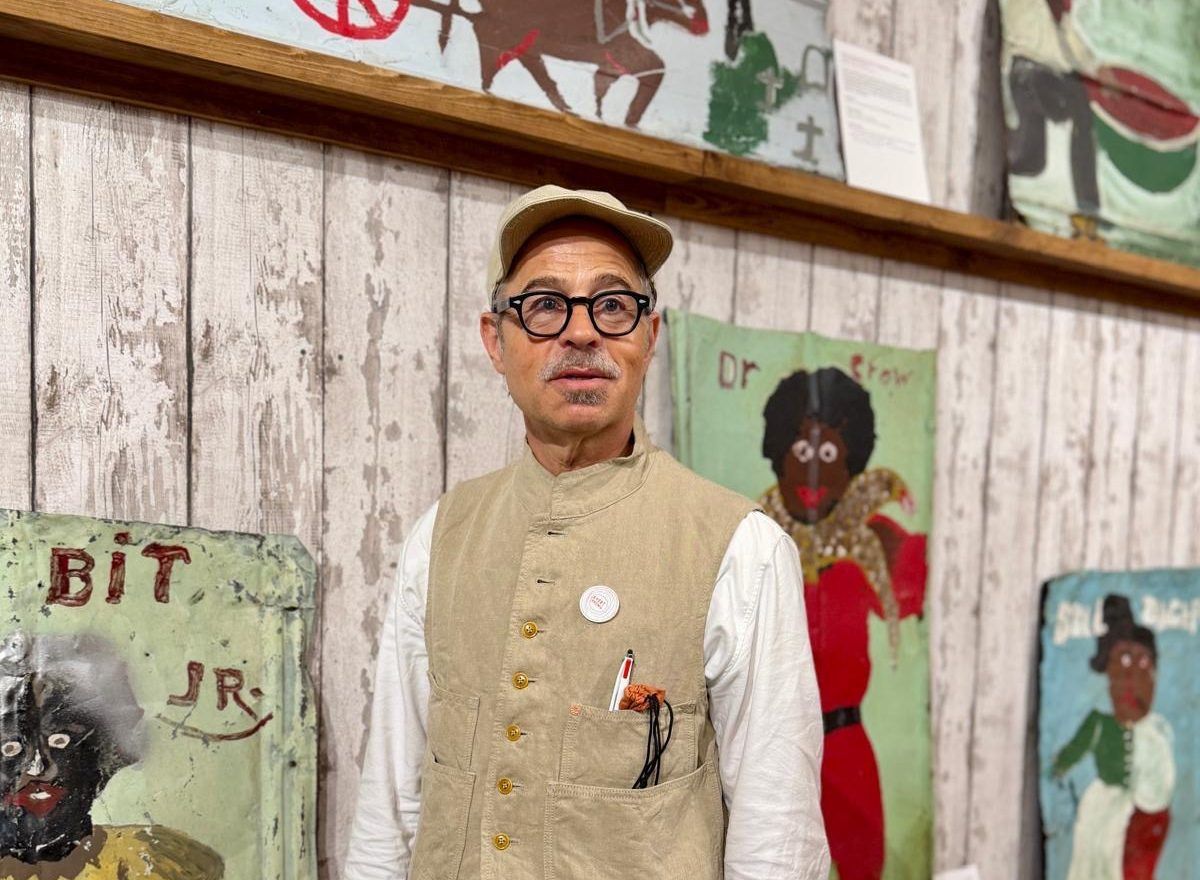
Brett cited Sam Doyle, to whom the gallery is devoting an extensive survey, following the artist’s presentation at the Outsider Art Fair in New York earlier this year. Running through November, “What I Paint Is History” is the first U.K. solo exhibition of the South Carolina artist, bringing together more than 20 paintings and sculptures, many shown publicly for the first time.
Born into the Gullah community of St. Helena Island, South Carolina, Doyle was self-taught and used house paint on roofing tin, sheet metal and found wood to chronicle the island’s Black community, combining portraits of neighbors and local figures with histories of slavery, emancipation, religion, sport and Black American culture. “When he was at school, he wanted to be an artist, but he did not have enough money to be one, so he became a hundred different things,” Brett explained. Outside his home, Doyle created the St. Helena Outdoor Art Gallery, covering its frontage with bold, graphic paintings of famous basketball players, musicians, Christ, Black emancipation and Martin Luther King Jr. Brett described Doyle’s art as born of genuine creative and emotional urgency. “He memorialized the unusual people and the people who formed that society. He felt he was writing the history of the island.”
A natural storyteller, Doyle turned his art into a witness to the broader history of Black emancipation and cultural life. He gained national attention after his inclusion in the landmark 1982 exhibition “Black Folk Art in America: 1930–1980” and later entered the orbit of Jean-Michel Basquiat, who collected several of his works and displayed them in his studio. Today, Doyle is recognized as a central figure in 20th-century African American art, with works in major collections including the Smithsonian American Art Museum, LACMA and the High Museum of Art. With prices ranging from $55,000 to $95,000, the Outsider Art Fair presentation quickly sold out, and the institutional interest that continues to build around Doyle suggests the London exhibition will draw similar attention.
While many of the artists Brett has championed are only now entering or reentering major museum narratives, he worked backward from the usual gallery model: research and his museum project came first, the marketplace only later. A former filmmaker with no conventional art-world training, Brett founded the nonprofit Museum of Everything in 2009 before opening its commercial sibling, The Gallery of Everything, on London’s Chiltern Street in 2016.
“I had already been looking at these artists for 10 or 15 years, so it seemed like a good opportunity to look a little toward the marketplace,” Brett said. “I have a gallery because I have a project. I am not really a gallerist at heart.” Indeed, he described the gallery, like the museum, as a platform. “It can go to art fairs, and it has a space, which allows us to be quite flexible and to look at this material and these artists in a very concentrated way with dedicated shows.”
Although his model rests on rigorous research, Brett did not arrive at it through formal training in art history, Jungian psychology or related fields, as one might assume. He was working in film when he happened upon this kind of art, and these artists. “It was at a time when I was very open to it,” he said. While in the U.S., Brett became interested in Black artists from the South, many self-taught. “I found it really interesting and graphic, and it seemed to me like music. Everyone talks about Black music, but no one was really talking about this side of expression,” he added, explaining that at the time, even some Black art historians were hesitant to embrace self-taught Black artists, wanting instead to establish Black artists firmly within recognized schools and histories. “The Harlem Renaissance and those artists were celebrated, but the artists I could see were fantastic were not. I liked that tension. I am a person who likes opposites, so I loved that this was against what people said and thought, while I could see that it was excellent.”
From this vein of Black American art, Brett moved on to work by people with neurological conditions, people who made things privately and people who built extraordinary homes, towers and fortresses for themselves. “They fall into categories: the vernacular or folk vernacular, the spiritual, the mystical, the neurological and the brain and people who may have disabilities,” he said. “All of these areas intersected and were very interesting.”
Above all, Brett added, the images were simply good and unlike anything else. For him, the aesthetic dimension must be present, even when an artist has developed the most original symbolic language. He began buying whatever works he could afford. “Eventually, I knew so much about the material that I thought, ‘Why not set something up? There are no museums. Let us call it a museum, and maybe people will agree.’ Then we started doing these museum shows, and they were very successful. I was surprised,” he said. Since opening as a nonprofit in 2009, The Museum of Everything has welcomed more than half a million visitors to its projects.
Rediscovering these figures comes with its own challenges. How does one find artists who have often operated outside the main cultural networks and then decide what is truly worth bringing forward? There is no single strategy, Brett argued. Because no curator or dealer can be everywhere, much depends on word of mouth: “Usually one of these artists is doing something, and somebody, often somebody very creative, is the first point of contact.”
That initial advocate lifts the work from invisibility into partial visibility. Once it rises slightly above the surface, someone like Brett can encounter it. “When it is under the water, it is very difficult to know about, unless you happen to be walking down the street, or you are in the countryside and see some strange house and knock on the door,” Brett explained. That said, sometimes an open call can prove remarkably effective. He described a project in Russia about a decade ago in which The Museum of Everything advertised publicly, sent people into the streets and invited anyone to bring forward what they were making. It worked. “We found a lot of people directly for the first time by literally saying, ‘You might not think you are making art, but we think it is. Do you want to show us?’ There are all sorts of interesting strategies.”
Over time, the reputation of the museum and The Gallery of Everything has led more people to approach Brett directly. That creates another difficulty: many artists and families now knock on the door, but not all of them fit the program. According to Brett, much comes down to eye, instinct and intuition, though there are qualities he tends to look for. “All criteria are subjective, and mine are very subjective. I have to like the aesthetic. I am not interested in the biography before the aesthetic; the aesthetic comes first.”
Brett resists notions of “authenticity” and “purity,” which can turn difference into a romantic category. What interests him more is a kind of truth-telling: people trying to say something directly and truthfully, usually in close relation to their own lives. “So I would say my main criteria are: the aesthetic, the truth of the material, and, somewhere within that, the context and life of the artist become relevant,” he said, adding that these are not fixed points. “I am interested in all kinds of people, including artists who have been to school and trained as well as artists who have not. My criteria are quite broad. It is more a type of person, a type of making and something that ticks certain boxes. It is very hard to describe.”
He prefers instead to point to an artist whose rediscovery he has helped shape—for example, Anna Zemánková, a self-taught Czech artist who created extraordinary botanical and spiritualist drawings, pastels, collages and embroideries largely outside conventional art-world structures. “She made art for much of her life, largely in private, until a few people began to see it, and there were a few shows. It has taken decades since her death for the work to gradually become more appreciated and more visible.”
Her work appeared in Gioni’s “The Encyclopedic Palace” and later entered the collections of major institutions including the Centre Pompidou, the Collection de l’Art Brut, Boston’s Museum of Fine Arts and the American Folk Art Museum. “Today her work is highly regarded and highly sought after, and prices have gone up because people are agreeing that it is simply extraordinary,” Brett said. Her auction record stands at $42,240, set by an untitled work on paper sold at Capsule Auctions in New York in 2025.
Surfacing an artist, Brett stressed, is only part of the process. Building a sustainable market can take years of work with estates, relatives, archives and inventories. Families may experience an artist’s legacy as a burden as much as an opportunity, particularly when there is a large body of work to organize or when financial expectations have formed that do not match the material’s current value. In Zemánková’s case, her family was deeply involved in preserving her legacy from the start, and her granddaughter became a curator and the estate’s central representative. “It is interesting when the family has been involved in the curation because it is very personal for them. They do not necessarily want to let go, and that is sometimes good.”
Supporting this process of revaluation, building a market and an institutional presence in tandem, requires a gallery structure with an unusual emphasis on research, which is not necessarily a priority for every commercial gallery. Yet more and more young people, according to Brett, seem to want to do this kind of work. “I wish there were more programs at formal art colleges to enable them to do so because every artist is so interesting. Sometimes a single object could be an entire Ph.D.”
Sales, however, can remain modest for long stretches. In Brett’s field, an artist’s commercial standing often shifts only when the work crosses into a more mainstream gallery, museum or curatorial context. That crossover can be crucial, giving audiences accustomed to established contemporary-art structures a familiar point of validation. Brett cited the trajectory of Seyni Awa Camara, the Senegalese sculptor whom he will show at 1-54 Contemporary African Art Fair, which runs alongside Frieze. Conceived as a memorial presentation for Camara, who died earlier this year, the exhibition brings together more than 15 terracotta sculptures spanning different moments and scales of her career, including some of her final works and monumental pieces standing more than two meters tall.
Camara gained international visibility through Jean-Hubert Martin’s landmark 1989 exhibition “Magiciens de la Terre” at the Centre Pompidou, which Brett described as an early, radical attempt to place material Western institutions might once have dismissed as ethnographic on equal footing with contemporary art. She had been making her sculptures largely in private in Casamance. That moment of international visibility brought her work to curators’ attention, but a market took time to develop. The Gallery of Everything began working with her during her lifetime, including through an arrangement that provided regular financial support for production in exchange for first choice of works.
Things changed after artist Michael Armitage included some of Camara’s sculptures in his exhibition at White Cube. Once the work appeared within the orbit of an artist and gallery trusted by a mainstream contemporary-art audience, viewers could encounter Camara within a familiar framework and were more willing to accept the work on its own terms. “That was enormously helpful because suddenly a mainstream audience was seeing the work and saying, ‘Yes, we agree this is great. We like Michael Armitage, we trust him, and he says it is great,’” Brett said.
Brett sees participation in fairs such as Frieze, Art Basel and 1-54 the same way: the point is to bring new artists into old conversations rather than maintain a parallel category for them. And over the past 10 years, interest in other forms of art-making and other kinds of people has grown—”unusual people,” as Brett put it. “Artists are all quite unusual, but these artists are extremely unusual, or unique humans. Increasingly, young curators are looking at this not simply as something exotic, but perhaps as something more fundamental.”
Toward the end of our conversation, we asked whether this renewed appetite for work that feels direct, human or psychologically grounded might also stem from a moment when human consciousness, intelligence and creativity are increasingly measured against machines—and when people may simply want to return to fundamentals, to something that feels “authentic.” But Brett resisted using “authenticity” too casually. Everything can be authentic to itself, he argued: Jeff Koons and Damien Hirst are as authentic to their own art and style as any supposedly marginal or self-taught artist.
What’s real, however, is the contemporary search for authenticity, the desire for something that feels real and holds up a mirror to human existence. The Gallery of Everything is anchored in the belief that much of the work it champions can serve precisely that function. “Our search for authenticity is about looking for something that feels real, something that feels like a mirror to our existence. I think this work is often better at doing that than a lot of high art,” Brett added.