
Want a water-conscious yard? Here’s a guide from experts.
Can Colorado do more with less water?
Where Colorado will find the water it needs to thrive is a more urgent question than ever amid historic drought, undeniable climate change and unprecedented interstate conflicts over limited river supplies.
The Colorado Sun is embarking on a solutions journalism series asking who in the state is doing their share to save precious water. Our solutions-oriented reporting will assess whether specific water conservation projects can free up water at a large scale, or whether local conservation is always overwhelmed by uncontrollable natural conditions or immovable market realities.
The Colorado Sun series, “Can Colorado do more with less water?,” will create a body of work showcasing what may or may not be possible in creating water solutions across the state. From Akron to Aspen, we’re looking for signs of success or failure that will help lead us to water security.
Expansive, green lawns with large trees in the front yard are on their way out in Colorado — and they need to be, experts say.
Temperatures are warming and rain continues to be unpredictable in Colorado. Parts of Colorado have experienced some level of drought for almost all of the last 25 years, and this year was no different. Cities responded with watering restrictions, and residents saw their lawns go dry and then turn brown.
It’s time for a change, experts told 60 people gathered at The Colorado Sun’s water solutions event Sept. 26. Colorado doesn’t have the resources to continue East Coast lawn aesthetics — it never really did in the first place, said Kevin Hartley, water efficiency specialist for the town of Windsor.
“As the population’s grown, and the climate’s been changing, we just don’t have it,” he said. “Lawns have got to go. The best place to start is your front yard.”
Cities, towns and industries currently have enough water, but they could face supply gaps of as much as 740,000 acre-feet in the driest years by 2050, according to the 2023 Colorado Water Plan.
One acre-foot can supply two to four households with water for a year. The maximum water supply gap roughly equals the annual water use of about 1.5 million to 3 million households.
Many water utilities have been able, or are trying, to keep community water use relatively flat as populations grow. The state has also been pushing the idea of xeriscaping — using water-saving landscaping plants, tools and strategies — since the 1980s. It’s time for Coloradans to take the hint, experts said.
Residents aren’t going to be able to keep doing things the way their parents did, said Ruth Quade, owner of NoCO Ecoscapes and former manager for the city of Greeley’s water conservation program.
Communities have to change their way of thinking, but learning how is often the biggest barrier.
“They want to do it. They just don’t know how, and they’re a little bit afraid to attempt it by themselves,” she said. “This is a whole different way of doing things.”
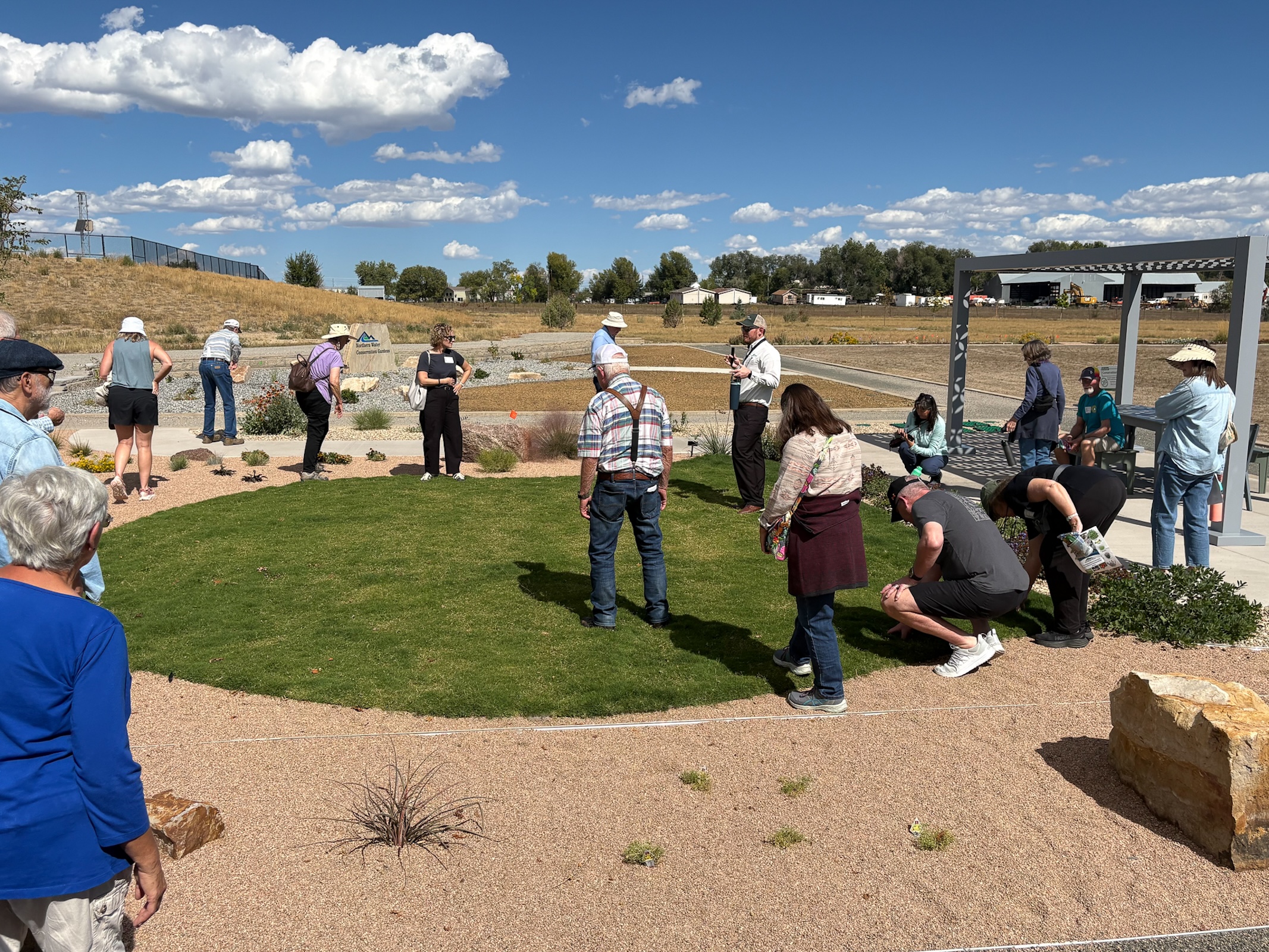
The Colorado Sun hosted a panel and tour of the conservation garden at Northern Colorado Water Conservancy District’s campus in Berthoud to teach and demonstrate best practices for waterwise home landscapes. Check out the list below for some of the main takeaways.
How did Colorado communities respond to drought this year?
After a winter of poor snow, cities and towns across Colorado tightened up their summer irrigation rules for lawns, gardens, golf courses and public parks.
In some places, residents were limited to watering their lawns two days a week on assigned days and within certain hours. No filling pools or operating outdoor fountains. Colorado Public Radio tallied over 20 communities with restrictions by April — when the state’s snowpack normally reaches its annual peak. Other communities didn’t announce any restrictions.
But customers actually need to follow water restrictions for them to work.
Aurora’s smart meters track over-watering during drought restrictions. Some cities sent out warning letters or announced fines for too much watering. Others announced mandatory restrictions for the first time ever.
In the Denver area, residents fell short. Denver Water, the largest water utility in the state, set a 20% reduction goal compared to its five-year average. By midsummer, residents had only cut about 2%. The utility cut off lawn watering for its 1.5 million customers Oct. 1 and announced fines for rule-breakers.
What does at-home water conservation really do?
Coloradans use about 5.3 million acre-feet of water on average each year. Cities and towns represent about 7% of that overall use, while agriculture totals 90%. So what good does it actually do for residents to try to conserve water on their landscapes at home?
“When we look at what municipalities are using … outdoor irrigation accounts for about 50%,” said Michael Guidi, manager of horticulture research at Denver Botanic Gardens. “So within that context, that’s a huge chunk. So there’s a lot of power there.”
Under Colorado water law, many farmers and ranchers face water shortages during drought years and have to adjust their practices. Some are trying out different crops or trying creative ways to retain more water in healthier soil.
In cities and towns, water utilities pay close attention to how customers use water to decide treatment plant management and long-term plans, like whether they need to buy additional water in the future to serve their communities in years to come.
It’s expensive to treat water to drinking standards, and communities are then using that expensive water for their lawns, Quade said.
“It doesn’t make a difference to the (water) portfolio maybe, but it makes a big difference to the homeowner who’s paying that bill,” she said. “And we’re using drinking water to water lawns.”
What are common myths, misconceptions and landscape questions?
Myth No. 1: You can’t adapt a xeric plant palette to any gardening or landscaping style.
Gardeners can adapt xeric plants for formal, cottage, hyper-naturalistic and other styles. It’s all about selecting the right plants from the get-go, Guidi said.
Myth No.2: Xeric plants won’t have the same aesthetic value.
Once people start to experiment with plants that thrive in Colorado’s arid climate, they’ll find plants look better and people don’t have to spend as much time making them look better, Guidi said.
Myth No. 3: Officials are pushing for “zero-scaping” — all rocks, no plants.
That’s not going to help pollinators or climate change, Quade said. It makes landscapes hotter and drier, and unwanted plants, like bindweed and thistle, thrive in rocky landscapes.
But I like my Kentucky bluegrass. Why change?
Kentucky bluegrass requires 18 gallons of water per square foot per season just to keep it alive. For a pristine yard, the water use is more like 30 gallons per square foot. In general, alternative types of turf use more like 8 gallons.
“It is the most thirsty plant that we try and cultivate here,” Hartley said. “It doesn’t belong here. If you looked it up in the dictionary, the definition of a weed actually fits that description.”
The reason people like it is because it’s a turf plant that allows for running, playing and lounging — and it actually goes dormant instead of drying out fully. It lasts through the winter, he said.
Popular alternatives that still allow for plenty of activities, but use less water, include buffalograss and blue grama.
Reader question: Do I need to kill existing grass to start a low-water project from scratch?
In short, yes. Experts recommended slicing off the turf or killing it using herbicide, tarps or other materials — and doing it thoroughly. Otherwise, the former grass will become a weed on the landscape, or it’ll take over when irrigation starts again, Quade said.
Bluegrass needs a lot of water, but it’s savvy. It can go dormant through winter and drought seasons. That means it’ll wake up and start growing again when residents are trying to water a new type of turf.
“Site preparation is both the key to success,” Guidi said, and when it doesn’t happen, it’s “the thing that I see holding so many projects back from a good outcome.”
Drought killed your lawn. Now what?
Some Coloradans saw their lawns die this year, and they wanted to convert their thirsty turf to something more water efficient.
“It actually made the process a lot easier,” Hartley said. “Perfect time to start. … You’ve got a clean pallet, go ahead and get started with something different.”
If lawns have been overtaken by weeds, the worst thing to do is to disturb the soil, Quade said. She recommends avoiding rototillers, and turning to buffalo or blue grama turf. She punches holes to provide aeration and drills seeds, that’s it.
There’s still some time to take action this fall. It’s a great time to prepare sites for future work, Guidi said.
If lawns are truly dead, residents can leave it in place and do light harrowing — removing thatch — or tarping it over the winter to prevent a weed takeover.
If parts of the lawn are still alive, Guidi recommends grabbing a turf cutter to slice off the lawn, spray it this fall with herbicide to let it die off, or trying out occultation, an organic, no-till method that uses light-blocking tarps to kill weeds and prep for new uses.
If tarping isn’t an option, smothering the old plants is another strategy. Residents have to make sure they do it for long enough and while the plant is growing (not dormant), or it won’t work, Guidi said.
“By the time next May rolls around, you’re in a position to — with the right planning and irrigation — make that next set of steps,” he said.
What can you do before doing anything with plants?
Homeowners don’t have to spend a ton of money on ripping up turf, buying new plants or hiring a landscape designer to start saving water.
They can start by just checking their current water use and their sprinkler system, Hartley said.
Understand the landscape design and then change the irrigation system to suit it. Installing drip irrigation systems, which involves using hole-y hoses on the ground to water landscapes, helps efficiently water new plants as they start to grow. But it’s important to adjust drip systems, or they’ll promote rot, Hartley said.
Other sprinkler systems broadcast water into the air to land on plants — or, if they’re not monitored — sidewalks. Broadcast systems lose water to evaporation at the hottest parts of the day. Automatic systems can water on rainy days if they’re not adjusted. Sometimes sprinkler heads are simply pointed in the wrong direction.
Connect with a city or water utility to do a water audit and identify the best ways to conserve.
Reader question: What do you do about bindweed?
Bindweed is tough. It’s aggressive, and it’s everywhere. But there are a few ways to take it out, Guidi said.
It thrives among low-competition plants, so having more plants on the landscape to compete with it will help with maintenance.
There are two ways to “nuke” it, Guidi said. One: Use the occultation process and starve the light from the plant by tarping it for the whole season. That will significantly cut down the bindweed population.
Two: In the autumn, use a combination of herbicides to remove it. Guidi recommended 5% glyphosate with 2% 2,4-D (2,4-dichlorophenoxyacetic acid) in a tank mix to kill it.
“I don’t want to oversell this. It’s not like that will get rid of it forever,” he said. “There’s always that maintenance piece, but those are two ways that you can get yourself started with that really awful weed and buy yourself some time.”
Reader question: What should my HOA do?
In some homeowners associations, the resistance to not having green yards is “mindboggling,” one attendee said. Turf like Kentucky bluegrass stays green longer than native grasses — that’s the problem.
“What do I tell them if they want to have green grasses and want to reduce their water?” the attendee asked.
Some alternatives, like Tahoma 31 and Dog Tuff, use less water and are still long-lasting grasses. Clover is great for pollinators, but it doesn’t handle yard activities well, and it’s a cool-season plant. It won’t offer much in terms of water savings, the experts said.
Another challenge often comes up: Some residents who are 55 or older don’t think they’ll have a return on their investment if they redo their landscape to be water efficient.
Removing turf and then seeding it is less expensive than adding finished plants or rolls of turf. Seeding might cost 10 to 15 cents per square foot.
“That’s orders of magnitude cheaper than buying plants,” Guidi said.
Our speakers’ favorite super plants and resources
Michael Guidi, manager of horticulture research at Denver Botanic Gardens
Kevin Hartley, water efficiency specialist for the town of Windsor
Ruth Quade, owner of NoCO Ecoscapes
The speakers also recommended a selection of plant databases, resource guides, education hubs and more for anyone starting their own waterwise landscaping project.