
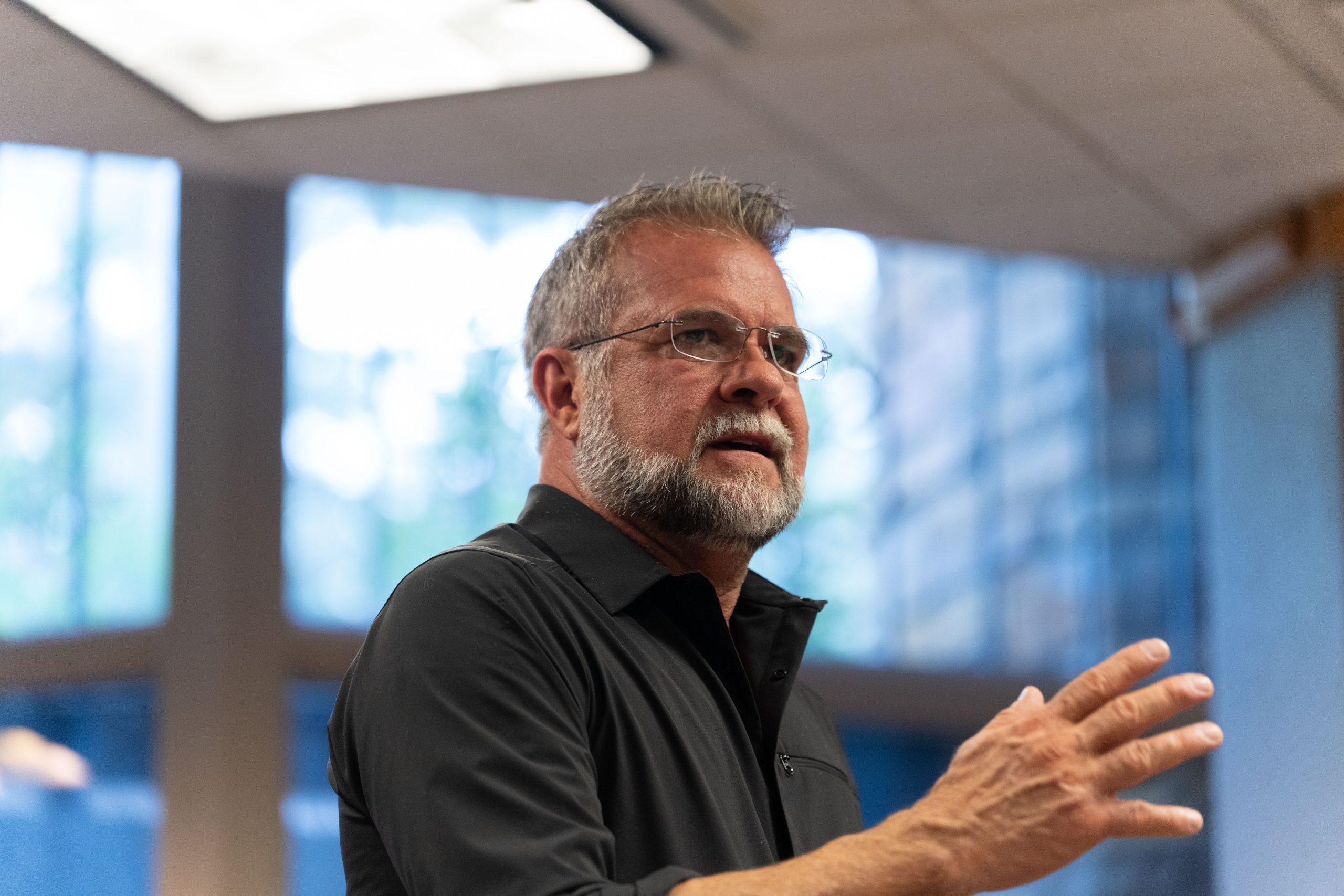
Victor Marx’s spending is as unusual as the rest of his campaign
LAS VEGAS — Somewhere in this gated subdivision not far from the city’s opulent casinos and 24-hour nightlife lies the address of one of the larger recipients of Victor Marx’s campaign cash.
The home — a three-bed, three-bath residence — is the registered location for Varyation Consulting, which a Marx spokesperson initially described as a security consultant to the campaign. The company was started by Varya Shozen, a Tokyo-based Realtor. Varyation has so far been paid $20,000 from funds given to Marx’s campaign by people who want to see him become governor of Colorado.
This story was produced as part of the Colorado Capitol News Alliance. It first appeared at cpr.org.
But neither Varyation Consulting nor Shozen have Nevada licenses to do security work. The company seems to have no other footprint — physical or online — beyond registration with the state last year as a nondescript corporation. That came just six weeks before Marx announced his candidacy. Nothing in Shozen’s online or business profiles suggests expertise in security, just ties to Chinese universities and a career in real estate.
Much of the reporting on Marx’s Republican campaign for Colorado governor has focused on the contributions. The campaign faces numerous complaints about finances. His campaign has admitted that it erroneously accepted donations over the legal limit, and now faces one of the largest penalties in state history. Marx is also dealing with an open complaint that he used his merchandise store as a way to circumvent contribution limits.
Less attention has been devoted to how the Marx campaign has spent that money, and how it runs counter to long-established playbooks for how statewide campaigns are traditionally run in Colorado.
“I think it’s fair to say an unusual expense report for an unusual candidate, but I would also add that it appears very unprofessional and sloppy comparatively and done by someone without experience,” said Mario Nicolais, an attorney and campaign finance expert. “When you don’t hire professionals and people who have done this professionally before, you wind up making reports that do have all of these questions.”
The Marx campaign did not acknowledge multiple requests for an interview, and only responded to questions in writing through a series of emails that provided an evolving explanation for Varyation’s work.
The campaign initially said Varyation’s work was for security assessments for events, but provided no more specific breakdown despite multiple requests from CPR News. All attempts to contact Shozen were unsuccessful. A woman, who did not identify herself, opened the door at the Las Vegas address, but wouldn’t respond to questions, saying she didn’t speak English.
At the real estate office where Shozen is listed as a broker, a co-worker said she had not been there in months, but is still on the roster of salespeople.
Shozen and Varyation are registered with the World Association of Detectives, which describes itself as a global networking organization for private detectives. Marx’s campaign manager, Buddy Jericho, said he met Shozen at a World Association of Detectives conference.
After initially saying she provided security analysis for the campaign, Jericho said in a follow-up that Shozen provided broader analytic skills beyond just security.
“She was brought onto the campaign for a relatively short period early in the race to conduct research and analytical work that helped us understand the environment we were operating in and develop our initial strategy,” wrote Jericho. “I don’t think someone’s work in real estate is inconsistent with also having experience or capabilities in research and analysis.”
Shozen speaks Shanghainese and Mandarin Chinese according to her LinkedIn, and she spent at least three years attending Beijing universities.
“I have never seen anyone like this who’s being paid by a campaign,” said Nicolais, who noted that China has attempted to influence American elections. “It just raises questions that need answering.”
It’s just one of multiple security expenditures being paid for by Marx’s campaign supporters. All would seem to be lawful under Colorado election law, if Marx’s campaign filings accurately reflect the purpose of the expenditures.
But the amounts are far larger than any Colorado candidate typically spends on security, and they are among several categories of expenditures that are very different from most campaigns.
Family and friends
Few, if any, in the Republican Party knew who Victor Marx was when he first announced he would run for governor. And Marx did not embrace the GOP establishment nor did he rely solely on professional political operatives.
His expenditures show that he instead relied on a trusted group of friends, family and previous associates with little to no experience in elections. The web of payments isn’t large, but they are complex. And all are listed as consulting and professional services.
Former chair of the Colorado GOP, Brita Horn, said relying on outsiders can be a mixed bag.
“They can bring some good things from outside,” said Horn. “But the danger of bringing somebody from the outside, they don’t know all the rules or all our institutional knowledge and how we run things here in Colorado.”
Jericho, a longtime associate, has become the Marx campaign manager and primary media contact. Jericho has worked with Marx on anti-human trafficking initiatives for years and has been a board member of Marx’s All Things Possible nonprofit. Jericho has received $71,000 for campaign work.
Avery Jericho, who is Buddy’s daughter, also received $15,000 in payments for consulting services, which Buddy described as organizing and scheduling events.
Buddy Jericho is connected to other businesses paid by the Marx campaign.
Jericho founded Indago Technologies, which markets itself as “a next-generation AI intelligence platform.” Indago was paid $3,600 directly. The director of product for Indago is Heather Perez, who formed Athene Strategic Intelligence LLC in Florida six days before Marx announced his run for governor. Athene and Perez have been paid $34,164 and $10,125, respectively, by the Marx campaign.
A similar pattern repeats for other Marx confidants.
Mark Geist is a former Marine and security contractor whose organizations have partnered with All Things Possible. Geist was paid $26,167 for consulting related to outreach and “donor engagement.” The campaign said he was not part of the security team, but more than $3,000 in payments to him were labeled “security.” His wife, Krystal Geist, was also paid $16,635 for consulting related to recruiting and organizing volunteers. Their company, Client Response, received another $8,000.
Torin Beeler was hired as the managing director for corporate travel sales for Best Western Hotels in June. Before that, he worked for Marx for a year as the director of strategic development for All Things Possible, though his professional background is otherwise focused on hospitality management. Beeler was paid $2,945 for consulting services. And a company registered to him in Arizona in 2020, listed in Marx’s campaign filings as ABMAM Investments LLC, was paid another $20,000.
Then there are small payments directly to family members. Brie Marx and Shiloh Marx, Victor’s daughter and son respectively, have been paid for campaign work — less than $30,000 total.
“Hiring decisions have been based on the work that needed to be performed and our assessment of who could perform that work effectively,” wrote Jericho in an email. “We won the primary.”
Jericho also disputed that the campaign relies on just family and friends, citing vendor relationships with longstanding professional firms.
“Prospecting“
One of those professional campaign firms received the most money from Marx. More than 36% of Marx’s campaign spending — about $1.4 million — is classified as fundraising expenses.
Nearly all of that money went to a Virginia company called HSP Direct, and $792,861 in payments to HSP and another vendor are explicitly described as “prospecting.”
“Prospecting” is an unusual label in Colorado campaign-finance records for what is a common fundraising practice: trying to acquire new donors. Also unusual is how much Marx is spending on fundraising.
Marx has spent far more on fundraising than his Democratic opponent for governor, Phil Weiser, who reports $423,838 in fundraising expenses — while raising more than twice as much money as Marx. Marx is new to politics and had no previous campaign records or donor base to draw on. His campaign was essentially starting from scratch.
Colorado hasn’t elected a Republican to statewide office in a decade, as the state has steadily trended towards Democratic control. Only one Republican has held the governor’s office in the last half century.
But one thing that Marx could walk away from the campaign with is contact information for thousands of donors who have given him contributions.
HSP Direct, which provides direct-mail and donor-list services, is the campaign’s single largest vendor. The firm is new to Colorado; a search of Colorado’s campaign-finance database found no payments by any Colorado candidates to HSP Direct before Marx’s campaign. But the firm has extensive experience working in conservative politics in other states.
The firm didn’t respond to a request for comment from CPR News.
HSP Direct offers a full suite of fundraising services including mail, graphic design and account management, according to its website. HSP Direct markets donor list services including “more than 2.5 million names of conservative Americans.” The company can also “oversee and market the use of your donor names to generate additional revenue for your organization or campaign.”
The Marx campaign responded that the data gathered through HSP has not been used by Victor Marx’s affiliated organizations.
“No campaign donor data has been transferred to All Things Possible or any other outside organization,” Jericho wrote in an email. “The ownership, control, and permitted future use of data generated through individual vendor programs are also governed by the campaign’s agreements with those vendors and applicable law.”
Jericho didn’t respond to a question about what will happen with that data once the campaign is over.
The explanation for HSP Direct in the campaign reports to the state notes that the expenses are focused on direct mail.
“This looks to me like a campaign from 20 to 30 years ago,” said Nicolais, who worked on Republican campaigns around that time. He said the reliance on mail in a digital world seemed like a relic of past campaigns.
The campaign finance mailings have a dual purpose. “Because if you’re sending lots and lots of mail, if that’s your main advertising, trying to raise money, then you’re sending huge amounts of mail,” said Nicolais.
Advertising, or the lack thereof
While Marx has spent more than any other candidate this cycle on fundraising, he spends an unusually small amount on advertising for a statewide candidate.
Records show just $242,922 on expenses identified as advertising. That’s just more than 6% of his total spending. By contrast, Weiser has spent $5.2 million, or about 67% of his total spending, on advertising, mostly on TV, radio and digital.
Among Colorado campaigns that have spent at least $200,000 this election cycle, the median share of spending on advertising is about 32%.
Marx has a large social media following, numbering about 3 million followers across channels, and so a traditional advertising campaign is perhaps less necessary. Marx also has no contracts for future TV advertising in the public inspection file for major Denver stations.
Security
Over the last 10 years, no other Colorado candidate has reported spending more than $5,000 in campaign funds on security.
Marx is different. His campaign has paid various firms and individuals more than $150,000 for security — a total that doesn’t include the payments to Varyation Consulting.
When asked why the campaign was spending so much on security, they said that it was “not simply a general precaution.”
“Victor has a unique background that includes years of work involving trafficking, violent criminal organizations, high-risk environments, and other sensitive matters,” wrote Jericho, in response to questions from CPR News. “As a statewide candidate, he has also participated in a significant number of public events throughout Colorado. Those factors were evaluated as part of our security planning.”
Most of that money went to a firm called Gray Shadows Protection, based in Aurora. Gray Shadows is run by Sean Jabrayilov, who has said in podcast interviews that he immigrated from Russia and became a U.S. citizen recently. Records show the Marx campaign has paid the firm $91,887 from December 2025 to September 2026.
Jabrayilov did not respond to an email seeking comment.
Marx has paid smaller amounts to various contractors for security. A vendor listed only as Jose Jimenez, based in Texas, was paid $50,628. Most of those payments are uncategorized, but at least $5,000 is listed as for “security.” The campaign later clarified that he is the director of security, and they said all payments are security-related.
Another $3,432 went to Mark Geist for security. Extra Duty Solutions, based in Connecticut, received $3,637. Fidelis Security Solutions, based in Colorado Springs, received $1,500.
Weiser, by virtue of being the Attorney General of Colorado, has security provided by taxpayers, though the exact amount is unknown. Weiser’s office said those details are kept confidential for security purposes.
While Marx’s security spending is unusual, it makes sense in the current political environment, said Nicolais.
“Whether you’re talking about the assassination attempts against President Trump when he was a candidate or whether you’re talking about the assassination of Charlie Kirk or whether you’re talking about the assassination of Democratic lawmakers in Minnesota — times have changed,” said Nicolais.
This story was produced by the Capitol News Alliance, a collaboration between KUNC News, Colorado Public Radio, Rocky Mountain PBS, and The Colorado Sun, with support from news outlets throughout the state. Startup funding for the Alliance was provided in part by the Corporation for Public Broadcasting.