Rubio Wants Europe Awake. Latin America Is.
ANALYSIS · THE WEST AND POWER
Key Facts
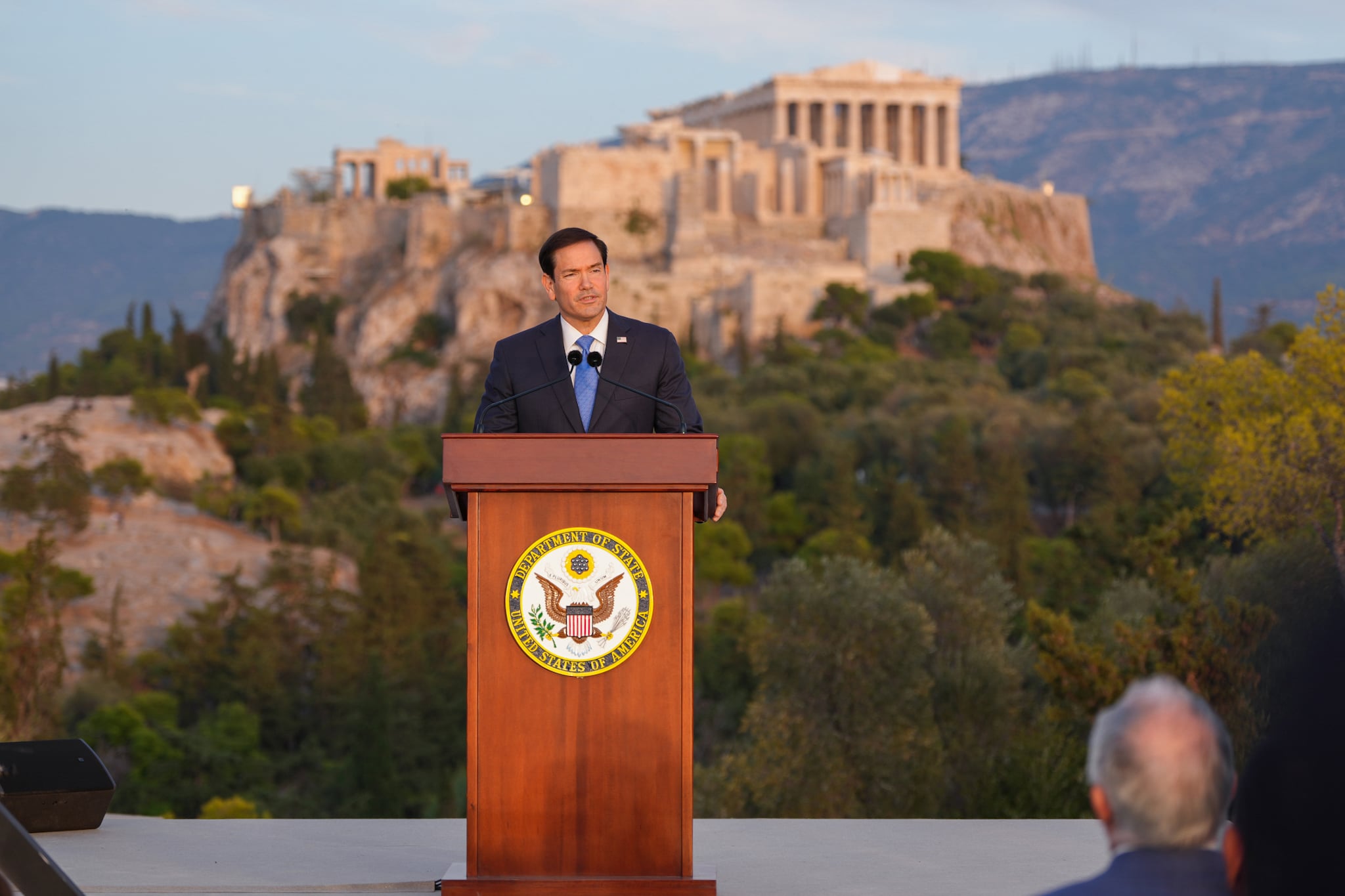
- —The speech US Secretary of State Marco Rubio spoke on Wednesday, 7 October 2026, on the Pnyx in Athens, with the Acropolis behind him.
- —The core line “We choose the unapologetic pursuit of national power.”
- —The backdrop America has been at war with Iran since 28 February 2026, and Iran says the Strait of Hormuz stays shut until its conditions are met.
- —Prediction markets Polymarket puts a US invasion of Iran before 2027 at 15.5% and a Democratic House win on 3 November at 90.5% (8 October, 2:32 p.m. ET).
- —What it means for you Expect years of heavy spending on defense, chips, energy and factories, and more US pressure on allies to pay their share.
For three decades, the West believed trade and global institutions would make raw power old-fashioned. On a rock in Athens, Marco Rubio declared that era over.
On Wednesday, 7 October, US Secretary of State Marco Rubio stood on the Pnyx, the hill where ancient Athenians voted on war and peace, with the Acropolis behind him. He told the Western world that it had become ashamed of its own greatness, and that this shame now threatens its survival.
His message fit into one sentence: “Under President Trump, the United States has made its choice. We choose the unapologetic pursuit of national power.” After thirty years of the globalization consensus, it marks the start of a new era in which the West intends to show its teeth again.
The Speech in Plain Words
Ancient Greece, Rubio said, gave the West its character: ambition, curiosity, a love of competition and the fighting spirit the Greeks called thumos. “Without it, nations lose their will to fight, the will to strive, the will to survive.”
Then he named what went wrong. The West opened its borders, shipped its factories abroad, let its armies wither and decay and handed decisions “to global bureaucracies far beyond the reach of our control,” while rivals were “all too happy to fill the vacuum.”
His message to Europe was blunt but friendly. “We believe that Europe can awaken from its long slumber,” he said, praising Greece as “a model ally” and NATO’s 2025 pledge in The Hague to raise defense and security spending to 5% of GDP by 2035.
Follow this story
Get an email when there’s news on Marco Rubio
Why Athens, and Why Now
The place carried a lesson. Around 483 BC, Athenians on this hill chose to spend a silver windfall on 200 warships instead of sharing out the money, according to the historian Herodotus. The ships were built for a war with the nearby island of Aegina, but three years later they formed the core of the fleet that crushed the Persian king Xerxes at Salamis.
Athens survived because it built power before it needed it. Rubio recalled the Athenians who defended the Acropolis to the last against the Persians, and today Persia’s heir is at war with America.
On 28 February 2026, the United States and Israel struck Iran and killed its supreme leader, and Iran closed the Strait of Hormuz, the route for about a fifth of the world’s oil. A ceasefire collapsed in July, oil topped US$100 a barrel in September, and on the day of the speech President Trump said a deal was no longer something he wanted. A day later he said the United States would not attack Iran before the midterm elections.
Rubio’s attack on “the radical mullahs of Iran, whose cult of death hails child suicide bombers as national heroes” sent Europe a clear signal: this war is yours too. He aimed at the regime, not at Iran’s roughly 90 million people, many of whom have risked their lives protesting against it.
In the Line of Truman and Reagan
Great American speeches to Europe have marked turning points before. In 1947 Harry Truman asked Congress for US$400 million to save Greece and Turkey from communism, and in 1987 Ronald Reagan stood at the Berlin Wall and said, “Mr. Gorbachev, tear down this wall!”
In Warsaw in 2017, Donald Trump asked “whether the West has the will to survive,” and in Munich in 2025 Vice President JD Vance warned Europe of “the threat from within.” Rubio’s own speech in Munich this February was the handshake; Athens is the battle plan.
What is new is that Rubio no longer claims Western values belong to everyone. Truman, Reagan and George W. Bush spoke of universal freedom, but Rubio called heroism, honor and duty “the product of a distinct character,” echoing the Harvard scholar Samuel Huntington, who wrote in 1996 that the West is “unique, not universal.”
He also made power an explicit goal, joined to “prudence and diplomacy” and to “the credibility that you are willing to use it.” That is the classical rule the Greek historian Thucydides recorded 2,400 years ago: “the strong do what they can and the weak suffer what they must.”
Everyone Else Never Stopped
“War did not disappear simply because we preferred peace,” Rubio said, and the record proves it. China joined the World Trade Organization in 2001 and now makes close to 30% of the world’s manufactured goods, Russia invaded Ukraine in 2022, and Iran turned the world’s oil supply into a weapon in 2026.
Europe Is Living on an Inheritance
Europe’s comfort is real, but much of it was earned long ago: centuries of risk, conquest and invention, then the American security umbrella since 1949 and, until 2022, cheap Russian gas. That inheritance is shrinking, and the EU’s birth rate fell to a record low of 1.34 children per woman in 2024, far below the 2.1 needed to keep a population stable.
Migration is the most explosive issue. Some 46.7 million people born outside the EU lived in the bloc at the start of 2025, about one in ten, according to Eurostat, and the US National Security Strategy of December 2025 warned of Europe’s “stark prospect of civilizational erasure”; in Athens, Rubio praised the shared US-Greek ambition to “secure Europe’s borders from the threats of mass migration.”
Latin America Is Choosing Sides
The speech landed in a hemisphere that has already moved. Since October 2025, voters have elected right-leaning presidents in Bolivia, Honduras, Chile, Peru and Colombia, and more than a dozen countries in the region have joined the Shield of the Americas, a US-led coalition against cartels.
Of the region’s biggest economies, only Brazil and Mexico are still governed by the left, and Brazil may turn next. Flávio Bolsonaro, son of former president Jair Bolsonaro, won 47.03% in the first round against 45.16% for President Lula da Silva and has promised to join the Shield if he wins the runoff on 25 October.
For the West, the region is a treasure chest. Chile, Argentina and Bolivia hold roughly half of the world’s identified lithium, Chile and Peru mine about a third of its copper, Mexico and Peru produce more than a third of its silver, Venezuela has the largest proven oil reserves on earth, and Brazil leads the world in exports of soybeans, beef and coffee.
China noticed first: its trade with Latin America is worth more than US$500 billion a year, and a Chinese state company owns 60% of Peru’s new megaport of Chancay. The region can slide back into a colonial pattern of raw materials out and finished goods in, or become an indispensable partner in the West’s comeback, if its leaders use that leverage to build industry at home.
What the Critics Miss
The left says culture is “fluid” and that what binds nations is “material,” as Representative Alexandria Ocasio-Cortez argued in Munich, while Mexico’s President Claudia Sheinbaum condemns anyone who praises Hernán Cortés, whom Rubio named beside Alexander and Caesar. None of these critics offers an alternative to power, and they argue about tone and history while Beijing, Moscow and Tehran keep arming, buying and building.
Why the West Must Show Its Teeth Again
Power never disappears; someone else simply picks it up. Athens built its fleet before Xerxes came, Truman armed Greece before communism could take it and Reagan rebuilt American strength before the Berlin Wall fell, and each time power came first and freedom followed.
Today only the United States can lead that comeback, because Europe has the money and the history but not yet the will. If Washington joins force with prudence and loyalty to its allies, the speech on the Pnyx will be remembered beside Truman’s and Reagan’s as the day the West decided to stand up again.
What It Means for US Readers
For investors, the new doctrine means years of public money for defense, shipbuilding, chips, critical minerals and energy. For households, the Iran war is the immediate cost, because oil stays expensive as long as shipping through Hormuz is blocked or restricted, and in Latin America the war splits oil exporters from importers.
What Prediction Markets Say
On Polymarket, a US invasion of Iran before 2027 was priced at 15.5% on 8 October at 2:32 p.m. ET, and the Democrats had a 90.5% chance of winning the House on 3 November. The midterms are therefore the first big test of Rubio’s doctrine at home.
Why we show this: prediction markets turn real-money bets into a live probability that moves within minutes of the news, which is why investors, campaigns and newsrooms in the United States now follow them closely. We show them next to polls and official results, never instead of them.
What Is Not Known
Nobody knows yet whether Europe will turn its spending pledge into real ships and factories, or how the Iran war will end. Rubio has also said nothing about running for president in 2028, although some commentators read the staging as a sign of bigger ambitions.
Frequently Asked Questions
Where did Marco Rubio give his Acropolis speech?
He spoke on Wednesday, 7 October 2026, on the Pnyx, the hill in Athens where the citizens of ancient Athens met in assembly. The Acropolis stood behind him.
What did Rubio mean by the unapologetic pursuit of national power?
He meant rebuilding industry, supply chains and defense and competing to lead in technologies such as artificial intelligence, chips and drones. He said real power needs both diplomacy and a credible willingness to use force.
Why did Rubio mention the Persians and Iran?
He opened with the Persian attack on Athens in 480 BC and later condemned the radical mullahs of Iran. The United States has been at war with Iran since February 2026.
How does Latin America fit into Rubio’s vision?
Most Latin American governments now lean right and work with Washington on security through the Shield of the Americas. The region’s lithium, copper, silver, oil and food make it essential to any Western comeback.
Sources: US State Department, Rubio remarks, 7 October 2026; Herodotus 7.144; Truman Doctrine; Reagan Library; Warsaw 2017; Foreign Affairs 1996; Eurostat population by country of birth; Eurostat fertility; TSE Brazil; RTP; Konrad Adenauer Foundation; USGS 2025; LatinFinance; Washington Times; CNBC; elDiario.es; Fox News; Polymarket Iran; Polymarket House (accessed 8 October 2026).
Ask Rio Times
This story and the bigger picture.
Answers are generated from Rio Times reporting only — every claim links to its source article.