Inside the Vanity Museum That George Lucas Built
It’s hard to miss the new Lucas Museum of Narrative Art, which opened late last month in Los Angeles. For one, the building, designed by Ma Yansong of MAD Architects, looks like a glowing piece of futuristic Hollywood kitsch. It’s spaceship-adjacent, fittingly enough given Lucas’s background as the creator of the Star Wars franchise. And indeed, a lot about this museum is, I hate to say, obvious.
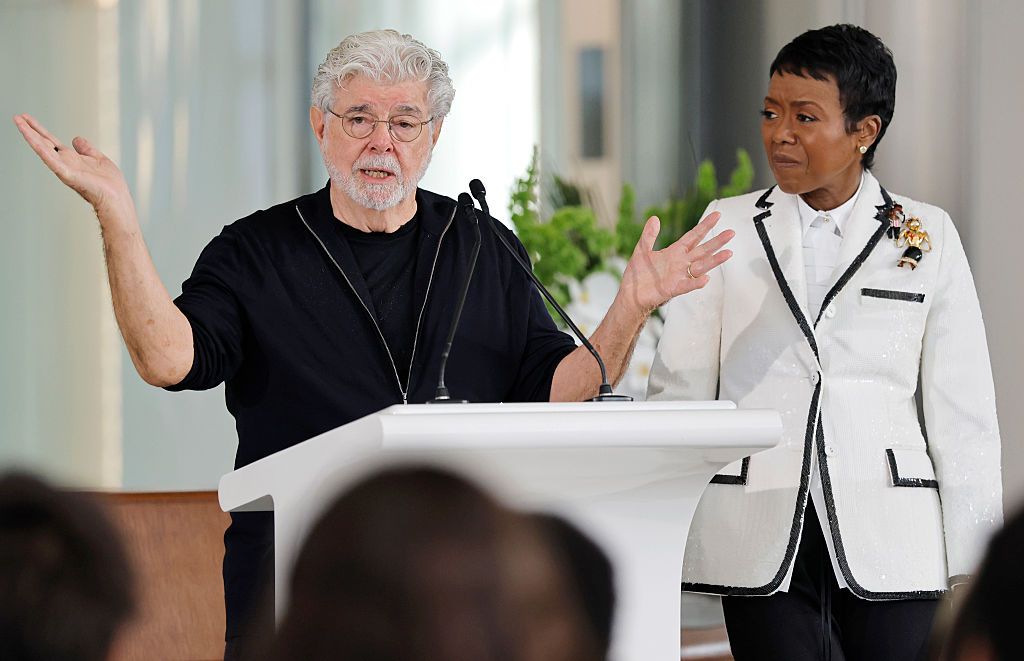
The museum, which cost $1 billion and took 20 years to build thanks to substantial delays, was co-founded by George Lucas and his wife, Mellody Hobson. While less than 10 percent of the collection is Star Wars-related art and ephemera, there are 30 galleries to peruse, featuring everything from manga and Norman Rockwell paintings to comic art and murals by JR and Diego Rivera. The goal, Hobson said in a statement, is for people to “see themselves—and the world they know—reflected back.” The premise of the museum, according to Lucas himself, is to show “art that illustrates a story.”
“The Lucas Museum of Narrative Art was created to honor humanity’s stories and the artists who illustrate them,” he said in a statement. “The artists in this collection didn’t just create images, they connected our modern imaginations with our ancient emotions—with common beliefs creating community.”
But that isn’t necessarily true. Even though Star Wars fans will likely come for any writer who criticizes this museum (“why can’t you just celebrate how great this museum is?” they’ll ask, wide-eyed), Lucas underestimates the intelligence of his audience, assuming that myth is the only thing that binds us. And he treats the idea of storytelling in a flat, opaque way.
Housed in a sleek sci-fi spaceship, this grandiose vanity project is certainly selfie-friendly. With its glowing lights and modular shapes, the building is one of L.A.’s marvels. But when you peel back the pizzazz—and practically everyone in Hollywood showed up to the red-carpet opening, from Kim Kardashian to Leonardo DiCaprio—you’ll find more than 1,400 relatively simple, often myth-driven artworks curated into categories like motherhood, work and family.
Highlights include Ernie Barnes’ Quintet (1989) of jazz musicians; Mary Cassatt’s Children Playing with a Cat (1907); Doug Chiang’s Starship Landing Platform (2000-02), production art for Star Wars: Episode II – Attack of the Clones; and Joey Terrill’s cover for Chicos Modernos, vol. 3 (1989), a comic by an artist who fused LGBTQ+ activism with Chicano politics at the height of the AIDS epidemic. There are paintings by Frida Kahlo, Vincent van Gogh and Jacob Lawrence. Lucas has taste, no doubt about it, and his collection spans thousands of years of art history.
But what is “narrative art,” anyway? Is it a fabricated category, or simply another term for cinematic art? The museum defines narrative art as work “created to tell stories through images.” As it explains in a statement: “Much of the world’s artistic expression has been motivated by storytelling, transmitting narratives rooted in religion, myth, history, literature or notable events.” To me, that label implies that art must tell a story, that it can’t be abstract or avant-garde and that viewers need a narrative to understand it.
So don’t expect to find works by Barnett Newman or Jackson Pollock. They run counter to Lucas’s idea of ‘storytelling’ and his overall philosophy of art and creativity. Lucas believes that when fine art shifted toward Abstract Expressionism, “it abandoned the public” because it “stopped telling human stories.” But abstract art is neither mechanical nor dehumanized. It’s okay to own art you can argue with, art you disagree with, art that challenges you. After all, art isn’t decoration. Unless, perhaps, you’re Lucas.
Abstract art still tells a human story. Look at Lee Krasner’s 1956 painting Prophecy, which all but predicted Pollock’s death and captures, from a female perspective, the emotional friction of a marriage falling apart. Or consider how Piet Mondrian’s 1942 painting Broadway Boogie Woogie tells the story of New York City’s vibrant jazz scene.
Mark Rothko’s color field paintings are deeply emotional landscapes that capture the pre-digital human experience, letting viewers be awash in color and allowing color to speak to them without words or traditional imagery. Abstract and non-figurative art was also used by dissident artists working under authoritarian regimes as a coded form of political rebellion.
Walking through the galleries can feel like browsing a billionaire’s impressive but wide-ranging fine art holdings—and they are impressive, particularly in their number. The one exception might be the engaging comics galleries showcasing artists like Robert Crumb, Alison Bechdel and Jack Kirby, which makes perfect sense, since comic art can be read like a storyboard, something filmmakers love. But taken as a whole, there is no real thematic framework at the Lucas Museum of Narrative Art beyond the words that label each gallery, which is strange, considering how many visitors will be film or sci-fi buffs who are likely expecting Lucas to tell a more cohesive story.