Can a Black gay man still call the hogs?
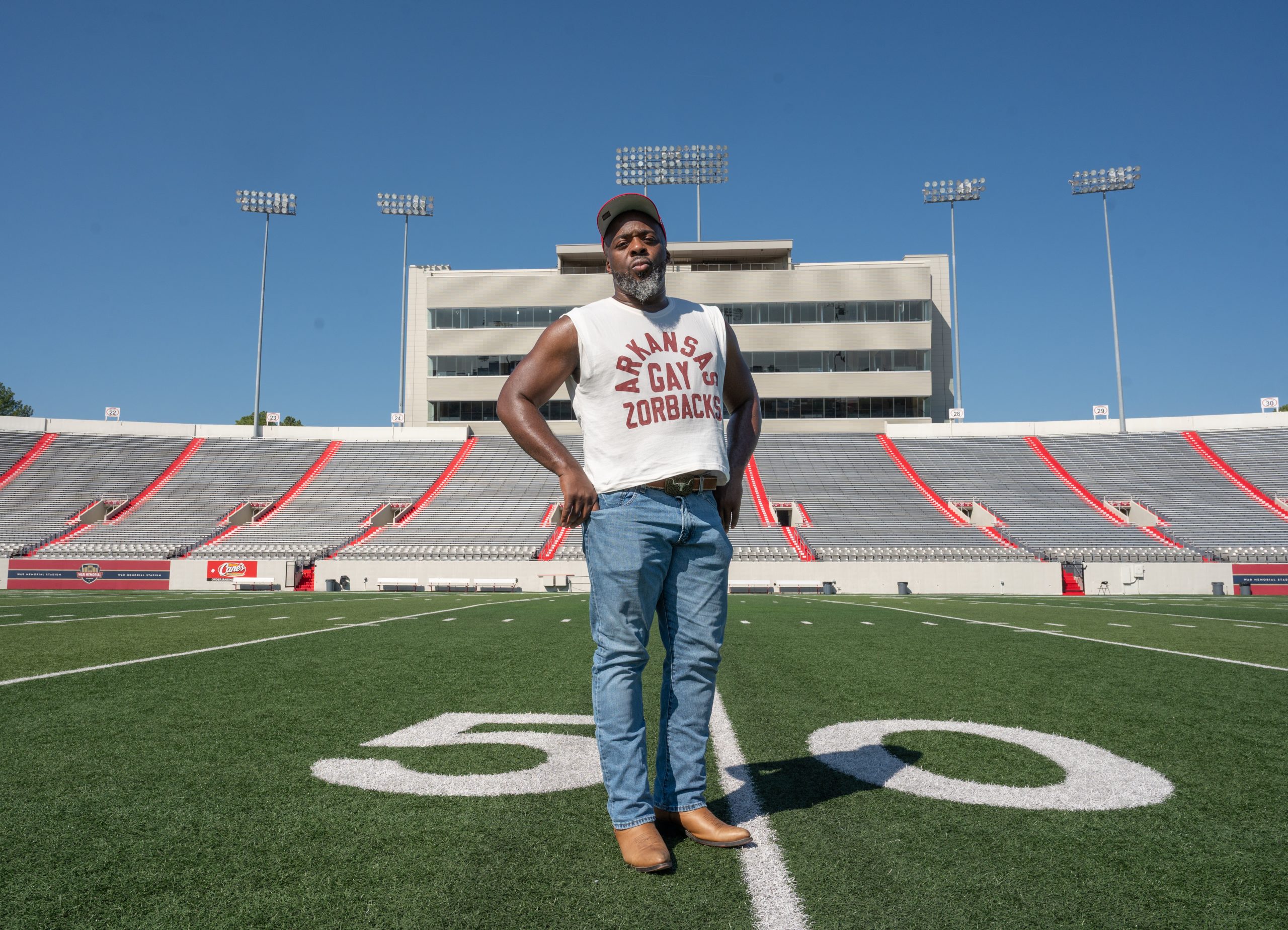
Nothing brings out my inner snob more quickly and satisfactorily than the University of Arkansas at Fayetteville, the chance to turn up my nose at the Razorbacks. But I’m starting to understand this hoity-toity attitude as a reflexive defense against a complicated FOMO, which perhaps says more about me than it does about the U of A.
What features of Razorback fandom do I confess to longing for? A taste for cold beer, childhoods spent tailgating with one’s parents, being gifted a pickup truck in high school, participating in any number of water or outdoor recreational activities during the summer. Having an affiliation with the state’s majority that might grant me the eternal blessing and consideration of local movers and shakers. You know, white people stuff. Cosplaying as a good ol’ boy, basically.
I’m trying to become better about naming the envy or jealousy I feel as an adult, emotions no one wants to claim because it’s an admission of longing, tainted by lack or weakness. When I think of Fayetteville, I think of a kind of cut-and-paste conveyor belt to security and comfort. It is a terrarium where inside the glass, plastic coeds go about playing their parts in a rom-com or — better yet — a reality show: “Love Island of the Ozarks.” It’s taken me into my 40s to realize that the meritocracy I long valued doesn’t just measure success by who manages the best grades. Life beyond academia keeps score on so many fronts — who’s most attractive, who’s the wealthiest, who’s in the best shape, who’s having the best time.
Sometimes, when I look at the U of A, I wonder if I’m in fact losing the game. If only I were able to abandon the ceaseless drama of coveting the lives of white folks. But, alas, this institution, the favored pet of the state, incites these kinds of feelings.
Which is not to say the university and its alumni are without any redeeming qualities. I’ve known many U of A grads to be resilient, hard-working, resourceful and even self-deprecating, their humility seemingly derived from being trained in a system that dwarfed them. State schools check your ego like this, it seems, forcing you to become a part of a horde. And maybe that develops some part of your character, being a small piece — but just that — of something so massive. No doubt it’s the reason so many co-eds are steered into fraternity and sorority culture in the first place, to shrink such a hulking environment somewhat.
On the outside looking in, though, everyone at the U of A seems to always be having so much fun as they float through all those longstanding traditions, the football games and Greek life. Ole Miss alum and college football writer Steven Godfrey recently told me in an interview for the Oxford American that schools like the U of A are being marketed as resorts. “You’re turning on the TV every Saturday and watching a 3-hour advertisement of 72-degree weather, young attractive people, essentially a ceaseless party, right? Then you get online and you look at social media culture, and see RushTok at places like Alabama and Ole Miss. It all compounds into selling a vacation,” he said.
But, as the party rages, I feel like I’m relegated to just looking on, having not actually been invited. I think what I’m trying to admit here is that while I have some curiosity about accessing mostly white spaces, they scare me, and it’s not worth expending the social and cultural capital to access them if they’re only ever going to hold me at arm’s length.
Is there really room within the firmament of the U of A — with a Black population that makes up about 4% of the student body (as opposed to roughly 15% at both the University of Central Arkansas and Arkansas State University and nearly 25% at UA Little Rock), with a Greek culture so firmly entrenched that organizations famously host high school students to begin indoctrinating them into the system before they’ve even graduated — to truly accommodate and support the growth and well-being of a Black gay man?
There is, of course, the fabled path of the late E. Lynn Harris (1955-2009), a bestselling Black gay writer who attended the U of A in the mid-’70s and then returned as a professor and cheer coach in the early 2000s. Given his status as the university’s first Black, male cheerleader and first Black yearbook editor as well as his eventual career trajectory, Harris seems to offer proof of someone like me’s ability to establish genuine community — and post-graduate success — in the rarified hills of Northwest Arkansas.
So with this example, can I finally reconsider my ambivalence toward the institution and begin to dismantle my idea of the place as a bastion of white heteronormativity?
And then, as I’m beginning to ponder the themes for this essay, Nolan Wells, an 18-year-old Black junior college football player, dies in southern Mississippi while partying with a crew of friends — all white guys — after riding on one of their family’s boats to Horn Island on the Fourth of July. Suddenly, all the old terror about letting your guard down and allowing oneself to be seduced into the proximity of whiteness comes crashing down around me.
Fraternity members mocking the death of George Floyd; racially tinged arguments on message boards over whether the U of A should play games at War Memorial Stadium in “crime-ridden” Little Rock; rumors of watermelons being thrown from a parking deck when Barack Obama was elected president; the accusations of race-baiting around coach Nolan Richardson’s firing; the mistreatment of Joe Johnson in his recruitment to play at the U of A as a Prop 42 athlete; coach Lou Holtz backing segregationist candidate Jesse Helms of North Carolina in 1983; the struggle to integrate the school’s athletic departments — all of these things resurface in my memory in the wake of a seemingly unrelated incident down in Mississippi, and the mortal fear of white disregard for Black humanity resurfaces.
The allure of red and whiteness
“It was 1969, I was 12 years old, and I had a boyhood crush on the Arkansas Razorbacks football team,” E. Lynn Harris wrote in Sports Illustrated in 2003 of his upbringing in Little Rock. “Mama, and everyone else in my neighborhood of colored people (that’s what we called ourselves then), didn’t like the Razorbacks because they were lily-white; in 76 years of fielding a team, they had had but one black player, a walk-on in ’66. My neighbors pulled instead for the all-black mighty Bearcats of Horace Mann High and the Golden Lions of Arkansas AM&N, a historically black college in nearby Pine Bluff.
“But even though mama tried her best to steer me away from the Razorbacks — she wouldn’t even let me listen to their games on the big radio in the kitchen — they were my passion. I would read legendary sportswriter Orville Henry’s columns in the Arkansas Gazette as if they were love letters from Miss America contestants.”
Harris seemed primed for a charmed life in Fayetteville. His childhood had been a study in fleeing the rank homophobia of his midcentury working-class Black community by attracting the favor and patronage of white benefactors, first at the racially integrated but by then predominately Black and poorer West Side Junior High in Little Rock, then at the predominately white Hall High School, before continuing on to Fayetteville and then a short-lived corporate career at IBM.
It’s a bit harrowing to imagine such a big part of your identity deriving from distinguishing yourself from the racial community you come from. Something about that feels familiar, though, if I look at it through the lens of escaping the alienation experienced for your sexual identity by fleeing into white environs. Something like what Black people mean when they derisively accuse Uncle Toms or Oreos (Black on the outside, but white on the inside) of believing, “The white man’s ice is colder, his sugar sweeter and his water wetter.” There’s the interminable allure of acceptance and ease to be found among white people for Black gay men who’ve been castigated by their own community. I’ve certainly been accused of this at times, and sometimes even accepted it as my truth.
Harris wrote of his abiding preoccupation with whiteness in his 2003 memoir “What Becomes of the Brokenhearted,” explaining that he chose to transfer schools in the eighth grade because he was “curious about white people” and that “‘Archie’ and ‘Richie Rich’ comic books had become my windows to the white world I was so curious about.”
Which is not to argue that Harris was a snow queen, or a Black gay man with an ultra-selective sexual appetite for white men. At least that perspective is not evidenced in his fiction, where he, as a writer, took obvious delight in describing the various hues of Blackness — the “silk chocolate skin,” the “honey-amber skin,” the “beautiful cider-brown [complexion]” — of his casts of characters.
I think it might be important to distinguish the kind of gay man Harris was from the kind that I am. While I’m sure he had his affectations, Harris was not the type to shield himself from the potential violence of the world by armoring himself with pomposity. “He believed very much so in the value of showing up well,” Kimberly Williams, a former Arkansas cheerleader and Miss Arkansas contestant who was coached by Harris in the 2000s, told me. Harris’ literature, despite privileging gay and Black characters, was decidedly mainstream and sought “happy endings.”
Even in his memoir, he wrote of not driving Interstate 540 into Fayetteville until he returned in 2003, because he only knew “the old pig trail.” Homespun colloquialisms like that make me cringe. All that quaint folksiness you hear in something like “Dixieland Delight” by the country-Western band Alabama. I, unlike Harris, feel much more hostile to honky-tonk kitsch, having once savored learning of the U of A’s designation as a “land grant” institution because that moniker sounded so agrarian, so hick-ish in a way I decidedly was not.
But I want people to understand this seeming haughtiness of mine as partially a defense mechanism, the withering critique of a gay man trying to steel himself against the hurt of being excluded, of the physical and romantic longing in oneself that so often goes unrequited. The default response to navigating life as a sexual minority is either feeling “brokenhearted,” as Harris confesses to having felt, or recasting oneself as more urbane, more sophisticated than one’s origins, as Harris also did, often imagining himself enrolling at my alma mater, Howard University in Washington, D.C.
“My first thought was to leave school, and I considered transferring to Howard University. Howard sounded good because of D.C. and its large ‘gay problem,’” he wrote in his memoir, following the dissolution of a close friendship in Fayetteville. Black people sometimes see flight as a kind of revenge. I certainly did once, when I absconded from Little Rock to the storied HBCU, discovering a campus that, while Black, did not afford much visibility to queerness.
Much of Black life on the U of A campus in the early ’70s seems to have happened in a marginal universe running parallel to the more mainstream lives of white classmates, according to “What Becomes of the Brokenhearted.” “The three hundred or so black students formed a community within the university community,” Harris wrote of campus life during his undergraduate years. Regarding his relationship with a close white friend from Arkansas Boys State who largely influenced his decision to come to the U of A, Harris wrote: “We talked on the phone often, but the socialization of the campus prevented us from spending a great deal of time together.”
By the time Harris begins describing his college years in his memoir, we’ve already read of his habit of sublimation, which he deployed throughout high school to disguise and deny his sexual proclivities. His interest in student government at Hall High derived from an attempt to “overachieve so people wouldn’t notice the differences about me that I was beginning to hear loud and clear in my heart.” Later, he “realiz[ed] that my interest in politics and the support of others was a search for self-esteem. If I could win an office … [white people] would view me as an equal, while black students would respect me and look up to me.” All of which makes you wonder whether some of the good times he claimed to have had in white academic spaces wasn’t just a way of masking all the disappointment he felt in not being able to claim himself fully.
Still, sifting through digitized issues of the Black Americans for Democracy News, a campus publication that existed from 1971-1977 and that Harris edited in 1975, one can read about and see the quiet dignity of the university’s fledgling Black community. As pugnacious as a small-town bulletin, the paper recorded both the gleeful triumphs and the bitter hostilities encountered by a beset tribe of Black Arkansans struggling to secure purchase on an unfriendly campus. There again is Harris, cheerleading the community, shouting the accomplishments of the group through a megaphone.
The prodigal gay son returns
While Harris enjoyed a clandestine affair with Mason Walker, a football player from Oakland, California, during his senior year at the university, he wouldn’t begin the long slog of coming out of the closet until sometime after leaving Fayetteville in 1977 to live and work in cities like Dallas, New York, Washington, D.C., and Atlanta.
In its wake, however, Harris’ sexual identity seems to have left him much more magnanimous than me. While we both learned the machinations of appearing highly sociable, probably out of necessity, Harris’ literary success made him incredibly generous. When, after publishing several novels, he returned to Fayetteville as an English professor and coach in 2003, he wanted to create a community for Black people in that predominantly white space.
“At one point we led the entire SEC in having African American cheerleaders. I think we had nine or 10. But all of us came through him,” Brandon Hammons, a former Razorback cheerleader who Harris affectionately called his son, told me.
Without Harris’ intervention, Hammons might have skipped college altogether, having enlisted in the Air Force just before Harris recruited him to the university for his tumbling. Winning admission and a partial scholarship to the school redirected the course of his life.
“He always gave back and always mentored and made sure that we understood that cheer was a privilege to represent the university in the way that we did,” Hammons said. “We were well-known on campus. And then whenever we would go on away trips, we would get the best lodging. … We did a lot of things and received a lot of things that other SEC schools didn’t get.” Whether the feeling of welcome extended to every Black student on campus or not, Harris certainly supported the Black cheerleaders, providing them with a home away from home.
Harris lived comfortably in his sexual identity in Fayetteville in the early aughts, according to his former assistant Celia Anderson. “I never met an E. Lynn who was in the closet,” she told me. “Now, he wasn’t flamboyant. He was very masculine. But it was never a secret, and it wasn’t secret to his students. It wasn’t a secret to colleagues. … By the time I met him [in 2003], he had already evolved into this human being who was so authentic that it was inspirational.” Perhaps this owes to Harris’ own personal growth by this point in his life. But then too, maybe this kind of openness toward people of different sexual orientations could be said to be an indication of Fayetteville having become a bit more cosmopolitan.
Harris also seemed to find a Black community of peers in Fayetteville as an adult that made him feel even more at home in the town. “There was finally an adult community of African Americans, people doing things. And so it was really a great place to be. That’s kind of why I went ahead and bought a house here. Now I’m at a point in my life when I will always come back. I’m just that comfortable here. I’ve met some wonderful people and I’ve had some wonderful students,” he shared in an interview for an oral history called “Remembrances in Black: Personal Perspectives of the African American Experience at the University of Arkansas 1940s-2000s.”
“He would have these parties, but they were the most elegant affairs,” Anderson recalled. “They would be catered, he would have soft jazz, and people would show up, and you would have intellectual conversations. He just created this collection of people from all walks of life that would get together. And he would provide everything.” If Fayetteville lacked the kind of social scene Harris had by then grown accustomed to from his time in New York and Atlanta, he could manufacture such an environment.
A part of me wants to call bunk on this facade of conviviality. It could be argued that a Fayetteville that truly accepted Harris would have treated his legacy with much more care than it has. His impact would have reached further into the recesses of the place, making it seem different, more open, better than it does. To me, Harris is worth the kind of enshrinement I’ve seen Toni Morrison and Ta-Nehisi Coates enjoy at my alma mater, but I’ve yet to meet a creative writing student who studied at the U of A after his death who’s aware of his work.
I wonder if the literary acclaim and the attendant wealth relieved Harris of the obsequious performativity white people always seemed to draw from him. I suffer from the same affliction, my nerves in the face of their privilege causing me to default to a kind of disingenuous animation that makes me grin and nod my head involuntarily. The sensation running through my body while engaging them sometimes is not unlike feeling desire, though I’m too ashamed to simply call it that.
Perhaps that’s what made it bearable the second time around — the celebrity, festooning himself with Black achievers, and an entourage of student athletes. He’d by then picked himself up from a suicide attempt in D.C. in 1990, the time when he’d imbibed 100-proof vodka and a bottle of sleeping pills due to a debilitating bout of depression over his abiding loneliness. This feat of fortitude one certainly cannot sniff at. I’m wary, though, of Black achievement narratives that single one of us out, the university having perched Harris on a shelf in a gesture of self-congratulation while he was producing bestsellers but ultimately not proving itself a faithful steward of his legacy posthumously.
A home for me, perhaps
I’m still not sure I can wholeheartedly claim the University of Arkansas for myself, though. It seems that for a Black person, one has to be comfortable being tangential to the overall sweep of the institution. The main point of places such as these is reinscribing a certain narrative on succeeding generations of white Southerners. But for Black, or queer, folks, it seems that spaces connected to auxiliary organizations (cheerleading, the drama program, etc.) are necessary in order to have a satisfying experience. I wonder if Harris would have been able to impact the life of an unathletic, Black student in Fayetteville, someone like me, whose volubility hid a clandestine, shame-inducing queerness that remained masked from most of my peers in those years.
Reviewing the spotted racial past of the university, one quickly recognizes an aggrieved response by white folks to accusations of racism by Black people affiliated with the university. Usually, a charge is made by someone represented by the late, famed civil rights attorney John Walker, like Nolan Richardson in 2003 after his firing.
Still, there is also a legacy of protest and mutual aid at the U of A. This same rambunctious spirit has inspired the NAACP today to strike up the “Out of Bounds” campaign, where Black players are being asked to boycott playing for SEC teams because of efforts to hamstring Black voting rights in some Southern states.
And, of course, there’s the Twitter hashtag — #BlackatUark — a phenomenon that sparked in the wake of George Floyd’s killing, where “former and current Black UARK students, faculty, and staff unified … to oppose dominant public memories of Senator J. William Fulbright and share their experiences of anti-Black racism on campus,” according to a paper by T. Jake Dionne, Jake Hatfield and Gabrielle Willingham.
Also, I’ll admit how gratifying it is watching Joe Johnson on the “Nightcap” podcast these days with Shannon Sharpe and Chad “Ochocinco” Johnson, remembering the discourse in the local papers and on sports talk radio about how his standardized test scores weren’t high enough for him to be admitted to play for the Razorbacks. Such scornful talk, about one of the state’s native sons no less, only reified the seeming disposability of Black athletes, and by extension Black people, by the university and its fanbase. Of course Johnson went on to star for the Razorbacks, remembers his time in Fayetteville fondly, and proceeded on to a legendary career in the NBA. But witnessing his facility with expressing complex ideas and sports analysis on such a major platform feels like vindication against all the aspersions cast on his intellect — and by extension Little Rock schools — back in 1999.
Reading the recollections of Edward Duffy, a graduate student at the university from 1972-74, from “Remembrances in Black,” you can even find evidence of Black U of A students working on behalf of Black students throughout the state, protesting to halt campus construction until “they fix[ed] some of the problems at the University of Arkansas at Pine Bluff.” Duffy also shares an anecdote of Black students dispensing some physical justice on behalf of a Black female classmate who was assaulted by a white male student.
There are, however, times when the well-being of the U of A seems to supersede the fate of any of the other state-supported institutions of higher learning. Like in 1974, when the Department of Health, Education and Welfare’s desegregation plan included a “policy that allowed tuition waivers to a limited number of blacks attending the University of Arkansas at Pine Bluff, a historically black college, if they transferred to a school ‘where their race will be in the minority,’” according to “Remembrances in Black.”
This seeming favoritism has bedeviled UAPB since 1959, when it was the only college in the state whose budget was cut that year. The state reasoned that “‘the legislature for several years had given favored treatment to [UAPB] as part of the effort to stave off school integration,’ and that some legislators believed the school wouldn’t need as much money going forward because integration would open the door for Black students to attend other schools,” according to Leon Jones III, reporting for the Arkansas Times in 2025. Any other school in the state was considered a superior option to the state’s only public HBCU, and funding was diverted to those options, at the expense of the Black institution.
I wonder what impact making Harris’ memoir “What Becomes of the Brokenhearted” required reading would have on incoming freshmen at the university. I imagine it going a long way toward building the kind of empathetic capacity literature is famous for creating. What kind of transformation might the culture in Fayetteville undergo were successive generations influenced by the life, struggle and ultimate triumph of a poor, Black, gay Little Rockian, who took his training from those same hills all the way to The New York Times bestsellers list?
Perhaps, in the meantime, I should take direction from Harold Colclough, one of my older brother’s best friends from high school, a former student at Dillard University, an HBCU in New Orleans, with a Black wife and Black kids, whose extended family nevertheless decided to gather annually with friends and their huge family to host a tailgate party in Little Rock for Razorback games that has attracted an integrated but mostly Black crowd of supporters for going on 12 years now. Who knows whether this tradition will survive the Razorbacks’ official decampment from War Memorial Stadium.
Will the Colcloughs now travel to Fayetteville? Probably not, says Harold’s cousin Kalon, who reported that on their previous sojourn to the U of A’s home field of Reynolds Razorback Stadium, the campus police seemed selective about who they enforced the open-container prohibitions and noise ordinances against. Still, there’s no need to stop having a party altogether, Kalon said. Perhaps they’ll use the occasion to support UAPB’s tailgating efforts instead. The Colclough cousins’ advice, along with Harris’, it seems, is to take up space wherever and whenever you can. And try to have a good time while doing it.
Source link