Time Names Kyoto Mayor Among 100 Emerging Global Leaders
NEW YORK –
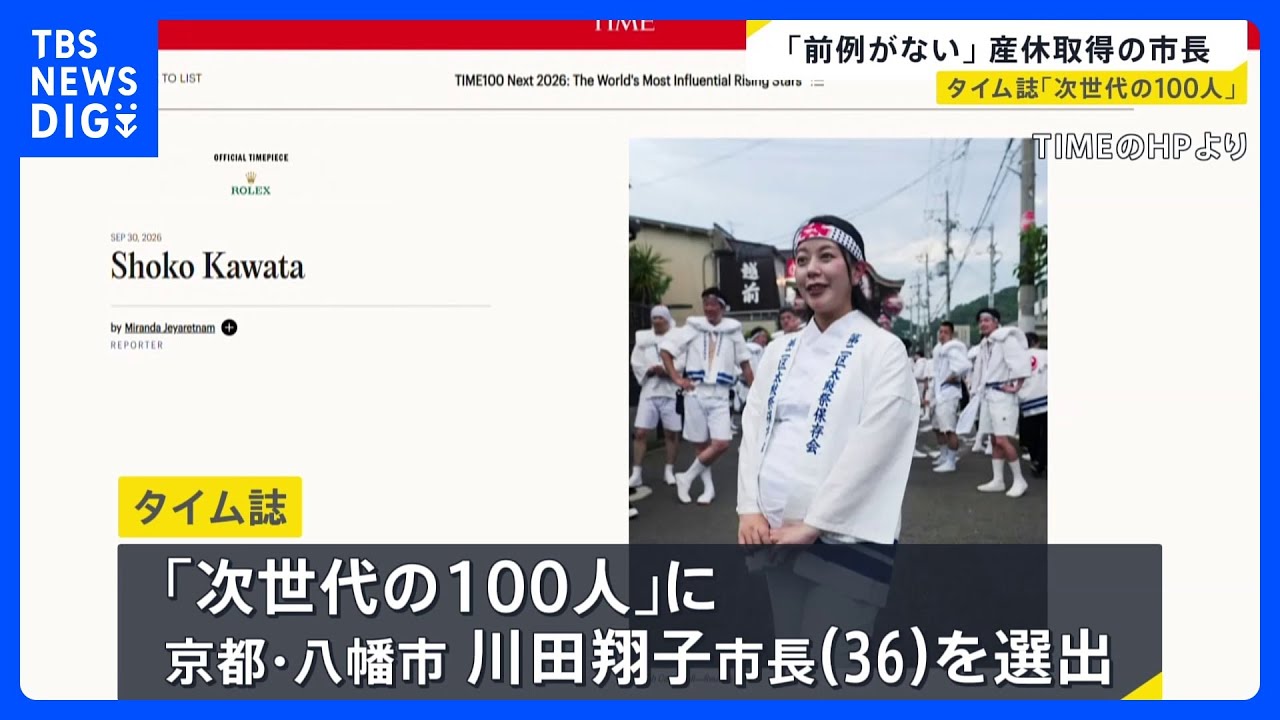
Time magazine has named Shoko Kawata, the 36-year-old mayor of Yawata in Kyoto Prefecture, among its 100 most influential emerging figures worldwide, recognizing her decision to become Japan’s first sitting mayor to take maternity leave and highlighting a political career that has taken her from municipal administration to national politics and the leadership of a city of nearly 70,000 people.
The American magazine included Kawata in its Time100 Next 2026 list, announced on September 30, describing how she had established a precedent in a country where elected municipal leaders are not covered by the maternity leave protections available to regular employees.
Kawata, who became Japan’s youngest-ever female mayor when she was elected at 33 in November 2023, began maternity leave in July 2026 and gave birth to her first child, a daughter, on September 15. Her leave is scheduled to continue until November 8, although she has remained involved in municipal administration through online meetings and communications.
Time highlighted not only her decision to take leave but also her administration’s efforts to support families, including reducing school lunch expenses, providing diapers at childcare facilities and expanding postpartum care services.
The international recognition marks another milestone in a career that began with an interest in public policy during Kawata’s school years and developed through more than a decade of experience in local government and national politics.
Born on August 30, 1990, in Nara City, Nara Prefecture, Kawata attended Osaka Toin Junior and Senior High School before entering Kyoto University’s Faculty of Economics, where she studied economics and business administration.
Her interest in government and public policy developed long before she entered university. In a 2025 interview with the Osaka Bar Association, Kawata described two experiences that shaped her thinking about the role of government.
The first involved her younger brother, who was born with an intellectual disability. Kawata recalled watching her parents struggle to obtain suitable educational assistance and guidance from public institutions. Their difficulties made her aware from an early age of the challenges governments face in providing effective support for people with different needs.
The second influence was Japan’s prolonged economic stagnation. Born around the collapse of the country’s asset-price bubble, Kawata grew up hearing older generations describe the prosperity of the high-growth and bubble-economy years, while her own generation experienced what became known as Japan’s lost decades.
She became interested in why the economy had lost its momentum and whether government policy could help restore economic and social vitality.
At Kyoto University, she encountered a professor’s explanation of public policy as a prescription for society, an idea that helped shape her ambition to work in government. Kawata later explained that she wanted to identify social problems and develop practical measures to address them.
Her years at Kyoto University also established a lasting connection with the city. Living near Shimogamo Shrine, she became familiar with Kyoto’s traditional festivals, religious customs and historic neighborhoods, and developed an appreciation for the relationship between local communities and cultural heritage.
After graduating, Kawata joined the Kyoto City government in 2015 rather than pursuing a career in the private sector.
Her first assignment was as a public assistance caseworker in the Fukakusa area of Fushimi Ward, where she spent about two years working directly with residents receiving welfare support.
Kawata has described that experience as particularly important in shaping her understanding of poverty and public administration. She encountered people facing financial hardship despite making considerable efforts to support themselves, reinforcing her belief that government services needed to respond to the different circumstances of individual residents.
She subsequently moved into municipal asset management and administrative reform, working on projects to redevelop former public school properties.
Kyoto had been left with numerous unused or underused school buildings following school closures and consolidations caused by declining student numbers. At the time, more than 20 former school sites required decisions about their future use.
Kawata worked on public-private partnerships intended to reduce maintenance costs, generate revenue from municipal property and preserve facilities for community use.
Among the projects she was involved in was the redevelopment of the former Rissei Elementary School site in central Kyoto, where negotiations between residents, private developers and the city helped establish a new use for the historic property.
The work required balancing commercial development with neighborhood interests, an experience Kawata later identified as valuable preparation for municipal leadership.
During her approximately seven years at Kyoto City Hall, she gained experience in welfare administration, public property management and urban development, providing a practical foundation for her subsequent political career.
Her move toward national politics began through a connection with fellow Kyoto University economics graduate Shin Tsuchida, who entered national politics in 2021.
Tsuchida introduced her to the possibility of working for Akiko Santo, a veteran Liberal Democratic Party politician and former president of the House of Councillors.
Interested in understanding how decisions were made at the national level, Kawata resigned from Kyoto City Hall and moved to Tokyo, becoming a private secretary to Santo in 2022.
Working in Nagatacho, Japan’s political center, gave her direct exposure to parliamentary affairs, political negotiations and the relationship between national policy and local administration.
Kawata’s opportunity to enter electoral politics came the following year when Yawata, a city southwest of Kyoto, held a mayoral election following the resignation of longtime mayor Fumiaki Horiguchi in October 2023.
She entered the November 12 election as an independent candidate, receiving support from the Liberal Democratic Party, the Constitutional Democratic Party of Japan and Komeito.
Her principal opponents were Ken Ogata, a former Kyoto prefectural assembly member representing the Japan Innovation Party, and Yuko Kameda, a former Yawata city assembly member backed by the Japanese Communist Party.
The campaign focused heavily on support for families, local government reform, municipal finances and Yawata’s future development.
Kawata presented a platform built around four broad priorities: improving childrearing support, making the city more accessible and comfortable for residents of all generations, promoting economic development and tourism, and securing new sources of municipal revenue.
Her proposals included reducing the financial burden on families, improving transportation services, encouraging business investment, redeveloping areas around Iwashimizu Hachimangu Station and making better use of municipal property.
Kawata won the election with 10,516 votes, defeating Ogata, who received 8,334, and Kameda, who received 5,878.
Voter turnout reached 43.67%, compared with 29.64% in the previous mayoral election in February 2020.
Her victory at the age of 33 made her the youngest woman ever elected mayor of a Japanese city, bringing national attention to a municipality better known for its historic shrines and riverside scenery than for political developments.
Yawata, located between Kyoto and Osaka, has experienced many of the demographic challenges facing smaller Japanese cities.
Its population peaked at approximately 76,000 in 1995 before gradually declining to around 69,000. The city faces an aging population, falling numbers of children and growing costs associated with maintaining public infrastructure constructed when further population growth was expected.
Kawata entered office arguing that local government needed to respond to these changes while making the city more attractive to younger families.
One of her administration’s early priorities was reducing the financial burden of raising children.
The city pursued expanded medical expense assistance for children and introduced measures to reduce school lunch costs, initially covering one-quarter of the expenses as part of a gradual approach to providing greater support.
Other initiatives included free diapers at preschool facilities and additional postpartum care services.
Kawata has argued that financial assistance alone cannot reverse Japan’s declining birth rate, and that families also need practical services and a social environment that makes raising children easier.
Her administration has also emphasized urban development and the need to generate more economic activity from Yawata’s tourism resources.
The city is home to Iwashimizu Hachimangu Shrine, an important historic religious site, as well as the Shokado Garden and the Sewaritei riverside area, whose approximately 1.4-kilometer avenue of cherry trees attracts visitors during the spring.
Despite these attractions, Kawata has identified a shortage of restaurants, accommodation and shopping opportunities as a major obstacle to converting tourism into local economic benefits.
In a January 2025 interview with Kyoto University, she said average spending by visitors to Yawata was only about 300 yen per person, illustrating the limited commercial activity generated by tourism.
She outlined plans to improve connections between attractions, develop areas around railway stations and encourage private investment in tourism-related businesses.
Kawata has also promoted a longer-term approach to urban planning, arguing that the city must consider how its transportation network, public buildings and commercial areas should function over the next 10 to 20 years.
Her administration has sought cooperation with universities and researchers on urban development, transportation and community planning, while also examining ways to reduce the cost of maintaining aging public facilities.
Her interest in the cultural history of Yawata has extended to efforts to raise awareness of the religious heritage surrounding Iwashimizu Hachimangu Shrine, including its historical connections with Buddhism before the separation of Shinto and Buddhist institutions during the Meiji era.
Alongside her mayoral duties, Kawata has taken on positions in organizations involved in local government and public administration.
These include serving as a councilor of the Japan Association of City Mayors, chairing a finance and administration subcommittee of the Kyoto Prefecture Mayors Association, and serving as a director of the National Association of Young Mayors for the Kinki region.
She has also held advisory positions connected with education, sports policy and government services, including membership of a Sports Agency council and a Justice Ministry panel examining the future of Japan Legal Support Center services.
Outside politics, Kawata’s publicly listed interests include tea ceremony, traditional Japanese clothing, visiting shrines and temples, and running.
Her national profile rose sharply again in May 2026 when she announced that she was pregnant and intended to take maternity leave while remaining in office.
Although maternity leave is an established right for many employed women in Japan, elected mayors are not covered by the same labor protections, and no established maternity leave procedure existed for Yawata’s mayor.
Kawata therefore had to arrange how the city would operate during her absence.
She began leave on July 20, becoming the first sitting mayor in Japan widely reported to have taken maternity leave.
Her decision attracted international media coverage but also prompted debate within Japan over the responsibilities of elected leaders, their compensation during leave and whether public officials should be expected to remain continuously available.
Some critics questioned whether a mayor could step away from regular duties while continuing to receive a salary. Supporters argued that elected officials should be able to have children without having to leave public office.
Kawata said she had never considered pregnancy and public office incompatible, explaining that she wanted childbirth to be treated as a normal part of life for women in positions of authority.
She arranged for the deputy mayor to handle responsibilities during her absence while maintaining contact with city officials and participating in some matters remotely.
Her pregnancy announcement also brought attention to Japan’s broader difficulties in encouraging women to enter political leadership and balancing professional responsibilities with family life.
Kawata gave birth to a daughter on September 15, with the city announcing the following day that both mother and child were healthy.
She expressed gratitude to residents who had supported her and to municipal employees who had continued the city’s administrative work during her absence.
Her maternity leave is expected to end on November 8, after which she plans to resume her regular responsibilities.
Time’s decision to include Kawata in its 2026 list places her among emerging figures from politics, business, science, culture and other fields recognized for their influence and potential contribution to society.
The magazine highlighted the significance of her decision in a country where women remain underrepresented in political leadership and where expectations surrounding work and family responsibilities continue to generate debate.
It also pointed to the connection between Kawata’s personal circumstances and her policy priorities, particularly her administration’s efforts to reduce the costs of raising children and improve support for new parents.
For Kawata, the recognition comes less than three years after she entered the mayor’s office as a political newcomer, following a career that began with welfare casework, continued through urban development projects and national parliamentary administration, and eventually brought her into local government leadership.
Her experience has also placed her at the center of questions facing Japan’s local governments: how to support families, respond to population decline, attract younger residents and accommodate childbirth and childcare among people occupying senior public positions.
By establishing a maternity leave arrangement for the mayor of Yawata, Kawata has brought those questions into the national discussion while continuing to pursue the municipal policies on which she was elected in November 2023.
Source: TBS