Remembering Professor Mike Shea, a quiet champion of the arts
Mike Shea never missed the chance to make a connection.
Teaching Shakespeare to his students at Southern Connecticut State University, he brought actors along with him, to make sure a scene came vividly to life. In the popcorn-scented lobbies of movie theaters, he stayed to talk with staff long after the final credits had rolled. If he was late — to a class, to a meeting, to an opening night — it was because he had met a friend along the way, or made one somewhere between the front door and his destination.
Shea, a steadfast champion of the arts who taught English at SCSU for 41 years and chaired the department for nine of them, died on Oct. 24, following a hit-and-run incident earlier that month in New Haven’s Westville neighborhood. In the wake of his death, a community of friends, family, students, professors, and lifelong theater kids have come forward to grieve a man who they describe as quietly generous, sharply brilliant and utterly himself.
He was 74 when he died, and his colleagues, family and friends said he possessed a knowledge of theater, film, and literature that often seemed vast enough to last a person three or four lifetimes. He is survived by his wife of 29 years, Central Connecticut State University Professor Candace Barrington, their two adult children, his three siblings, and thousands of people who adored him, from nonprofit arts leaders to SCSU staff and alumni still reeling from the sudden news of his death.
In his honor, friends and family have set up “Let’s See a Play: Mike Shea Student Performance Fund,” which will cover the cost of theater tickets for students who can’t afford to see a live performance. A memorial is also planned at the John Lyman Center for the Performing Arts on November 15, from 1 to 3 p.m.
“Mike believed that you bought art from artists, and it didn’t have to be an investment. The investment was in the artist, not the art,” Barrington said in an interview at their New Haven home last Wednesday. ”And you went to plays, and you bought the tickets, and you went to the movie theater to keep the movie theaters going. It was like, ‘If you want these things [to survive], you have to go. You have to pay for it, and you have to support it.’”
“He knew how to look and listen, and observe,” she added. “He wasn’t interested in what things meant, but how they meant. How they created meaning.”
Shea’s commitment to others, and his interest in asking questions, began in his very first years of life. The inquisitive youngest of four children (“and they thought he hung the moon,” Barrington said of his adoring siblings), Shea was born and raised in Baltimore, where he later attended Loyola College. As a kid, he grew up in the Jesuit tradition, a branch of Catholicism that is committed to social justice, education, and public service.
While Shea stopped formally attending church in high school, he never lost that tie to public service and community building. He was constantly checking in on people, from childhood friends to elders who had survived his parents, to students who were in the midst of a tumultuous life transition. Somehow, there was always room for more: Shea could not get through a semester, or sometimes even a dinner out with his family, without inviting someone new into his orbit.
“He’d say [to a waiter], you know, ‘How long have you been working here? Do you go to school?’ Because most servers do, right?” Barrington remembered. “If they look like they’re under 30, that’s a pretty safe question. [He’d say,] ‘Oh, what are you studying? Where do you go? Do you like it? What made you just choose that? And we would know the server’s entire life history” by the end of the evening.
In the last three and a half decades of his life, he often ended the conversation by pulling a card emblazoned with the sun out of his wallet, and inviting them to the solstice parties he and Barrington hosted at their home. By last year, the invite list included hundreds of people: actors Shea had met backstage, movie theater staffers, SCSU faculty and alumni, theater makers and film nerds, chefs and servers from local restaurants.
“It was his commitment to making a richer life for everyone, without any sense of self-aggrandizement at all,” his oldest sister Maureen Fry said of his wide-open, magnanimous spirit. “I think of it as a gift he was always giving to someone, either individually or to students, or to the community as a whole.”
“He Was Truly The Best Of Us”
Shea moved to Connecticut in the 1980s, after earning both graduate and doctoral degrees in English literature at Miami University of Ohio. Shea became a professor at Southern in 1985, where his students and colleagues quickly learned that he was as kind as he was rigorous, with a curiosity that was contagious.
“He was just so charming, and his enthusiasm was just so incredible,” said Rob Harmon, who first met Shea in 1999, when Harmon was working as the manager at the York Square Cinema and toying with the idea of going back to school. \ His advice that Harmon pursue the school’s “Media Studies” major helped steer him to Best Video Film & Cultural Center, where he’s now the video archive director.
Shea was constantly thinking about how to make the texts he was teaching feel alive, from in-classroom performances of Shakespeare to field trips around the state, and sometimes on and off Broadway, complete with dinner that he covered out of pocket (colleagues Joel Dodson and Phil Smith, who have known him since 2011 and 1985 respectively, estimated that Shea spent thousands of dollars of his own money so that students could experience live theater; more on that below).
Laura Kirk, now the director of audience services at the David Geffen School of Drama at Yale University, remembered meeting Shea three decades ago, when she was a young thespian at SCSU and Shea was a new professor. With a group of other young, bright-eyed theater nerds, Kirk became an early member of the Naked Theater, a grassroots company that existed for just a few years. Shea was one of its first boosters and board members, eager to cheer actors on even after the company disbanded.
When Kirk left acting to start a family, ultimately working in arts and educational nonprofits, Shea eagerly pulled her back in, asking her to act out scenes with friends during his Shakespeare classes. Once, she remembered with a laugh, he proposed Helena and Hermia’s fight from “ A Midsummer Night’s Dream,” but asked actors to play it as if they were on the Jerry Springer show. That was just who he was, Kirk said: he wanted to show students the same level of joy and delight he felt every time he returned to the Bard.
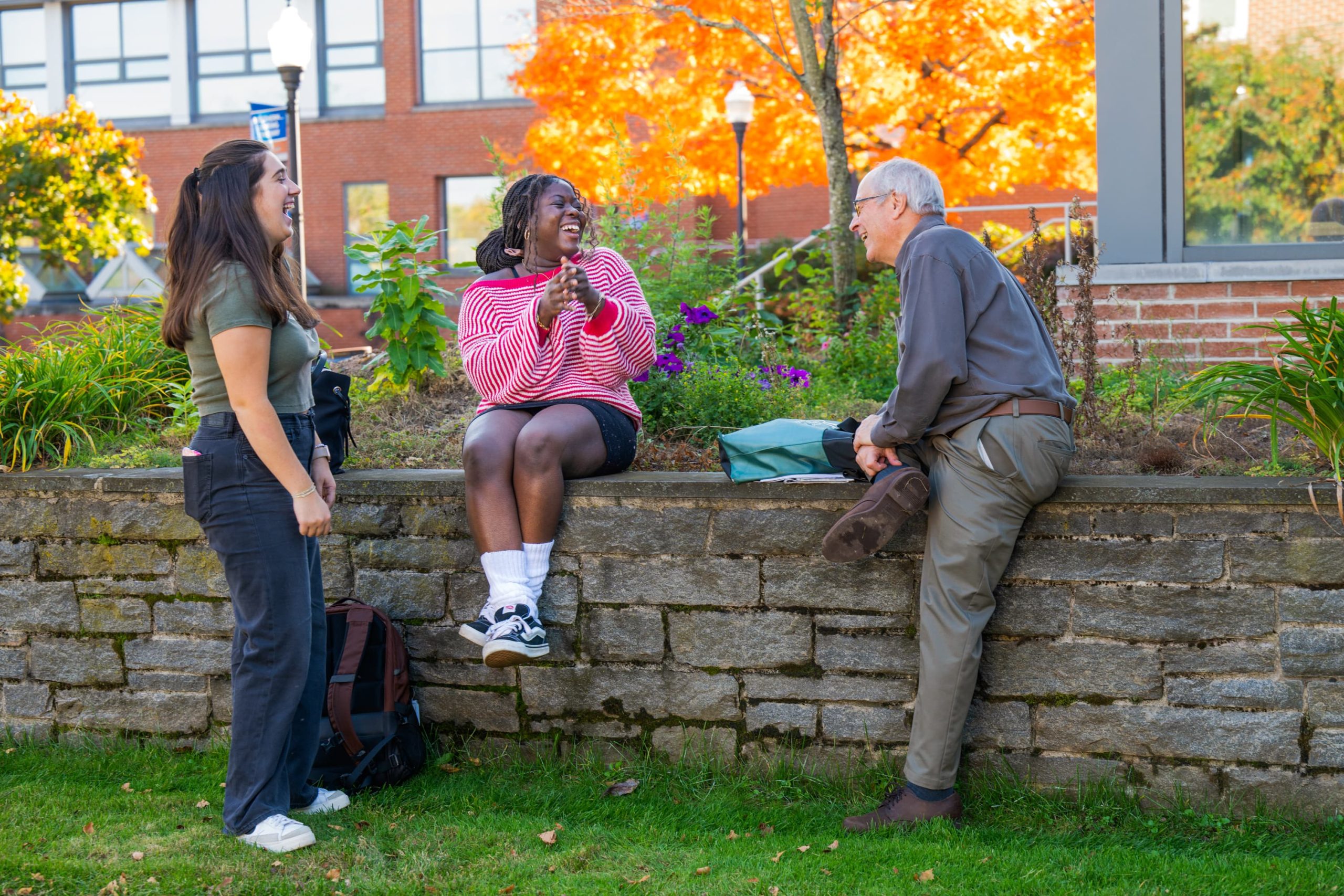
Shea’s love for literature, and care for his students, never waned. For some students, now alumni, it looked like frequent visits to his office hours, during which he helped steer them toward majors they hadn’t ever considered. For others, it was the way he made clear how bitingly funny and trenchant Shakespeare and his contemporaries could be, once students got the hang of the 16th-century language.
“You could just tell he was absolutely enamored with it,” said Justin Ayora, a high school English teacher in Danbury who took Shea’s introduction to Shakespeare in the fall of 2025, when he was finishing his studies in SCSU’s college of education. “I learned from him that the best way for students to be invested in the learning is simply being in love with the thing that you’re teaching yourself. Because he loved it so much, you wanted to show him, ‘Hey, I love this too.’”
Now, Ayora brings the same verve to his classroom, including a unit on magical realism and the author Gabriel García Márquez that the class just finished. It may seem far from Shakespeare, he acknowledged, but the core of how to teach the material remains the same.
“He truly got the best out of us, as learners and human beings,” he said. “He’s truly the best of us. You talk about an educator who helps you light a fire within yourself … that’s Mike. I want to show these kids, ‘I love this and I care for you,’ because that was Mike. What a privilege it is to have known him.”
“When In Doubt, Go To The Show”
While Shakespeare was Shea’s specialty, his interest in the arts spanned media and centuries, from early modern drama to modern and contemporary German and Japanese film to obscure and popular folk music. He had an insatiable hunger for the cinematic and performing arts, as eager to see a student show in Southern’s tight black box theater as he was to attend two off-Broadway plays in a single afternoon.
At least once a week, he caught a double or triple feature at the movies, a habit that made him a beloved fixture at the now-shuttered Criterion and York Square Cinemas in downtown New Haven, as well as Hartford’s Cinestudio, the Madison Art Cinemas, Regal Branford, and Regina A. Quick Center for the Arts in Fairfield, among others.
Rai Bruton, a former Criterion employee who is now the executive director of Hamden’s Best Video Film & Cultural Center, remembered seeing Shea each week, one of a handful of movie theater faithfuls she could count on before the theater ultimately closed in October 2023.
What stood out to her, and still does years later, was how genuinely friendly Shea was, and how curious he always seemed to hear what she and fellow staff members thought of the same film. It was only after he learned that she had left college under financial duress and was juggling multiple jobs with dreams of finishing a novel that she learned that he was a tenured professor.
“He tried to give me a little bit of a roadmap,” she remembered. “I had been in school to be a teacher, and it was very much what a good teacher would do. He was just so kind, and he talked to everyone.”
He was, in that same way, a quiet and unassuming supporter of Connecticut’s arts ecosystem, with a fondness for theater that never stopped at the state’s borders. At the time of his death, Shea was a season regular at the Yale Repertory Theatre, Yale Cabaret, Collective Consciousness Theatre, Long Wharf Theatre, Hartford Stage, the Brooklyn Academy of Music (BAM), Theatre for a New Audience, and the Red Bull Theater, among others.
In addition, he was a longstanding board member at Elm Shakespeare Company, with a particular dedication to its educational programming. Elm’s Artistic Director, Rebecca Goodheart, who referred to him as “the quiet glue for our community,” fondly remembered how Shea was often the only board member who seemed to fully read and weigh in on the minutes
Joel Dodson, an early modernist and professor of English and Arts Administration at SCSU who Shea hired in 2011, estimated that the two saw “ conservatively 10,” and likely closer to 20 or 30, movies together every year, in addition to several live performances across Connecticut, New York, and the Northeast.
In 2021, the two made the trip to New York to see a marathon performance of Shakespeare’s Roman tragedies, including “Julius Caesar,” “Antony & Cleopatra,” and “Coriolanus,” at BAM. This month, the two had tickets to see Ann Carson’s translation of Sopocles’ “Elektra” at the Theatre for a New Audience in New York
“Mike’s main ethos was, ‘When in doubt, go to the show,’” Dodson said. Whatever the outcome, Shea often left with the same five parting words: “I’m glad they did that.”
It wasn’t just that the two both studied and loved Shakespeare, Dodson added: Shea was something of a “social father figure in the arts,” who encouraged him to donate to organizations he liked, and “taught me what it meant to tie the academic work of loving Shakespeare to the public work of loving Shakespeare.”
He was often in awe of Shea’s three-week summer intensive “Shakespeare Alive,” in which he and students would read a Shakespeare play, watch a film adaptation, and then see a live performance before the end of the course period. Following Shea’s injury and death in October, Dodson took over his “Intro to Shakespeare” courses, in which students are reading “Twelfth Night” after starting the semester with “Much Ado About Nothing.”
“He believed in the liberal arts,” Dodson said. He pointed to Shea’s syllabi, in which the words “serendipity” and “community” often appeared together. “People can be so protective of their areas of specialization,” but Shea never was. He wanted to share his love for the subject matter, and so he did.
His belief in both the liberal and the performing arts, from cinema to experimental theater, often spilled over into the generosity he showed his students. In the summers, Shea was known and adored for “Shakespeare Alive,” which often ended with bug spray, picnic blankets and live Shakespeare in the August twilight of New Haven’s Edgerton Park. In the fall, he brought students into “Ambiguity in the Arts & Sciences,” an Honors College course that fused live theater and literature with Socratic-style dialogue.
From the 1980s until his sudden death last month, Shea paid largely out of pocket so that his students — often first-generation college kids, working one or two jobs in addition to a full class load — could take an afternoon or evening off, eat lunch or dinner with the class, and see a play. If the show was in New York, that included an all-expenses trip to the Oyster Bar in the basement of Grand Central Station, where feeding students could quickly amount to hundreds of dollars.
“There are some people whose presence strikes you as very noticeable, and Mike was not that way,” said Smith, who had hired Shea during his tenure as the dean of the College of Arts & Sciences, and remained close with him for four decades. “But he made a huge difference.”
Barrington, who Shea first met when she came in for an interview in 1997, saw him extend the same kindness to his colleagues, in and far beyond the English department.
That first job went to an internal candidate, but then a second opened up months later. After the two began working together, Shea would answer her administrative questions, connect her with the right people in the travel or HR offices, and steer her to fellow faculty members who had the answers she was looking for.
“And so after one semester, I knew everybody at Southern, because Mike had marched me around and introduced me to people,” she said.
At the time, she was a single mom of two young children, with a degree in Medieval literature, and Shea quickly became both an academic cheerleader and a devoted partner. Barrington can still remember him visiting their Cape Cod style house in North Haven for the first time, and going right down to the basement to play Nerf guns with her son.
That was it: the two spent the next 29 years learning from each other, from near-empty movie theaters to her academic conferences, where he was the life of the party in a crowd of Medievalists.
“He did that everywhere we went,” she said. “He just was so interested in people. And I think that that’s what the arts did for him, right? They allowed him to work with people and find out why they were interested in.”
In his 41 years at SCSU, Shea served as English department chair, president of the university’s chapter of the American Association of University Professors (AAUP), a member of the SCSU faculty senate, and a member of the Connecticut State University’s AAUP Faculty Union among other appointments.
“He never missed an opportunity to speak out publicly about his concerns — to the press, to the BOR [Board of Regents], and to state legislators,” wrote Louise Williams, a professor of history at CCSU who is also the president of the school’s AAUP chapter.
Now that he’s gone, friends and family members are thinking about how to keep his legacy alive. In addition to his memorial, which will feature a scene from “A Midsummer Night’s Dream,” a guided writing exercise, and tributes from many of the people who loved him, “Let’s See A Play” is committed to opening up opportunities for as many students as possible at a time when seeing a show can be prohibitively expensive.
“He was always this joyful, bright spirit,” Kirk said. “It was so clear that he adored meeting people and he loved taking it all in … There must be thousands of people who can just take that bright light and turn it around. It’s just an immense ripple effect.”
A public memorial for Shea is planned at the John Lyman Center for the Performing Arts on November 15, from 1 to 3 p.m. More information is available here.