Is ‘I Play Rocky’ Original or Adapted? Inside the Oscar Category Fight
Sylvester Stallone wrote “Rocky” in three days. Figuring out which Oscar screenplay category the movie about him writing it belongs in is taking a lot longer.
Amazon MGM Studios’ “I Play Rocky” has been the subject of multiple conversations among the studio, the Writers Guild of America, the Academy of Motion Picture Arts and Sciences and the film’s creative team over whether Peter Gamble’s script will compete as an original or adapted screenplay. No determination has been made.
Thursday, Nov. 12, is the final deadline for studios to submit Official Screen Credits (OSC) forms to the Academy of Motion Picture Arts and Sciences for the 99th Academy Awards in the best picture, animated feature and general entry categories. No films afterward will be considered.
Gamble conceived and wrote the script as an original, and it isn’t based on a book, article, memoir or any other single published work. He drafted it on spec, and a spot on the Black List carried it to producers Christian Baha and Toby Emmerich and eventually to director Peter Farrelly, who helmed best picture winner “Green Book” (2018). It’s Gamble’s second produced feature script after “Office Uprising” (2018).
But “Rocky” is one of the most established pieces of IP in Hollywood, and sources say some within each organization are weighing whether the screenplay is a better fit for adapted, the category for scripts built on previously established material. Rocky Balboa, Adrian and Apollo Creed are preexisting characters and Farrelly’s film restages some of the 1976 movie’s best-known scenes, written half a century ago.
Amazon MGM and the Academy declined to comment.
“I Play Rocky” expands nationwide Nov. 20, the same day WGA submissions close, but the guild won’t be weighing in. The film wasn’t produced under a WGA signatory agreement, so the guild can’t classify the screenplay or consider it for the WGA Awards, even though Gamble is a member. That leaves the decision entirely to the Academy’s Writers Branch executive committee, which makes its own determinations and has broken with the WGA before.
Elsewhere on the circuit, the question will carry less weight. The Golden Globes put all screenplays in a single category, while BAFTA and the Critics Choice Awards, which split original and adapted, generally go with the category the studio submits.
According to the Academy’s screenplay submission FAQ for the 99th Oscars, films don’t submit to a specific writing category. Instead, the Writers Branch executive committee reviews each eligible title and generally defers to the WGA’s classification, except when the guild hasn’t classified a film, as is the case with “I Play Rocky” or its classification “has been called into question.” The guidelines cut both ways for Gamble’s script.
A script is generally deemed adapted if it’s based on a sequel, a remake, an existing film or “pre-existing characters,” but it’s considered original if it tells a true story in which the writer “performed their own research and used multiple sources.” While a determination is under review, the committee may ask the film’s credited writers for a statement. Once it rules, the decision is final and no appeals or additional materials are accepted.
We seem to have one of these every awards season.
In January 2024, Greta Gerwig’s “Barbie” was moved to adapted after Warner Bros. campaigned it as an original and the WGA classified as well. Barbie and Ken existed as Mattel dolls long before Gerwig and Noah Baumbach turned them into a billion-dollar sensation, and there were multiple cartoons that existed with the characters. Ultimately, the script earned an adapted nomination and lost to Cord Jefferson’s “American Fiction.”
Category reversals aren’t new. Barry Jenkins’ “Moonlight,” Damien Chazelle’s “Whiplash” and Joel and Ethan Coen’s “The Ballad of Buster Scruggs” all carried original labels from the WGA before the Academy shifted them to adapted. The Academy has also long treated sequels as adaptations because their characters come from earlier films, which is how “Before Sunset,” “Toy Story 3,” “Top Gun: Maverick” and “Glass Onion” all landed in adapted.
That rule is being tested again this season. Aaron Sorkin’s “The Social Reckoning,” which dramatizes whistleblower Frances Haugen’s 2021 Facebook leak and Wall Street Journal reporter Jeff Horwitz’s coverage of it, was initially marketed as a sequel to “The Social Network” (2010), which won Sorkin the adapted screenplay Oscar. The WGA has classified the new film as an original. There’s no word yet on whether the Academy’s committee will accept that designation.
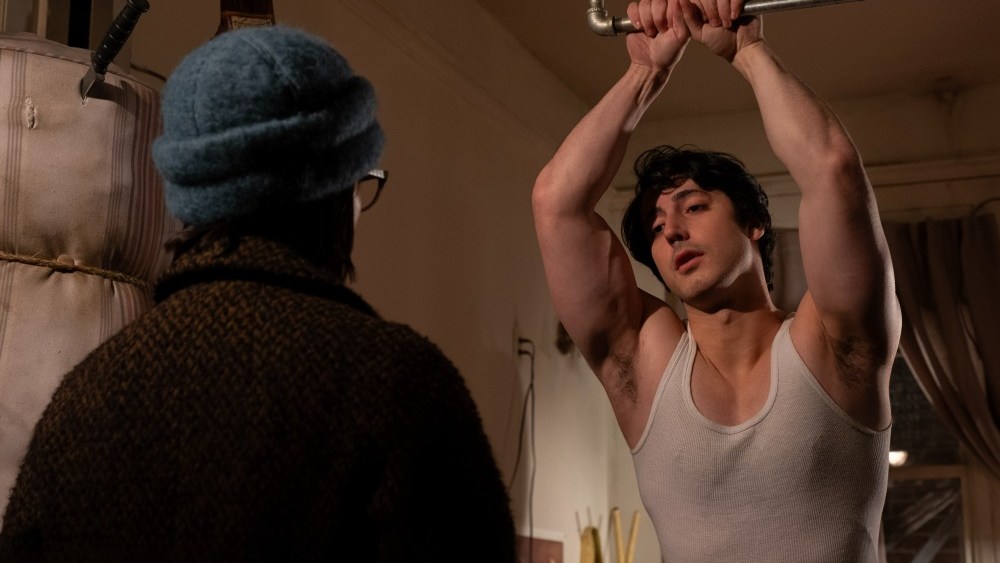
(L to R) Stephan James as Carl Weathers and Anthony Ippolito as Sylvester Stallone in I PLAY ROCKY, from Amazon MGM Studios.
Claire Folger
That’s the precedent Gamble’s script has to get around, and there’s a strong counterargument. “I Play Rocky” isn’t a sequel, a prequel or a spinoff. It’s a biographical drama about a real person, and biopics have routinely competed as originals. Dustin Lance Black won original screenplay for “Milk,” even though Harvey Milk’s life had already been chronicled in the Oscar-winning documentary “The Times of Harvey Milk.” Anthony McCarten’s “Darkest Hour” also competed as an original, despite covering Winston Churchill’s first weeks as prime minister, a chapter that fills every high school history textbook.
Movies about the making of movies are interesting territory, and they have produced originals, too. “Saving Mr. Banks,” about the making of “Mary Poppins,” competed as an original but didn’t land a nomination. Neither did Jason Reitman and Gil Kenan’s “Saturday Night,” which follows the 90 minutes leading up to the first televised episode of “Saturday Night Live.” Netflix’s “Mank,” written by the late Jack Fincher, father of director David Fincher, chronicles screenwriter Herman J. Mankiewicz’s work on Orson Welles’ “Citizen Kane” (1941). It was also deemed an original, and it also missed in the category, even as the film led the field with 10 nominations.
When a making-of film does land in adapted, there’s usually a book behind it. Scott Neustadter and Michael H. Weber’s “The Disaster Artist,” for example, was based on Greg Sestero and Tom Bissell’s 2013 nonfiction book of the same name. A public figure’s life, however, is fair game, as illustrated by A24’s Chris Hansen story, “Primetime,” which Ajon Singh based on an article by Luke Dittrich.
Interestingly, Amazon MGM owns the “Rocky” franchise. The 1976 original earned 10 Oscar nominations and won best picture, and Stallone was nominated for best actor and original screenplay. Director Farrelly knows the original side all too well, as he shared the original screenplay Oscar with Brian Hayes Currie and Nick Vallelonga for “Green Book,” another true story that drew from no single published source.
Where the film lands could reshape its trajectory, and both races are stacked. In original, Jesse Eisenberg (“The Debut”), Jordan Firstman (“Club Kid”), Mike Leigh (“Tender Loving Care”), Martin McDonagh (“Wild Horse Nine”) and Simon Rich (“Artificial”) are all in the conversation. A move to adapted wouldn’t clear the road. It would put Gamble up against Christopher Nolan’s “The Odyssey,” Drew Goddard’s “Project Hail Mary” and Rashida Jones and Will McCormack’s “The Invite,” along with Los Javis’ “La Bola Negra” and Denis Villeneuve’s yet-to-be-screened “Dune: Part Three.”
“I Play Rocky” has been gaining momentum since its world premiere at TIFF. It finished first runner-up for the People’s Choice Award behind “La Bola Negra” and was the runner-up at Middleburg. It was also the audience choice winner at Cinéfest Sudbury International Film Festival, and recently Ippolito was honored with the breakthrough award at SCAD Savannah Film Festival. It recently opened on Nov. 6 in seven theaters, capturing $345,000 from seven theaters, averaging $49,200 per location. The film has also made one category call already: it’s submitted at the Golden Globes as a musical or comedy, joining a field that includes “Wild Horse Nine,” “The Debut” and Amazon MGM stablemate “Project Hail Mary.”
The Academy’s final word likely won’t surface until nominations voting opens Jan. 11, 2027. Before that, the WGA announces its screenplay nominees Jan. 8. Oscar nominations will be announced Jan. 21, and the 99th Oscars take place March 14.