Journalism in the age of influencers
A smartphone can record a protest, document police action and bring stories from the ground to thousands of people. But does that make the person behind the camera a journalist? And when an influencer describes themselves as an independent journalist, what should audiences expect from them?
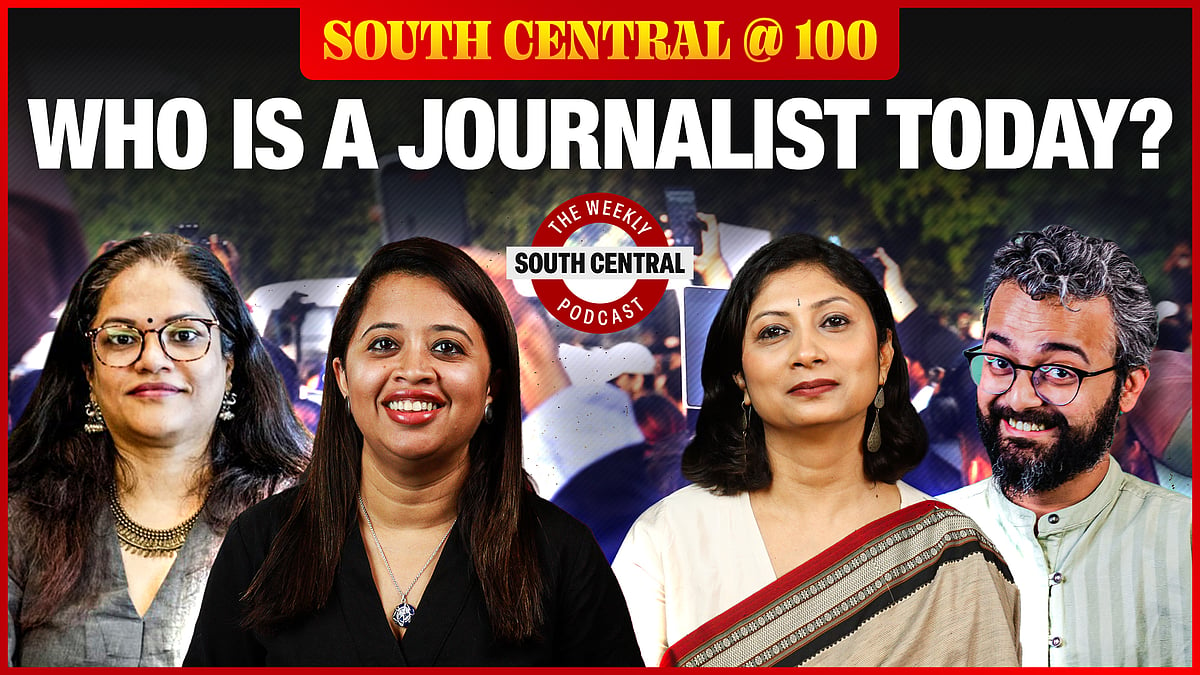
These questions form the basis of the 100th episode of South Central, as former host, Leena Reghunath returns to South Central for the special 100th episode along with hosts Dhanya Rajendran and Pooja Prasanna. They are joined by Carl Lafrenais, Meghnad and Priyanshi Sharma of Peek TV for a conversation on journalism, credibility and the growing role of content creators in news.
The conversation begins with Meghnad arguing that neither the government nor the Supreme Court should decide who qualifies as a journalist. For him, the people doing the work should be recognised as such. He points to those who are on the ground, recording events and preserving evidence.
He also questions the expectation that journalists can be completely unbiased. Even when someone reporting from the ground brings in their own opinions, Meghnad argues, that does not necessarily mean they stop being a journalist. The discussion also touches on the right of people to record police action during protests. Meghnad asks why the police can record citizens, while citizens are not afforded the same protection when recording the police. “The state is allowed to do that to me, but I am not allowed to do that to them?” he asks.
Priyanshi however, says there should be distinctions between journalists, influencers and activists, as blurred roles can affect how audiences trust a story. “When those lines between an influencer, a journalist and an activist get blurred, then the story suffers a little bit,” she says.
The conversation also examines how journalism has changed with the shift from print to television and digital media. Leena says the industry is still grappling with what defines a journalist, arguing that the focus should be on delivering “facts, fact-based information objectively with some sense of editorial supervision”.
Carl argues that influencers can also do journalism if their work is backed by facts and research. “A ring light doesn’t make you a journalist, but neither does a studio costing 20 crore rupees,” he says.
The conversation also turns to concerns about the use of the label ‘independent journalist’, particularly when political propaganda, campaigns and paid collaborations are presented as independent reporting.
Towards the end, the conversation turns to how independent creators can support one another. Meghnad speaks about young people going to the ground and reporting without financial backing, questioning why they should be dismissed for not belonging to established organisations. Carl points to examples from Brazil and Serbia, where content creators came together to promote each other’s work.
Tune into the full discussion here.