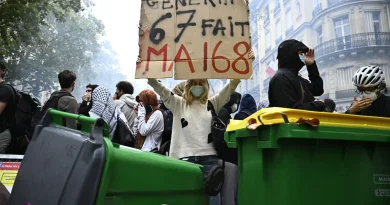
Clashes in Paris after new French protests
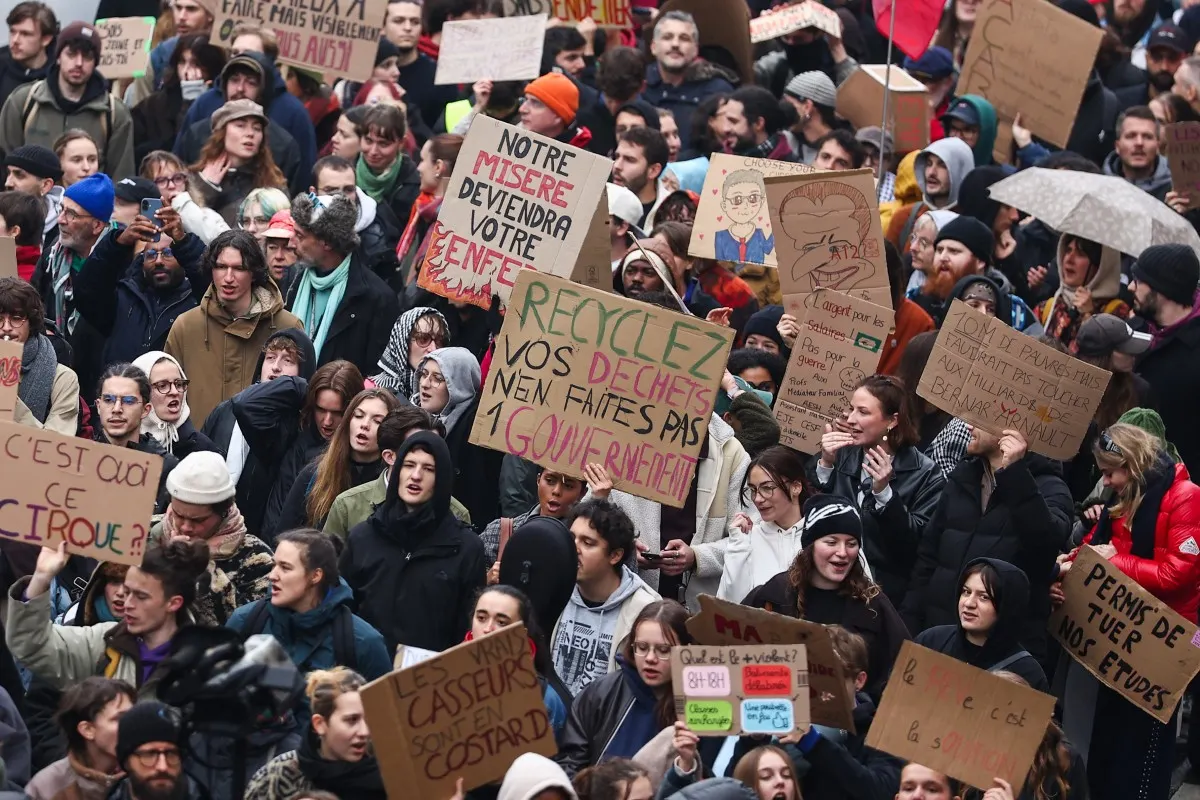
Thousands of people protested across France Saturday in a new show of anger against the government with clashes erupting between police and some protesters in Paris despite a lower turnout than on previous weeks.
The protests marked the fourth consecutive weekend of demonstrations against the rising cost of living which have erupted as the country heads to presidential elections in five months’ time where the far right sees its best chance yet to win power.
A total of 146,000 people took part in demonstrations across France on Saturday, including 46,000 in Paris, the interior ministry said. Unions put the figure at 250,000 protesters nationwide, with 75,000 in the capital.
Protestors gather next to the “Monument a la Republique” statue at Place de la Republique during a demonstration in Paris on November 7, 2026. (Photo by SEBASTIEN BOZON / AFP)
These figures were lower than the previous three weekends of protests but also came after a mass union protest on Thursday that rallied 575,000 people according to the authorities — 1.6 million according to unions.
At the end of the protest in Paris, police used tear gas against individuals throwing projectiles and homemade fireworks at the security forces, an AFP correspondent said.
Police said a group of 200 violent individuals attacked officers as they were arresting a man who had set fire to a trash bin in the square.
A protestor throws fireworks during a demonstration in Paris on November 7, 2026 as part of a nationwide day of protests over the rising cost of living and inequality organised by Yellow Vest movement, labour unions and high school and university students. (Photo by SEBASTIEN BOZON / AFP)
Banned protests thwarted
Some 70,000 members of the security forces were deployed Saturday, ready to move in quickly after mass protests on October 17 degenerated into the worst riots seen in France in years.
A firefighter extinguishes street furniture on fire during a demonstration in Lille, northern France on November 7, 2026. (Photo by Sameer AL-DOUMY / AFP)
Unions had staged a march along a traditional route, from the Place de la Republique in central Paris to Place de la Nation in the east of the city where the clashes erupted at the end of the protest.
But the Yellow Vests movement — a group whose protests shook Emmanuel Macron in the early years of his presidency almost a decade ago — called for a rival demonstration at the Place de la Concorde in central Paris, a stone’s throw from the president’s Elysee Palace and the lower house of parliament.
French Republican Security Corps (CRS – Compagnies Republicaines de Securite) police officers stop protestors from joining a rally called by Yellow Vest movement, at Place de la Concorde, in Paris on November 7, 2026. (Photo by GEOFFROY VAN DER HASSELT / AFP)
This action has been banned by the authorities, and on Saturday a large police presence prevented protesters from getting close. Some 100 people who arrived were surrounded by police and one of the movement’s coordinators, Benjamin Ball, and its spokeswoman, Azelma Sigaux, were among those arrested by police, an AFP reporter said.
Protestors take part in a demonstration near tear gas at place de la Nation in Paris on November 7, 2026. (Photo by GEOFFROY VAN DER HASSELT / AFP)
In the southeastern city of Lyon, police fired tear gas to disperse several hundred people in the city centre blocking a road during an unauthorised gathering.
‘This can’t go on’
The wave of demonstrations was sparked by a movement in late September by high school students angered by conditions at their establishments. These teens, joined by university students, remain at the heart of the protests.
Protestors do the conga next to police officers during a demonstration in Paris on November 7, 2026. (Photo by GEOFFROY VAN DER HASSELT / AFP)
“Today is a date that helps keep the pressure on,” said Sabine Kharbach, spokeswoman of the Student Union. “Many young people are mobilising because the government’s responses remain unsatisfactory.”
The police response has faced criticism for being heavy-handed, with dozens of internal investigations launched into allegations of brutality against demonstrators.
Local businesses are also feeling the pain. “So this can’t go on, otherwise I think it will be a disaster before long,” said Paris shop manager Jean Emile Moulinier. His store is around the main protest route and he said hardly any customers brave security barricades on protest weekends.
A person wearing a helmet written “press” (not visible) is pushed by police officers during a demonstration in Paris on November 7, 2026. (Photo by SEBASTIEN BOZON / AFP)
Shop windows of stores in Paris and other cities were again barricaded with wooden shutters and often closed for the day to prevent potential ransacking.
The government is grappling with ways to find solutions but is constrained by France’s gigantic debt pile, which is already spooking markets.
Prime Minister Sebastien Lecornu is to meet unions and employer federation representatives on Monday to discuss wages and purchasing power.
Protesters put saline solution in their eyes after being exposed to tear gas during a demonstration in Paris on November 7, 2026 . (Photo by GEOFFROY VAN DER HASSELT / AFP)
But student and teacher groups in France have called for a new strike on Tuesday to keep pressure on the government for more education spending, saying they were “in a position of strength (and) the government in a position of weakness and starting to yield”.
Polls indicate that far-right candidate Marine Le Pen is the favourite to win the Elysee in 2027 with her main rival currently not one of Macron’s centrist former allies but hard-left leader Jean-Luc Melenchon.
Melenchon, addressing 20,000 at a rally outside Paris Saturday, declared “we are going to win” and “everything must change”.