For these Connecticut dancers, love and art move together
Stepping into a pool of mid-afternoon light, Claire Mazza raised her left arm above her head, eyes fixed on the whisper-thin space between her thumb and second finger. Behind her, Alejandro Ulloa stepped forward in slow motion, his arms slack at his sides. He looked forward, lips parted, his whole face wide open. Even in the stillness, a person could see the gentle rise and fall of his chest.
Around them, a violin from Valentin Silvestrov’s “Dedication: IV Andantino” drifted up into the sun-dappled corners and high ceiling of the studio. The dancers spun around each other, planets in orbit, hands nearly touching. Then their arms dropped, and they stepped in opposite directions. Even in an empty studio, electricity buzzed and crackled through the room.
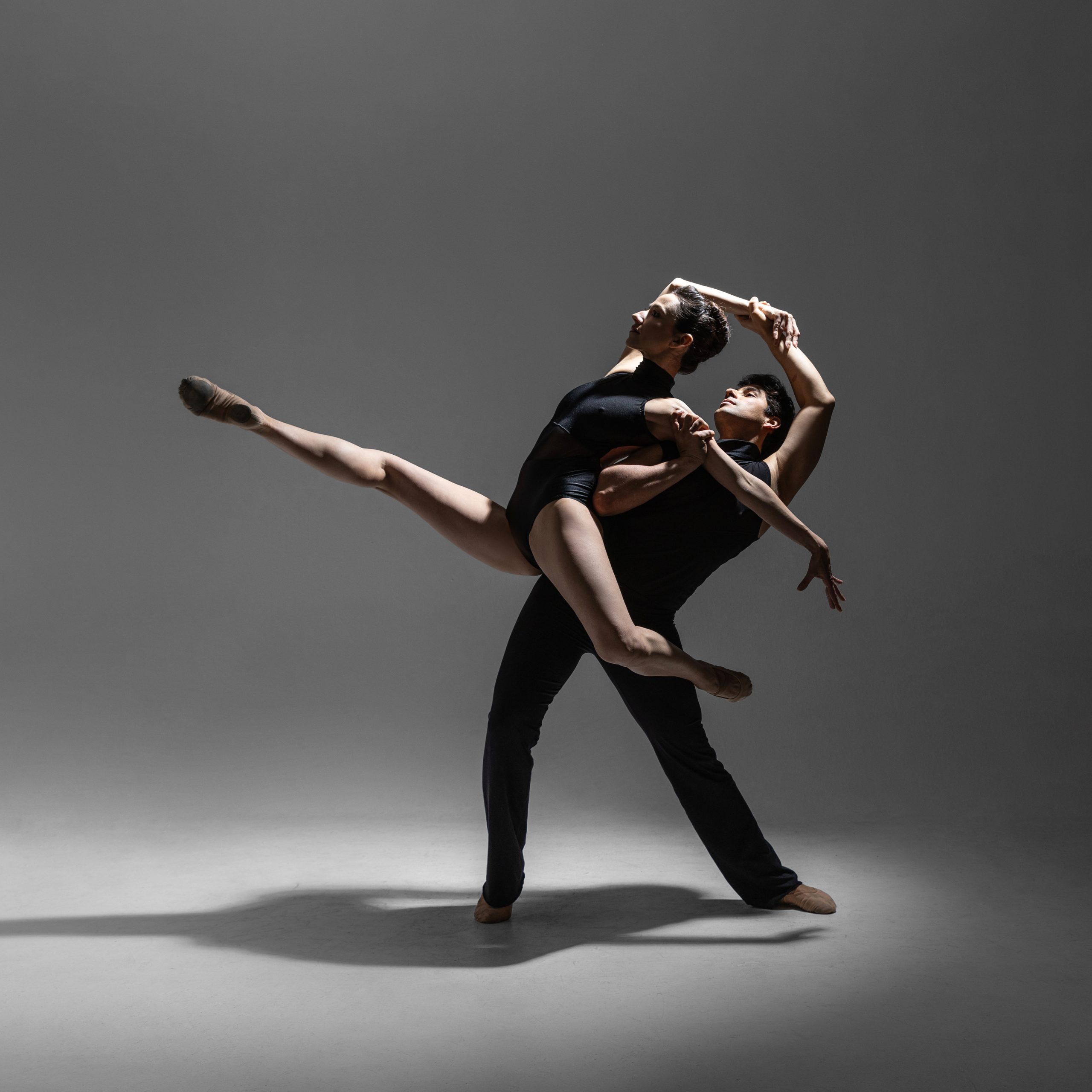
The affecting duet, entitled “Through You,” is the heartbeat of “Dancescapes,” coming to the Regina A. Quick Center for the Arts at Fairfield University on November 7. For Ulloa and Mazza, co-founders of the East Coast Contemporary Ballet who are partners in both life and work, the duet is a story of their love told in three parts, with a care for the form that has bloomed into 45 choreographed pieces, a 10-member company, and eight years of work.
“It’s our story of existing separately in the dance world, then finding each other, and falling madly in love,” Mazza said during a rehearsal at the Darien Arts Center, where she directs the organization’s 350-student dance program. “We’ve really trusted each other because we’ve had to. It’s allowed us to be so vulnerable with each other.”
That story, and the company it has birthed, is almost a decade in the making. Before Mazza and Ulloa ever collaborated, both were dancing, just a world apart. Mazza grew up in the School of American Ballet in New York, after starting lessons in a Brooklyn neighborhood studio as a small child. Ulloa came to it as a teenager from his native Nicaragua, where he danced traditional folklore, then transferred to the Escuela Nacional de Ballet.
Close to a decade ago, the two crossed paths at the Connecticut Ballet, often overlapping on the company’s pieces. While the state’s dance landscape is diffuse, both agreed it can also feel small, especially within a specific form. So when they began collaborating on a project with a small company in Westport, it made sense that they clicked almost instantly.
In part, their chemistry came from a belief that the project was beautiful, but left its artists chronically overworked and undercompensated. The longer they worked on it, the more they realized that they wanted to create their own model, in which artists — who often cobble together a living over multiple part-time jobs and punishing rehearsal schedules — could earn a salary that reflected the labor they were putting in. The idea behind East Coast Contemporary Ballet was born.
“It sounds so cheesy now, but we wanted to have a place where dancers are being treated correctly,” Ulloa said. “Let’s take care of people.”
From the jump, Mazza and Ulloa have tried to practice what they preach: their most significant expense in the organization’s $300,000 budget is its people. As artists themselves, they also remain keenly interested in exploring and sharing the difference between contemporary ballet and its classical foundation, with a focus on the form’s fluidity and lyricism.
“I love that it [ballet] gives you all the tools to explore and be proficient in other styles of dance,” Mazza said. “In contemporary ballet, you can use classicism as a base, but the vocabulary of dance becomes more abstract and more diversified.”
As they began to build the company in 2018 and 2019, the two knew they wanted full seasons, with performances in both Connecticut, where they teach and work (Ulloa was an educator at the New Haven Ballet for years), and New York, where they live together in Harlem and perform with multiple companies. After an unwelcome pandemic-enforced hiatus in 2020, the company debuted in 2021, with hours of masked rehearsals and original work set to the music of the late Cuban composer Ernesto Lecuona.
“We never wanted the company to be a project” that had a finite lifespan, Ulloa said. So it was perhaps not a surprise that the company continued to grow beyond 2021, with Mazza and Ulloa launching the Fairfield County Dance Festival alongside the New Canaan-based company Thomas/Ortiz Dance that same year. By 2022, Mazza was leading the dance program at the Darien Arts Center, where Ulloa is also a dance educator. With 12 faculty members, the program serves roughly 350 students from ages three to over 70.
Since 2021, the ensemble has created nearly 50 pieces for its repertoire, with artistic collaborators ranging from New York-based, Argentine-born bassist and composer Pedro Giraudo to Stamford’s own Orchestra Lumos to Italian sculptor Luca Serasini. Last year, for the first time, the company also rolled out its “Salon Series,” a kind of open rehearsal that travels to different museums, galleries, studios, and arts spaces to make the work ECCB is doing more accessible.
Across all of the company’s iterations, “Through You,” which Mazza and Ulloa choreographed as they fell in love with each other, has been a creative through-line. While it did not start as a narrative about partnership, Mazza said, the two quickly realized that’s what they were building. At one point, she remembered sitting in an Airbnb, listening to the music scoring the piece, with tears streaming down her face. The duet has three movements, set to works by Silvestrov, Dustin O’Halloran, and Lecuona, respectively.
As the two ran through it in a large, light-drenched studio last week, that journey felt palpable. Mazza began alone on the floor, her arms extended to their full wavelength. She began to cross the floor, toes nearly melting into the ground as they slid back, then rose again, lifting with the swan-like motion of her leg. She twirled, unhurried, and then bent forward, arms out as if in supplication. Her left leg became a pendulum, swinging back and forth as she looked on, winding one arm around the other as if it were a clock.
Only then, as she turned again, did Ulloa seem to come alive at the back of the room, his reflection springing forward in a wall-length mirror. He spun, one hand pressed to his heart, then extended it toward where the audience would be. Silvestrov’s melancholic strings soared around him, enveloping the duo in their sense of pining. Only after a few beats, perhaps, did a viewer catch on that he and Mazza were mirroring each other in passing.
Suddenly, one could see the storyline. The two danced in parallel, sometimes echoing each other’s movements, sometimes moving around each other like atoms that had lost their way. When at last they touched, backs pressed to each other, it felt as though the whole room shared a collective exhale.
Mazza seemed to know; she leaned back, her hand creeping along the floor. Her fingers pressed into the surface, curious, urgent. At last, they found Ulloa’s and held them for a moment, certain without needing any words at all. The two turned around, as if seeing each other for the first time.
“It has come to a different place since we first performed it,” Ulloa said of the duet. “They tell you that you keep falling in love, and it’s true. It’s a way more mature love [that we have now]. It’s an appreciation, as well. I feel privileged to be able to live with this love in my life, but to experience it with dancing, with no words at all …” he trailed off.
“It’s like falling in love all over again,” Mazza finished.
In addition to “Through You,” Saturday’s seven-piece program will include original work spanning the company’s eight years, from “Vessels,” an ensemble work with which ECCB debuted in 2021 to Mazza’s new piece “Power Play,” which she devised to the music of Cristina Spinei, to the Impressionism-inspired work “Brushstrokes,” set to the “Lautrec Suite” by the late composer Nicolas Flagello. Flagello’s surviving widow Dianne, a former director of the Manhattan School of Music, arranged the suite in his honor.
Elizabeth Hall, a longtime dance teacher at the Darien Arts Center who now serves as a substitute teacher and dedicated volunteer for the Center’s annual performance of the “Nutcracker,” said she’s thrilled to watch the two evolve and especially excited for the performance. Not only do the students love them; other faculty members do, too.
“Claire and Alejandro bring the best out in every dancer,” Hall said. “I’m just so excited for them. It’s a huge, huge deal, and they’ve worked so hard to get there. I’m super super proud of them, and I just feel lucky that the Darien Arts Center gets to have them as professional dancers who bring their knowledge and their expertise to everything they do.”