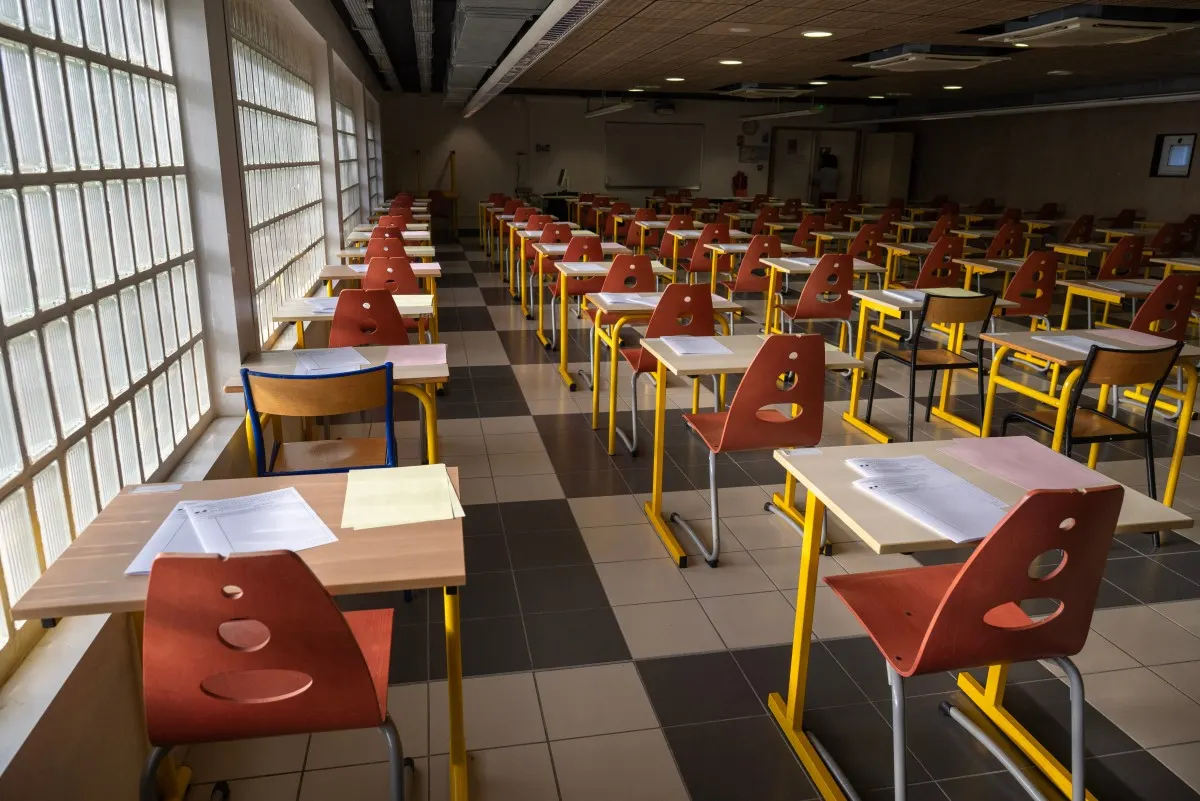
French language requirements for foreign nationals are inherently political

The French government has already imposed tougher language requirements on foreigners in France, and some of the 2027 presidential candidates want to go further – linguistics professors Grégory Miras, Maude Vadot, and Myriam Dupouy explain why language tests are always political.
Language is political. The campaign for the 2027 French presidential election will undoubtedly seize on it as a campaign issue, alongside immigration – two subjects that are often linked in public debate.
The increase in the level of French required to obtain residency permits and French citizenship raises questions about whether the complex relationship between language and social integration is being taken into account.
Is requiring a certain level of French for residency permits and citizenship simply a matter of common sense, or is it a tool for social selection? What assumptions lie behind this tightening of language requirements?
READ ALSO: Compared: The French presidential candidates’ policies for foreigners in France
A steady tightening of French language requirements
When it comes to the right to live in France, a distinction must be made between two categories of foreign nationals – those from the Schengen Area, who benefit from freedom of movement, and those from outside it, who are subject to stricter rules.
Across Europe, language proficiency is measured using levels such as A1, A2, B1 and B2, which form part of a common framework known as the Common European Framework of Reference for Languages (CEFR).
A2 corresponds to a basic level of proficiency, allowing someone to make purchases, talk about themselves and describe their daily life.
At B1, someone can speak in more detail about past events, explain their goals or justify their actions. B2 represents a more advanced level, allowing someone to discuss abstract subjects and defend a particular point of view. These skills are assessed through exams that test both oral and written comprehension and expression.
READ MORE: GUIDE: The changes to the rules around French citizenship you need to know
However, in less than 15 years, the language requirements applied to residency permits and French citizenship have become considerably stricter.
Until 2011, applicants for French nationality were simply expected to be able to communicate comfortably in French during an interview at the préfecture. As sociologist Abdellali Hajjat pointed out at the time, these assessments could be influenced by xenophobic prejudices. For example, a candidate’s command of French could be judged alongside supposed indicators of a lack of integration, such as wearing a headscarf.
The criteria also varied considerably from one préfecture to another. In principle, however, the assessment was supposed to take each candidate’s personal circumstances into account, particularly their educational background and social and professional situation. It was therefore not based exclusively on linguistic criteria and was conducted orally.
From 2011 onwards, the requirements were gradually tightened and formalised. The level of French required for applicants for citizenship was set out in regulations, making it easier to amend, and candidates were required to demonstrate their proficiency through a language test. In 2012, an oral B1 level was introduced as the requirement.
READ ALSO: QUIZ: Could you pass the new French language tests?
As for residency permits, no specific level of French was formally required before 2016. From that year onwards, applicants were required to demonstrate A2-level proficiency to obtain a 10-year residency card.
In January 2026, the requirements were raised again. A B1 level is now required for a residency permit, while a multi-year residence permit, valid for two to four years, requires an A2 level in both spoken and written French.
The same trend towards formalising and raising language requirements has affected access to French nationality, for which a B2 level is now required.
The apparent self-evidence of language proficiency
In public debate, the tightening of language requirements is justified by two frequently repeated misconceptions.
The first is that language is the primary, necessary and sufficient condition for successful ‘integration’. However, sociolinguist Philippe Blanchet points out that “the French language is not a prerequisite for the integration of migrants”.
A 2016 study by INSEE (the French statistics agency) showed, among other things, that the likelihood of being unemployed is only weakly correlated with a person’s level of French. Proficiency in French primarily translates into higher wages. In other words, it is possible to live and work without speaking French, just as it is possible to be unemployed despite having a good command of the language.
The non-recognition of foreign qualifications, as well as xenophobic and glottophobic discrimination in the workplace, also play a major role in difficulties accessing the labour market.
Another study shows that immigrants with higher education qualifications from their country of origin (a three-year degree or higher) who are required to sign a contrat d’intégration républicaine (Republican Integration Contract, or CIR) often experience social and professional downgrading in France. They end up in positions that are less skilled or prestigious than those they held before arriving.
The second misconception is that simply being immersed in a language leads to rapid and automatic acquisition.
When he was Minister for the Interior, Bruno Retailleau stated: “When a foreigner still doesn’t speak French well after several years, it’s because they haven’t made the effort.”
READ ALSO: OPINION: No, minister, having imperfect French is not due to a ‘lack of effort’
In other words, according to him, simply living in France should be enough to learn French quickly.
But when we listen to the people directly affected, a different picture emerges. Outside formal learning environments, finding opportunities to practise French with French speakers and improve one’s language skills is far from straightforward.
One participant in an action research project run by the collective Le français pour toutes et tous (French for All) described her experience in Spain as follows: thanks to the jobs she had there, she ‘spoke with the children’ and ‘with people’. In France, however, unable to find work, she is ‘always at home’ and ‘doesn’t speak to anyone’.
Assessing someone’s language proficiency in order to grant or refuse them the right to remain in France is therefore based, in part, on the idea that living in the country is something one must earn, that one must make an effort, and that some people simply do not try hard enough.
This overlooks all the factors that influence the pace at which someone learns a language. People do not learn at the same speed, depending on how closely French is related to the other languages they speak (learning French from Romanian, a related language, is very different from learning it from Arabic, which uses a different writing system).
Other factors include how someone experiences migration (do they intend to return to their home country?), their personal plans, their availability and constraints (work, family responsibilities, etc.), and their living conditions.
What do these language tests really measure?
Although language levels (A1, B2, etc.) are now widely recognised, particularly thanks to the school system, the assessment criteria used in the exams that measure them remain unclear to many people who did not attend school in Europe.
These individuals are often supported by highly committed volunteers who, however, have little training in teaching French as a Foreign or Second Language (FLE/S).
There are, of course, professionals specialising in teaching French as a Foreign or Second Language. However, since July 2025, only people who cannot read or write and have a very basic level of spoken French remain eligible for free, face-to-face lessons provided by the French Office for Immigration and Integration (OFII). Everyone else must learn independently through a 100 percent online platform.
READ ALSO: How to find affordable language classes in France
Demanding increasingly high language standards without providing appropriate support simply serves to reproduce the inequalities of the school system. As in education, those who start with cultural and financial advantages are often best placed to succeed. These advantages include access to preparatory courses, the ability to pay for language qualifications, cultural capital and the time needed to prepare.
Demanding ever-higher language standards without providing appropriate support simply serves to replicate the inequalities of the school system. As in school, it is often those who start out with cultural and financial advantages (access to preparatory courses, taking fee-based qualifications, cultural capital, time to prepare) who succeed best.
For example, in the mandatory TCF IRN (Integration, Residence and Nationality) language test required for certain residency permits, a common oral question is: ‘What is your favourite city? Why?’
Would a simple answer such as ‘Cairo, because it’s a beautiful city’ be enough?
At first glance, the answer is no. The implicit expectations – introducing an answer, structuring an argument and adopting a formal tone – favour people who have already internalised these academic conventions.
In reality, these tests measure more than just language proficiency. They also assess a candidate’s ability to understand what is expected of them in an exam. It is rather like the Code de la route, the French theory test for a driving licence – passing depends partly on understanding the logic behind the questions, rather than simply knowing how to drive.
As a result, candidates end up focusing more on passing the test than on using French in everyday life. This has been highlighted by practitioners working on the ground, who are inundated with requests for help from people trying to ‘pass the exam’.
For people with little or no formal education, difficulties understanding instructions or getting to grips with the test format can stand in the way of success, even when they are perfectly capable of communicating in French in everyday situations. The tests therefore risk excluding people whose language skills are, in practice, sufficient for everyday communication.
The tightening of migration policy has not been limited to language requirements. Passing a civics test has also become compulsory for obtaining a multi-year residency permit or a permanent residency permit, as well as for acquiring French nationality.
READ MORE: OPINION: Warning, the new French civics test for citizenship was harder than I imagined
The exam covers the principles, values and workings of the French Republic – subjects taught in French schools that many French adults themselves might struggle to answer questions about.
In light of all these issues, the right to reside in France and language proficiency are likely to feature prominently in the debate leading up to the 2027 presidential election. Addressing these questions in all their complexity requires an objective perspective, informed by scientific research.
This article was written by Grégory Miras, Professor of Language Education at the University of Lorraine, Maude Vadot, Senior Lecturer in Linguistics and Language Education at Savoie Mont Blanc University and Myriam Dupouy, Senior Lecturer in Sociolinguistics and Language Education at Le Mans University. It first appeared in French in The Conversation.