Fake news, bomb threats, hacked fridges and riots. What does hybrid war mean? « Euro Weekly News
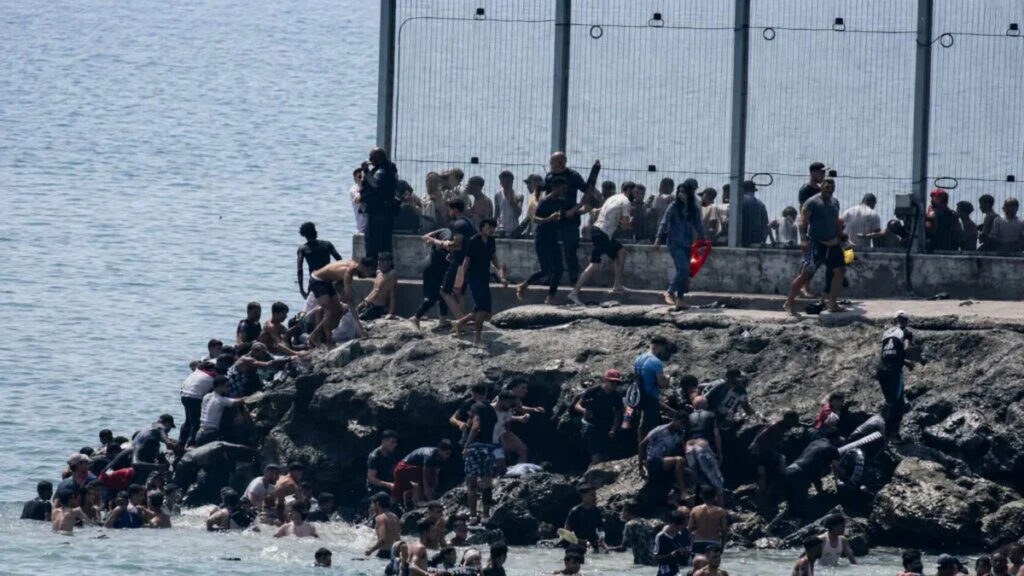
People arrive at the Ceuta border from Morocco. The episode has prompted debate about migration as a possible form of pressure in a wider hybrid war. Credit: JUPOL Nacional via X.
False claims helped mobilise people towards Ceuta’s border. Cyberattacks have disrupted supermarket fridges, while bomb threats have thrown European flights into confusion. These events show how pressure can be applied through ordinary life. They do not, by themselves, prove one campaign is behind them all.
A tank is easy to recognise. A false post telling people a border is open is less so. So is a hacked control system that warms a supermarket freezer, or an anonymous bomb warning that diverts a plane. Each can cause real disruption. None comes with a label identifying who ordered it.
What does hybrid war mean?
Hybrid war describes a combination of methods used to weaken or unsettle a country. The European Union’s guide to hybrid threats includes cyberattacks, information manipulation, political interference and the deliberate use of pressure at a country’s borders.
The phrase can be useful. It reminds us that pressure does not have to arrive in a uniform. It can come through the phone in your hand, the systems that keep food cold, or a sudden crowd at a border.
But the phrase has a drawback. It can make a collection of worrying incidents sound like a proven master plan. The word “coordinated” still needs evidence. Similar timing is not a command structure.
Ceuta shows how false claims can mobilise people
In July, tens of thousands of people crossed from Morocco into Ceuta amid rumours that the border was open and that people arriving by sea could not be returned. In its investigation of the crisis, Spanish broadcaster RTVE reported that false claims spread through social media and messaging groups. People shared routes and discussed when and how to cross. The investigation described an organised pattern of amplification, but did not establish who was behind the accounts or identify a government directing them.
That is the crucial point. People making the crossing were not a weapon. The possible tactic lay in exploiting false information and the pressure a mass arrival would place on border authorities. It is a serious example of how information and migration can interact. It is not proof that the fridge attacks or bomb threats had the same organisers.
What about fridges, bomb threats and riots?
EWN has reported on repeated bomb threats disrupting flights and on hacked supermarket refrigeration systems. Both incidents caused disruption. The attacks on fridges spoiled food. The flight warnings triggered searches and diversions. Those facts establish harm, not a shared perpetrator.
The European Commission has coordinated a response to the refrigeration incidents, but says investigations are continuing and it is too early to attribute responsibility. A freezer at 50C is a less theatrical instrument than a tank, but it can still leave a shop with spoiled stock and a bill.
Protests are another matter. Some far left groups have organised demonstrations, and some protests have ended in violence. That does not prove that one movement directed the riots across Europe. EWN’s reporting on the recent unrest describes different movements, local grievances and differing levels of disorder.
What can we conclude?
Hybrid war is a way to ask whether different forms of pressure are being combined for a common purpose. It is not a stamp to put on every hoax, hack or riot that happens in the same week.
The Ceuta crisis shows that false claims can help mobilise people towards a border. The fridge attacks and flight threats show that ordinary systems can be disrupted. The public evidence has not established that these events were directed by the same people.
The phrase should sharpen the investigation, not finish it. Until investigators show a common hand, the chef remains unknown.