Why the French police use so much tear gas

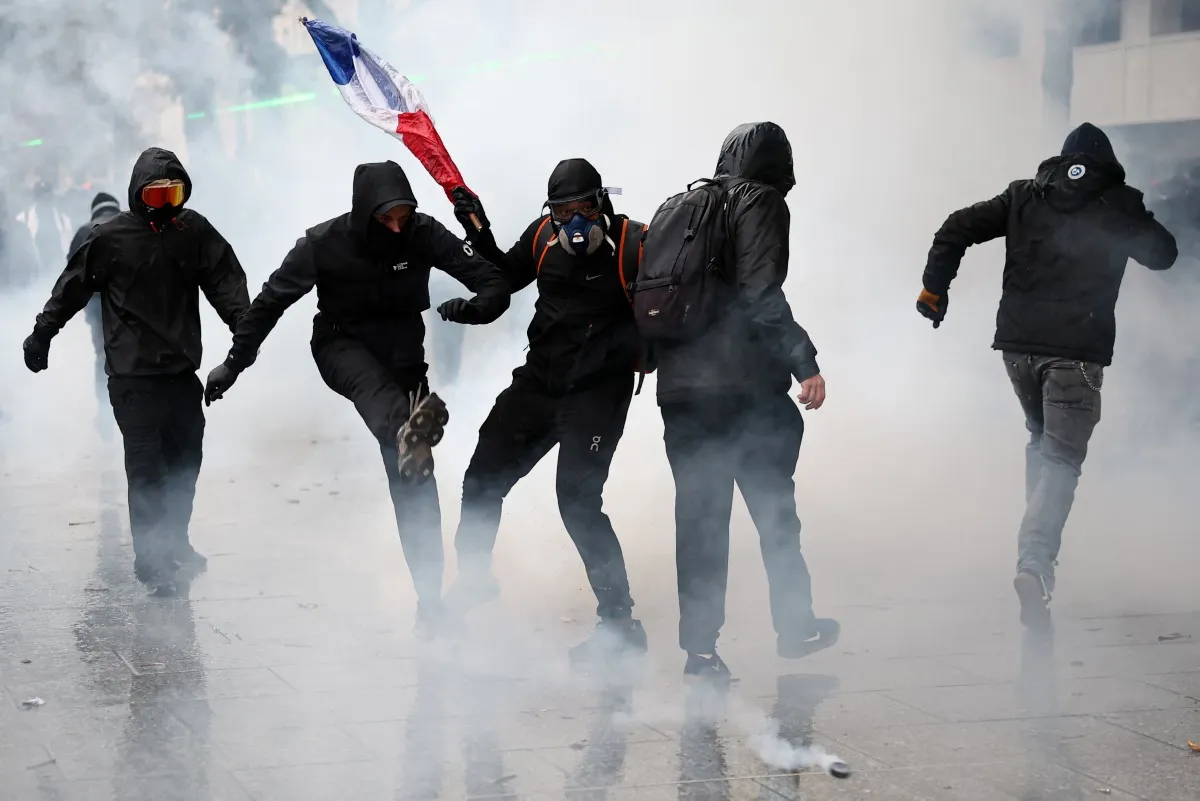
Look at many of the images of the recent cost of living protests that have gripped France, and you’ll notice clouds of whiteish-grey tear gas. So do French police really use it more often than in neighbouring countries? And why?
When France is in the grip of a protest movement, discussion about tear gas is never far away.
Its use is so common that the French ride-hire company Heetch recently began a marketing email: “Parce que entre le lacrymo et les stations fermées . . .” (because between the tear gas and the closed stations).
Meanwhile images of an orchestra being tear gassed as they played in Paris sparked outrage.
But do the French police really use more tear gas than anywhere else?
The non-profit organisation Armed Conflict Location & Event Data reports that between 2020 and 2026, 1,520 protests in Europe involved the use of tear gas – and half of them were in France.
This is likely to be at least partially due to the fact that France had more protests than its European neighbours – the period analysed comes after the Gilets Jaunes protests of 2018/19 but includes widespread protests over pension reform in 2023, riots in suburban France in the summer of 2023, the Bloquons Tout movement in 2025 and the most recent combined lycée student and Gilets Jaunes protests.
But even taking that into account, the use of tear gas is widespread in France when policing every kind of demo, including the recent protests by lycée students, who are mostly aged between 15 and 18.
The use of tear gas during those protests was condemned by Amnesty International.
In a highly critical piece on its website, Amnesty president Anne Savinel-Barras is quoted as saying: “Footage and testimonies … raise alarming concerns about the dangerous use of tear gas, batons and restraint techniques by police.
“Tear gas grenades have been discharged recklessly, and rubber bullets have been fired, causing serious injuries.
“Authorities must ensure that any response to demonstrations is necessary and proportionate, and that children and young people peacefully demanding their right to education are protected rather than being beaten, tear-gassed, or arbitrarily detained.”
Tear gas risks
Using tear gas on protesters is hardly new in France – or in several other countries in Europe.
France’s Interior Minister Laurent Nunez has said weapons used by police during the protests are “non-lethal”. However, some of the equipment is classified by France’s own internal security code as “war material”.
Interestingly, it would run contrary to agreements such as the Chemical Weapons Convention to use it against enemy combatants during war. Protesters with bricks, stones, and burning wheelie bins are clearly a whole different order of threat magnitude to trained, armed soldiers.
On October 17th, a 59-year-old man died of “acute cardiorespiratory failure in the context of pre-existing heart disease” after being caught up in violence at one demonstration in Paris’s Place de la République.
His family suspect a link between his death and exposure to tear gas and have filed an official complaint.
And thousands of women have come forward to report gynaecological problems after being exposed to tear gas during the protests, prompting LFI MP Mathilde Hignet to demand a moratorium on its use pending studies into its effects.
Made in France
Tear gas (gaz lacrymogène, often shortened simply to lacrymo, which gives a sense of how common it is in France) isn’t a gas. The term is a catch-all for a range of chemical irritants that – when delivered as an aerosol or spray solution – can cause choking, coughing, tears, nausea and burning sensations on exposed skin.
It was developed in France shortly before World War One – an early recorded use of it was against protesters in 1912, while the first tear gas grenades were developed by the US Chemical Warfare Service for use in riot control in 1919.
Today, it is frequently deployed by law enforcement agencies for purposes such as riot control, dispersing large gatherings, and self-defence.
French police have it in a variety of forms, from small hand-held sprays to the large tear gas grenades which are fired into crowds.
France even makes money from it, as Europe’s largest producer of gaz lacrymogène in a global market reportedly worth getting on for €1.5 billion – and rising.
In 2023, the government agreed to spend more than €78 million over four years on ‘crowd control’ grenades, including tear gas canisters and stun grenades, Politis reported.
Policing policies
According to United Nations-mandated standards – enshrined in French law – use of police force should be limited to the “prevention of crime” or during “lawful arrest”. Any use of force should follow a principle of “proportionality”. In short, it should be the exception rather than the norm.
Nunez, in several recent radio interviews, has insisted those rules are being followed. But French police have a reputation for heavy-handedness in situations where public order is not being organically maintained.
Since the start of the student protests, according to the Interior Ministry’s own figures, the police internal investigations unit, the Inspection générale de la police nationale (IGPN), has launched no fewer than 80 investigations, while the Inspection générale de la gendarmerie nationale (IGGN) has three open inquiries.
On October 13th, the Ministry confirmed 36 investigations were ongoing.
According to RTL, 20 of the 80 IGPN investigations involve “mutilating injuries” – most of these injuries come from other parts of the French police’s ‘less lethal’ armoury, including rubber bullets and the controversial LBD ‘stun’ grenades.
Protesters have lost eyes after being hit by rubber bullets, and some have lost hands or feet to the LBD grenades – in some cases after being hit by the grenades and in others after picking them up with the intention of throwing them back at the police.
The police themselves say they have no choice but to resort to these tactics when faced with increasingly violent rioters – and it’s true that a small minority of protesters (known as the casseurs or rioters) can be very violent. Many of them turn up equipped to cause trouble and have no hesitation in throwing stones or missiles at police.
READ ALSO: ANALYSIS: Who are France’s ‘casseurs’ and why can’t police stop their violence?
An attempted murder investigation has been launched after a Molotov cocktail was thrown at riot police on October 31st.
But it also seems that for police, tear gas is their first and last recourse.
One Marseille police official was quoted as telling the BBC that on October 17th: “Four thousand tear gas grenades were fired and then we ran out of ammunition. So at a certain point, you have no choice but to retreat.”