2026 Midterm Elections Live Updates: Voters Head to the Polls to Decide Control of Congress
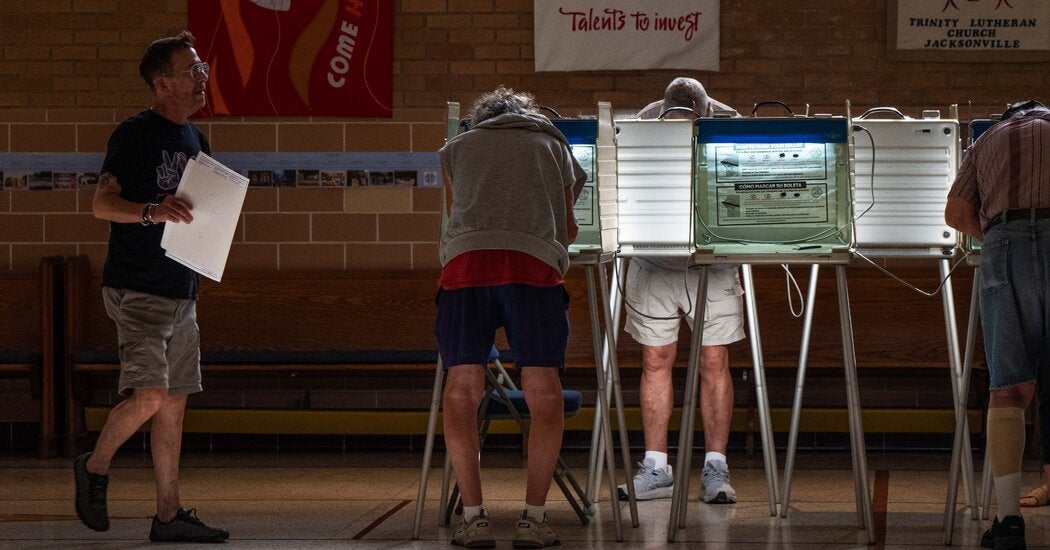
A number of technical glitches and other problems were reported at polling places around the country on Tuesday morning, some of them serving as fodder for right-wing conspiracy theorists even as local election officials described them as unfortunate but innocent hiccups that sometimes emerge on Election Day.
In Westchester County, N.Y., voting was proceeding despite an issue with scanning machines that prevented them from accepting ballots, state election officials said.
In Fulton County, Ga., election officials on Tuesday morning reported malfunctions of two ballot scanners that occurred in late October, during the early voting period, forcing the county to use an alternative scanning method for roughly 1,000 ballots.
And in Broward County, Fla., technical problems caused a 20-minute delay to what was scheduled to be a 7 a.m. poll opening, said Joe Scott, the county election supervisor.
Such problems, Mr. Scott said in a phone interview, are “to be expected” on Election Day. In the case of Broward, he said, the technical problem did not affect the processing of anyone’s ballot, although he said that some people who had showed up to vote first thing in the morning left polling sites before casting their ballots.
Any potential issues with voting on Tuesday are sure to be under a microscope by members of both parties after more than a year of attempts by the federal government under President Trump to exert more control over federal elections. With the president continuing to make evidence-free, false claims that the electoral process is rife with fraud, election officials across the country have grown increasingly concerned about federal interference and the possibility that innocent or benign issues on Election Day could be seized on by the president and his allies.
As news of these problems seeped online, conspiratorial messages began bubbling up. Katie Miller, the wife of Stephen Miller, one of President Trump’s most powerful aides, made note of the Westchester problems on social media, declaring, “This is how the Left steals elections.”
In another Tuesday morning post, Laura Loomer, the far-right activist and close informal adviser to Mr. Trump, wrote, “How is it that so many states are all of a sudden having ballot counting issues? Broward County. Of course. Democrats love cheating.”
Mr. Scott, the Broward elections official (and a Democrat), lamented the trend. “If anything happens with the election, people immediately go to conspiracy theories,” he said.
In New York, the state’s Board of Election said in a statement that the issue affecting voting machines in Westchester County stemmed from an adjustment to the county’s election programming that prevented the ballots from being recognized by all of the county’s voting machines except in the village of Ardsley.
Derek Tisler, a lawyer with the Brennan Center’s Elections and Government Program who specializes in election administration and security, said that while the situation in Westchester County appeared to be more widespread than typical glitches, it was still “well within the world of possibilities that election officials plan for.”
Voters in Westchester County were told on Tuesday morning that they could still safely fill out and submit their ballots. This note of reassurance came from a statement by Tajian M. Nelson, the Democratic commissioner of the county board of elections, and Douglas A. Colety, the Republican commissioner.
Letitia James, the New York State attorney general, wrote on social media that her office was monitoring the issue. Ken Jenkins, the Westchester County executive, said in a statement that he had directed county officials to monitor the voting process and that he would convene a bipartisan team once the issue is resolved to conduct a review of the “decisions and failures that led to this debacle.”
He said in a separate a video statement that there was no immediate need to extend the voting hours amid the issues with voting machines, though he said that candidates and campaigns had made requests to do so.
Voters in Westchester are casting ballots in several contests, including for governor and two House seats — the 16th District in the southern part of the county and the competitive 17th District in the north.
“Every ballot will be counted. Stay on line and vote,” Representative Mike Lawler, a Republican seeking re-election in the 17th District, wrote on social media. He is locked in a tight race against Cait Conley, a Democrat, who wrote: “Don’t be dissuaded and have your voice heard.”
The glitch affected the machines’ ability to scan ballots at many polling sites, according to town and county officials. Instead of feeding ballots into the machines, voters were being instructed to place them into separate, secure bags — a standard emergency protocol aimed at ensuring that voting continues without disruption.
Kathleen R. McGrath, a spokeswoman for the New York State Board of Elections, said in a statement that the impacted scanners rejected ballots they could not recognize instead of incorrectly counting them. Every valid vote would still be counted, she said, adding that “accuracy will never be sacrificed for speed.”
“While technical issues can be frustrating, contingency procedures exist for precisely these circumstances,” Ms. McGrath said. “Bipartisan election officials are diligently working to ensure every eligible voter has the opportunity to cast their ballot.”
Minor snags with voting machines happen in virtually every election and are usually resolved uneventfully. While the glitches on Tuesday appeared to worry some voters, officials said that every registered voter could be assured they would be able to cast a ballot.
Voters should not go to a different polling location, officials in the town of North Salem said on social media.
It was not clear whether the issue would extend the time it takes to count the ballots or whether technicians would be able to fix the machines before the polls close Tuesday night. Polling stations in New York are open from 6 a.m. to 9 p.m.
Minor issues emerged in other places around the country, including Chester County, Pa. Officials there said they were allowing for 30-minute extensions of voting hours at three polling locations to make up for delays caused by “machine set-up issues.”
In Florida, a number of polling places had to be relocated due to flooding from intense autumn storms, with state elections officials posting the substitute voting sites online.
In Arizona, elections officials in Maricopa County announced the temporary closure of two voting centers due to “power related issues.” The news prompted James O’Keefe, the conservative activist, to write in an online post: “Time to start investigating this.”
In Austin, Texas, a fire alarm at the student union of the University of Texas at Austin was pulled, leading to brief evacuations of a popular voting location for students, according to local media reports. The Travis County clerk’s office told KXAN-TV, the local NBC affiliate, said that voting resumed after a temporary disruption, and that law enforcement were “reviewing the cause.”
There were other hints of potential Election Day dirty tricks. In Georgia, Fulton County government officials warned on Tuesday that some voters had reported receiving bogus messages “regarding polling place changes.”
County officials urged voters to verify their polling place on the state’s voter information page.
Nick Corasaniti contributed reporting.